Crime & Safety
Members of the Tewksbury Fire Department Complete Fire Investigation Course
97 public safety officers from across the state completed the Basic Fire Investigation course.


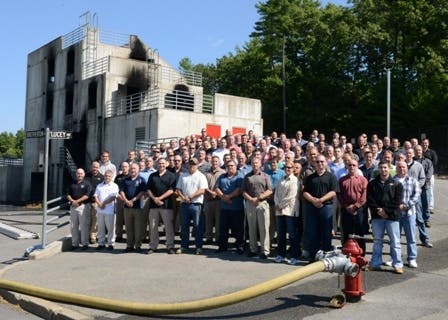
State Fire Marshal Stephen D. Coan and Deputy State Fire Marshal Peter J. Ostroskey are pleased to announce that 97 public safety officers have completed the Massachusetts Firefighting Academy’s six-day Basic Fire Investigation course, including members of the Tewksbury Fire Department.
This rigorous professional training provides fire, and state and local police officers with the technical skills to accurately determine the origin and cause of fires in their jurisdictions and together, build solid, prosecutable cases. The Massachusetts Firefighting Academy, a division of the Department of Fire Services, offers this program, tuition-free.
Team Concept of Fire Investigation
Find out what's happening in Tewksburyfor free with the latest updates from Patch.
“The team concept of fire investigation has been used successfully in Massachusetts for over 20 years and it starts with joint training,” State Fire Marshal Coan said. “When police and fire are trained in the same techniques and procedures together, the consistency leads to solid origin and cause determinations, and when arson is the cause, solid criminal cases.”
Massachusetts Firefighting Academy Deputy Director Joseph J. Klucznik said, “This course provides students with the most current techniques for determining the origin and cause of fires. They are exposed to the investigatory process as outlined in the National Fire Protection Association Standard 921: Guide for Fire and Explosion Investigations.”
Find out what's happening in Tewksburyfor free with the latest updates from Patch.
97 Graduates: 72 Firefighters and 20 Local Police and Five State Police Officers
The 97 graduates, including 72 firefighters, 20 local police officers and five Mass. State Police officers, represent the 76 agencies across the state, including members of the Tewksbury Fire Department.
The six-day basic fire investigation course covers the concepts of witness interviewing, fire behavior, scene examination, fire scene documentation, and evidence collection. Students must pass a written exam. The program covers unintentional fires, intentionally set fires, automobile fires, fatal fires and wildland fires.
Origin and Cause Determination
Fire investigators work to first determine the point of origin of the fire and then its cause. Once they are able to determine the point of origin, they often rely on witness statements to identify the possible sources of ignition at that point and then work to systematically eliminate each one, until they are left with only one most probable cause.
Fire investigators are trained to examine a fire scene by going from the minimum amount of burn damage to the point or points with the maximum amount of burn damage. The rationale being that the fire has been burning longest where the most damage is and that is often where the fire began. In addition, they learn to analyze burn patterns that can reveal how the fire spread and how long it burned. They learn how to effectively collect evidence samples, how and when to avail themselves of resources such as accelerant-detection canines, state police fire investigators in the Office of the State Fire Marshal, and technical experts such as electricians.
Witness-Driven Protocol
Massachusetts uses a witness-driven protocol of fire investigation. Investigators want to interview people who know the building or saw the fire start as quickly as possible while memories are fresh or before those displaced by the fire become hard to locate. Investigators compare the witness statements to the evidence found in the forensic scene examination to determine the cause of the fire. With possibly a large number of people to interview quickly, the benefit of the added manpower a team investigation brings is obvious. Investigators compare notes and often need to re-interview witnesses for clarification. A deep understanding of fire behavior is essential to evaluating witness statements.
“It is a challenge to determine the cause of the fire when so much of the needed evidence is destroyed by the fire itself,” Coan said. “This training provides our local fire and police investigators with the skills and knowledge to meet that challenge.”
Get more local news delivered straight to your inbox. Sign up for free Patch newsletters and alerts.