Politics & Government
Merrimack Valley Loses Clout In State House Shakeup
Brian Dempsey's departure has sent shockwaves through the Legislature.


By Matt Murphy, State House News Service
BOSTON, MA — The recent political history of the Merrimack Valley is kind of like the Boston Celtics on lottery night. What could have been had the ping-pong balls bounced a different way.
The valley, nestled along the New Hampshire border and the Merrimack River, could have very easily by now become the epicenter of Massachusetts politics.
Find out what's happening in Tewksburyfor free with the latest updates from Patch.
At one point in time, then-Lowell Sen. Steven Panagiotakos appeared to be the heir-apparent to the Senate presidency before he walked away from office in 2010. This week it was Haverhill Rep. Brian Dempsey's turn.
The long-running chairman of the House Ways and Means Committee announced less than a week after putting the final touches on his seventh state budget that he would be leaving the Legislature for a high-powered job at one of Boston's premier lobbying firms, ML Strategies.
Find out what's happening in Tewksburyfor free with the latest updates from Patch.
He takes with him the trust of the speaker, a wealth of institutional knowledge and experience earned over more than a quarter of a century working in the State House. "Nobody, in my opinion, knows the budget any better than he does," Gov. Charlie Baker told the News Service on Thursday.
The announcement - there were rumors of his possible departure - caught nearly every one of his colleagues off guard and sent shockwaves through the political establishment. Everything they thought they knew about the power structure of the House now and into the future was turned on its head.
Dempsey was more than just the "gravelly-voiced maestro of state budgeting," as he was once called in this space, but also the gatekeeper of virtually all other legislation that moved to House floor. Senators might also view him as the person who all too often held the gate down, blocking their bills. He was widely believed to be the next in line to the speaker's office, and few questioned that hierarchy.
While he never spoke about it - or spoke much at all unless it was to explain a bill to his colleagues in caucus - Dempsey's mere presence in the second-floor offices of the House Ways and Means Committee kept the wolves at bay.
As long as he sat in that chair, House Speaker Robert DeLeo did not have to worry about the kind of behind-the-scenes maneuvering that has periodically frustrated and undermined speakers in the past.
But everyone knows what they say about the best laid plans of mice and men.
Dempsey could have been speaker by now had House Speaker Robert DeLeo not preempted his term-limited exit from the Legislature by wiping the very eight-year limit he put into the rules in 2009 off the books in 2014.
Now the speaker says he's running for re-election in 2018 and doesn't have "any view in my mirror" in terms of an exit strategy. Dempsey said DeLeo's prolonged stay had nothing to do with his decision to take off his lapel pin, loyal until the end. But it's hard not to wonder what if.
DeLeo now has to choose a new Ways and Means chairman, or chairwoman, knowing that whoever he elevates will instantly be viewed as a contender to become the next speaker. It also appears certain that DeLeo will face pressure from groups like the Black and Latino Caucus, the Women's Caucus and the Progressive Caucus to pick a minority or a woman or someone more ideologically left of center.
Currently, some of the names wafting through the halls as possible Dempsey successors include Economic Development Committee Chairman Rep. Joseph Wagner, Education Committee Chairwoman Alice Peisch, Telecommunications Committee Chairman Thomas Golden, State Administration Committee Chairman Peter Kocot and Transportation Committee Chairman William Straus.
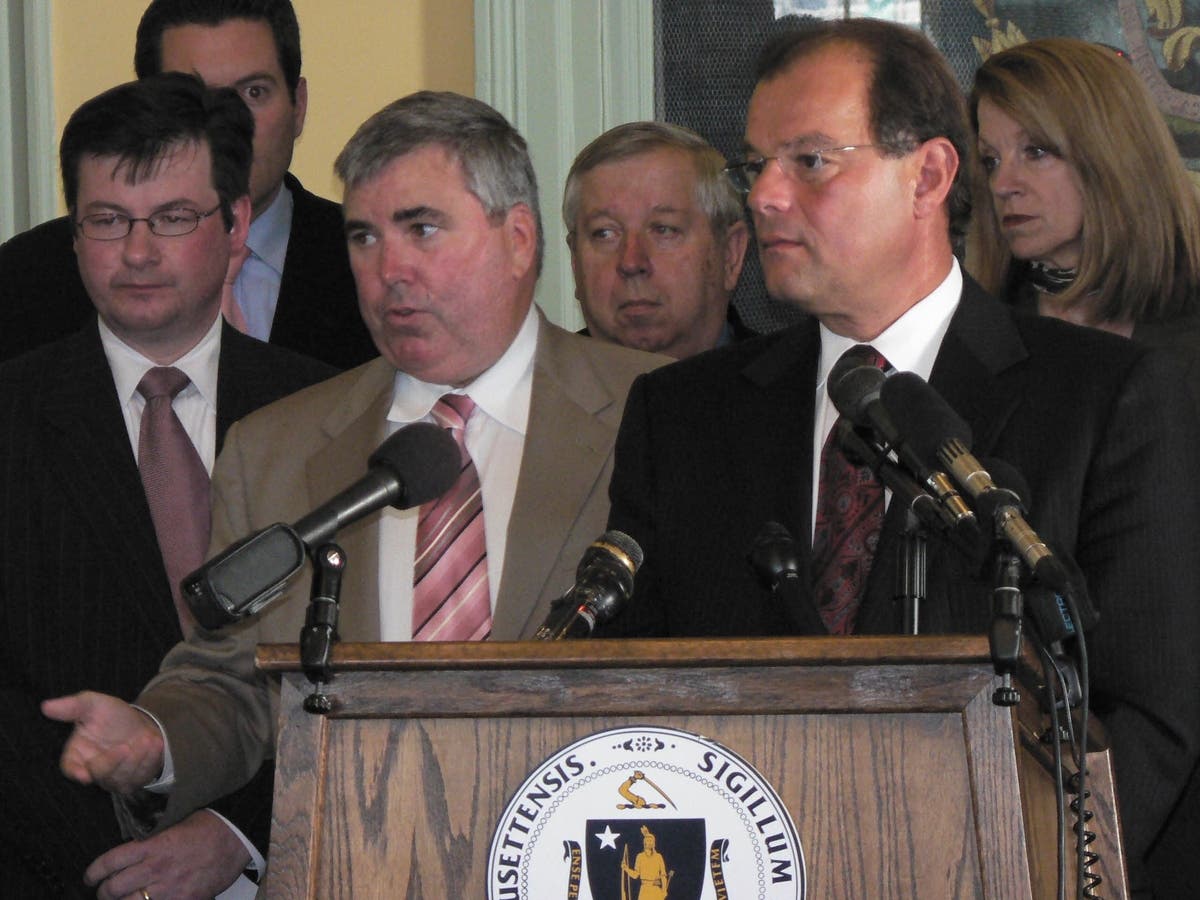
Baker learned of Dempsey's plan to leave the Legislature when Lt. Gov. Karyn Polito called him on his cell phone in Providence where the governor was taking part in the National Governors Association Summer Meeting.
The governor spent most of the day Thursday huddled behind closed doors with his fellow governors who had one eye on their conference agendas and another on their smart phones as details of the U.S. Senate's Obamacare repeal rewrite filtered out.
Vice President Mike Pence and Health and Human Services Secretary Tom Price were both expected in Rhode Island Friday and Saturday to sell the governors on a plan that already appears in jeopardy.
Baker remained back in Massachusetts on Friday to continue reviewing the $40.2 billion budget he must act on byMonday, but issued a statement saying that after review he believes the revised Senate bill would "put a harmful strain on the state's ability to continue providing health care coverage for the people of Massachusetts."
Administration officials said the governor was also still working through the options for how to handle MassHealth in the near-term before any possible federal changes come over the transom. Baker said Monday he was unsure whether he'd sign off on $200 million in new assessments on employers, agreed to by the Legislature, without the MassHealth eligibility reforms he sought as part of a compromise with the business community.
While Baker is expected to sign the budget, at least in part, on Monday, earlier this week he signed a hastily-approved $26 million spending bill to make sure that attorneys who handled cases for indigent clients last fiscal year could get paid.
The state's penchant for underfunding the Committee for Public Counsel Services account caught up to it this month when CPCS ran out of money to pay the lawyers for their work.
The temperature surrounding negotiations over marijuana regulation cooled a bit this week, even as the negotiators continued talking, and according to some close to the process, neared a compromise that could be ready early next week.
The conference committee meeting schedule, at least on Wednesday, had to be planned around a Senate "retreat" down the street at the UMass Club where leadership invited district attorneys, sheriffs, judges and just about anyone else you can think of to offer their thoughts on criminal justice reform.
Sen. William Brownsberger, co-chair of the Judiciary Committee, said "everybody" remains interested in taking up criminal justice reform in the fall.
"This was big picture discussion of the issues, understanding how different people are looking at the issues in a very broad way," Brownsberger said.
Off the hill, the still unresolved strike by Tufts Medical Center nurses provided a popular photo opportunity to lawmakers (and Democratic candidates for governor) eager to rally to their cause.
The hospital so far has refused to budge from its last-and-best offer and signed a five-day contract with temporary nursing staff, but a prolonged strike or lockout has the potential make some political leaders uneasy, not to mention patients.
Get more local news delivered straight to your inbox. Sign up for free Patch newsletters and alerts.