

We left and his buddies in the 17th century Waltham woods a few weeks ago. Let’s go back and see what he’s doing.
Most of this week’s information comes from Edmund L. Sanderson and my latest acquisition, Waltham as a Precinct of Watertown and as a Town 1630-1884, written in 1936.
It’s August of 1630, and Winthrop and his buddies are hot and tired. Most likely they traveled to the north side of the Charles River near Beaver Brook. Beaver Brook took its name from the animals that created dams across the stream.
Find out what's happening in Walthamfor free with the latest updates from Patch.
Imagine trees, water, and lots of bushes filled with raspberries and blueberries. There are no roads, just Native American trails.
Sir Richard Saltonstall, his wife Elizabeth and their eight children accompanied Winthrop. Saltonstall, a justice of the peace from Halifax, England, made the same voyage on the Arbella, and served as Winthrop’s first assistant as they wandered through Eden Vale.
Find out what's happening in Walthamfor free with the latest updates from Patch.
It’s safe to say he received land grants for this assignment. A few centuries later Watertown erected statues in his name and other nearby cities and towns now sport buildings with the Saltonstall moniker. Sadly, one of Saltonstall’s children became ill and a year later he returned to England, but he maintained his colony “interest,” which I interpret as land ownership.
There is no history I can find telling us where Winthrop or Saltonstall built shelter or if they just kept exploring during that year.
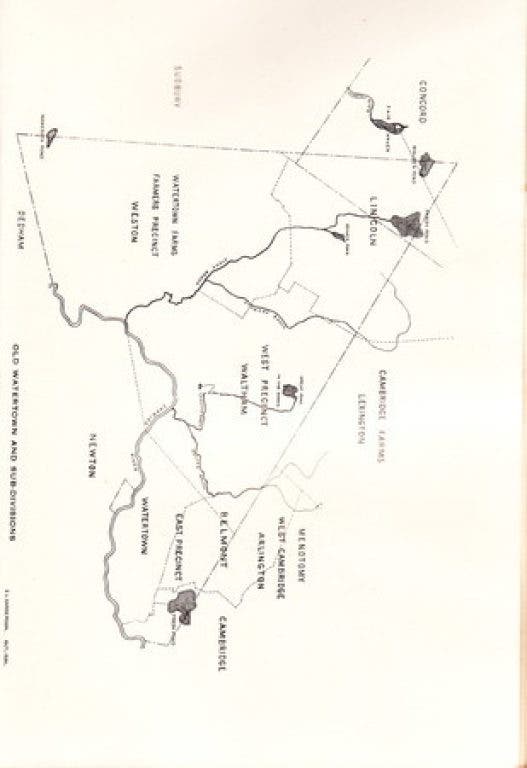
Sanderson tells us that Winthrop’s initial intention was to call the land where he settled “Boston,” but instead he opted for Watertown and divided it into sections we know as Waltham, Weston and Lincoln. In fact, according to the book, Waltham means “forest home” and England’s Waltham Abbey, Walthamstow, Waltham Cross or one of the three other English Walthams, are all possibilities for our name. Most agree Waltham Abbey is the winner, but there is still doubt.
As Winthrop and company walked through what we know now as Waltham they saw Adam’s Chair. It was a huge mountain of rock that nature split in two. The chasm was so wide it formed an alley for the walkers. The two rocks were considered arms and the floor or chair was named after the youngest member of the crew. This landmark was named and then lost when the Fitchburg Railway was built. It is mentioned frequently in Waltham history books, but unfortunately, there are no sketches.
We know from Sanderson’s research that our first Waltham settlers were Edward Garfield and John Page. The Garfield homestead was granted in April of 1638 at the northeast corner of Warren Street and Hagar Lane. Page’s home was near Beaver Brook, probably on Beaver Street.
Old Edward died in 1672 leaving a large estate that was included in the Governor Gore estate.
Most of our other Waltham ancestors settled near Chester and Beaver brooks and near Hardy Pond in what was eventually called Waltham’s West Precinct also known as Eden Vale. We were – it kills me to say it – a subdivision of Watertown.
Lexington was part of Cambridge and known as Cambridge Farms. They, like Waltham, found mandatory church meetings at the town meeting house every Sunday too much and too far. A 10- or 15- mile trek in a wooden wagon during stark winters was too much to ask even the hardiest souls.
So, Waltham fought to build its own meetinghouse and then petitioned the General Court to separate from Watertown. We succeeded in 1738.