Health & Fitness
An Explanation of Australian Rules Football
Football/Soccer Hybrid from the Land Down Under.


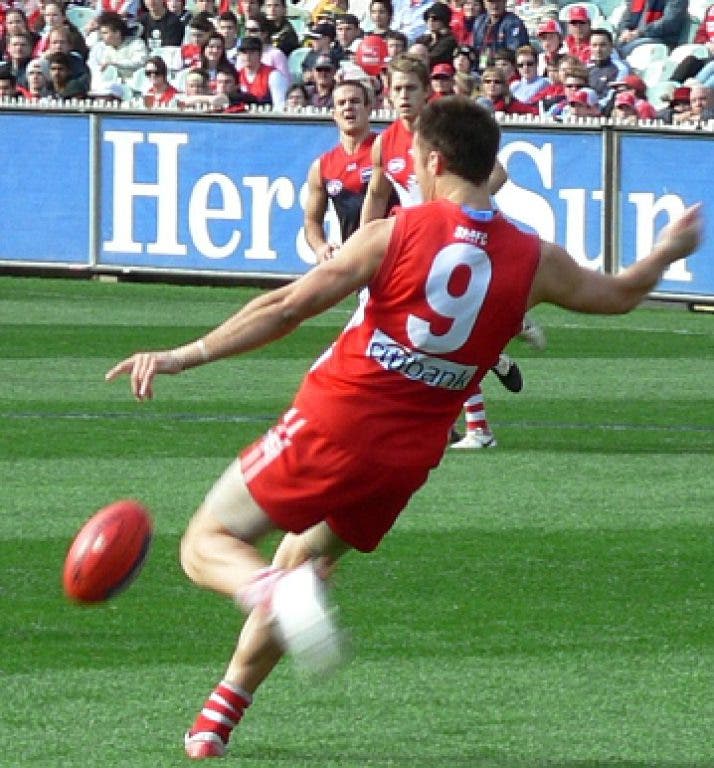
For as long as I can remember, I've enjoyed sports, but over the past few years I've gotten into sports that you normally can't find around here.
One of those sports I've come to enjoy is Australian Rules Football: it has all of the physicality of football (or as other parts of the world call it "American" football,) and the free flowing nature of soccer while integrating all of the good parts of about half a dozen other sports.
Find out what's happening in Westfordfor free with the latest updates from Patch.
Unfortunately, nobody in the United States seems to know what Australian Rules Football is, outside of some folks watching it on ESPN back in the 1980s before ESPN had the rights to show anything over here. And those folks probably weren't sure what was going on, outside of the fact that some guys with white hats and suits would occasionally do two handed index finger karate chops for some reason.
So.... I figured for my first blog post, and given the fact that the Australian Rules Football season started last month, I figured I could explain a little bit more about this sport, how it works, what it's like, and so on.
Find out what's happening in Westfordfor free with the latest updates from Patch.
I'm going to assume that just about everybody reading this knows the basic rules of soccer. If you don't, here's the basics: there's 11 players versus 11 other players on a rectangular field with a goal at each end and two rectangles near those goals, a big one and a smaller one inside that one. Each team's trying to kick the ball into the goal at the other side of the field.
Okay. Picture this in your head for a second.
Now, imagine there were 18 players on each team, the field was an oval, only the little rectangle near the goal was left, and the goals were replaced with four 20 foot tall poles.
Congratulations, you're looking at an Australian Rules Football field. If the ball's kicked through the middle set of poles, that's six points (a goal,) and if it hits any of the poles or goes between the inner and outer poles, that's one point (also known as a "behind.")
But we're not done yet.
Unlike in soccer, the ball is ovular like a football, but with curved ends. Plus, it's bouncy. You can run with it, but you have to bounce it like a basketball every 10 meters or so.
Like in football, the defending team is trying to tackle whoever has the ball, so if that player wants to pass it to a team mate, they can
a. punch it to them (this is called a "handball")
or b. punt it over to them.
If the punt goes more than 10 meters and is caught in the air by another player, it's what's known as a "mark." When a player gets a mark, they get a few seconds to take another kick without worrying about the other team's players trying to tackle them.
Referees start the game by bouncing the ball in the middle of the field (they do this whenever it's not clear who has possession or there's a goal) and the defending team kicks it out of that little rectangle left over from the soccer field after a behind.
Finally, whenever the ball goes out of bounds, the referee throws it up in the air over their head, and substitutes can go on and off the field on the fly.
That's pretty much all there is to the rules.
There's no overtime, and the scores are generally basketball-like, and the scores count the goals followed by the behinds and the total score (for example, you would say "Team A 15-7-97, Team B 10-15-75.")
The sport first developed in the late 19th century as a winter sport (remember Australia's winters are the opposite of ours) to play on cricket fields in Melbourne.
Eventually state leagues developed in Victoria, Western Australia, Tasmania, South Australia and the Northern Territory, with the Victorian League expanding into New South Wales (Sydney) and Queensland (Brisbane) in the 80s.
In 1990, the Victorian Football League renamed itself as the Australian Football League and expanded into South Australia (Adelaide and Port Adelaide,) Western Australia (Perth and Fremantle) and again in the past two years into new Queensland and New South Wales markets (Gold Coast and the western Sydney suburbs.)
Today the league has 18 teams, the top eight go into the playoffs (they call them "the finals.")
In the first round of the finals, the top four teams face off and the bottom four teams do as well.
Winners in the top seeded games get a bye to the semifinals, losers on the top seeded games face the winners of the lower seeded games to see who the other semifinalists will be.
Those semi-finals head to what is called the "Grand Final," although the Australians are always trying to compare it to the Super Bowl due to what I assume is an inferiority complex.
Although it's more popular in Melbourne and the western two thirds of Australia, it's beginning to gain popularity along the east coast of the country as a symbol of the country itself. Since the 1960s, the game's wrapped itself in national patriotism with traditional contests on the Queen's Birthday and ANZAC Day (their version of Memorial Day)
Unfortunately, the AFL doesn't allow any games to be shown overseas on the internet unless you fork out a ton of money, but you can watch it if you have Comcast on Fox Soccer Plus. Or, you could just ask for a recap from Hulk Hogan, who seems to be a fan.
Get more local news delivered straight to your inbox. Sign up for free Patch newsletters and alerts.