There has been a growing demand for tooth whitening in the U.S. over the past two decades. According to recent estimates, Americans are spending 1.4 billion dollars annually on tooth whitening systems, from various take-home options, in-office and over the counter strips. But how does it work? Why will some patient’s teeth get “ceiling paint white” while other patient’s grey staining(from Tetracycline) won’t whiten at all?
The main types of tooth staining are internal and external. External staining can usually be removed during your dental hygiene visit, but external discoloration can seep into the interior of the tooth through pits, fissures and surface irregularities causing them to become internal. Internal discoloration is improved by the use of peroxide containing whitening systems.
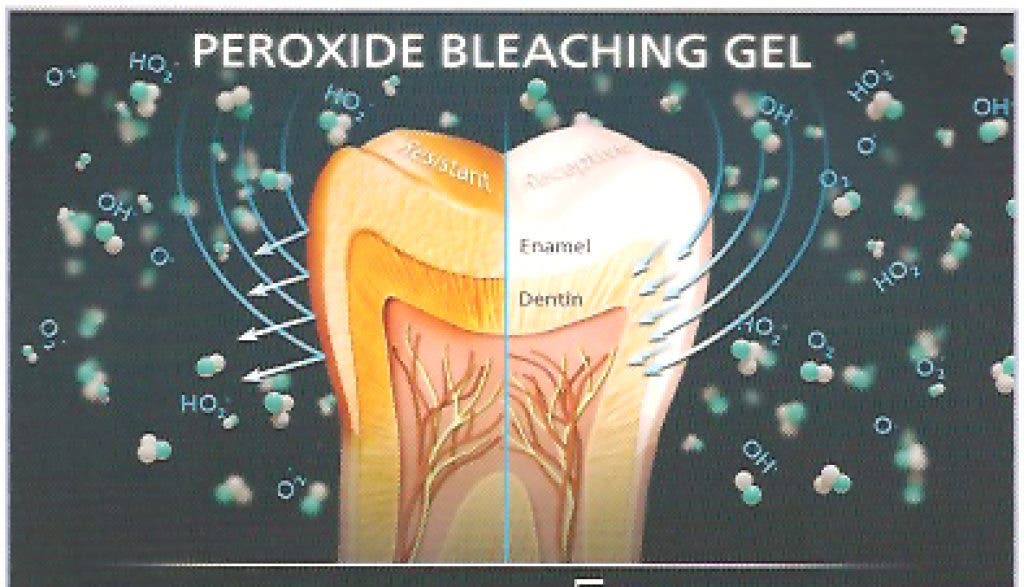
The shade of a person’s teeth is the result of internal color molecules and external stain molecules. The internal color is due to organic pigments that are part of the enamel when teeth are formed. The color molecules are comprised of atoms held together by bonding forces. Some of the bonding forces, called chromophores, absorb or reflect light. The absorption of lights gives the appearance of things being darker while the reflection of light gives the appearance of color. Peroxide based whitening systems work by breaking the chromophore bonds making the teeth appear whiter. Some chromophore bonds are stronger than others, which is why some patient’s teeth whiten easier than others.
There are dozens of whitening systems on the market even some that will work on tetracycline staining or fluorosis staining (caused by too much fluoride). To get the best results with the least side effects, the American Dental Association recommends that whitening procedures be provided and monitored by a dental professional and that it is part of a “comprehensive, appropriately sequenced treatment plan”. It’s important to remember that existing veeners, porcelain crowns and white fillings will not whiten with any system, resulting in the need to replace them after whitening is completed.
Find out what's happening in Westfordfor free with the latest updates from Patch.
Before you decide on any whitening system, you should consult with your dentist to find out what is the best system for you and if you have any underlying conditions which should be treated prior to whitening. Teeth whitening is the most affordable way of significantly improve your appearance, making it the number one cosmetic procedure.