Kids & Family
Haystack, Historically Speaking
The Westford Museum was packed with folks looking to hear about Westford's historical Haystack Observatory on Monday night.
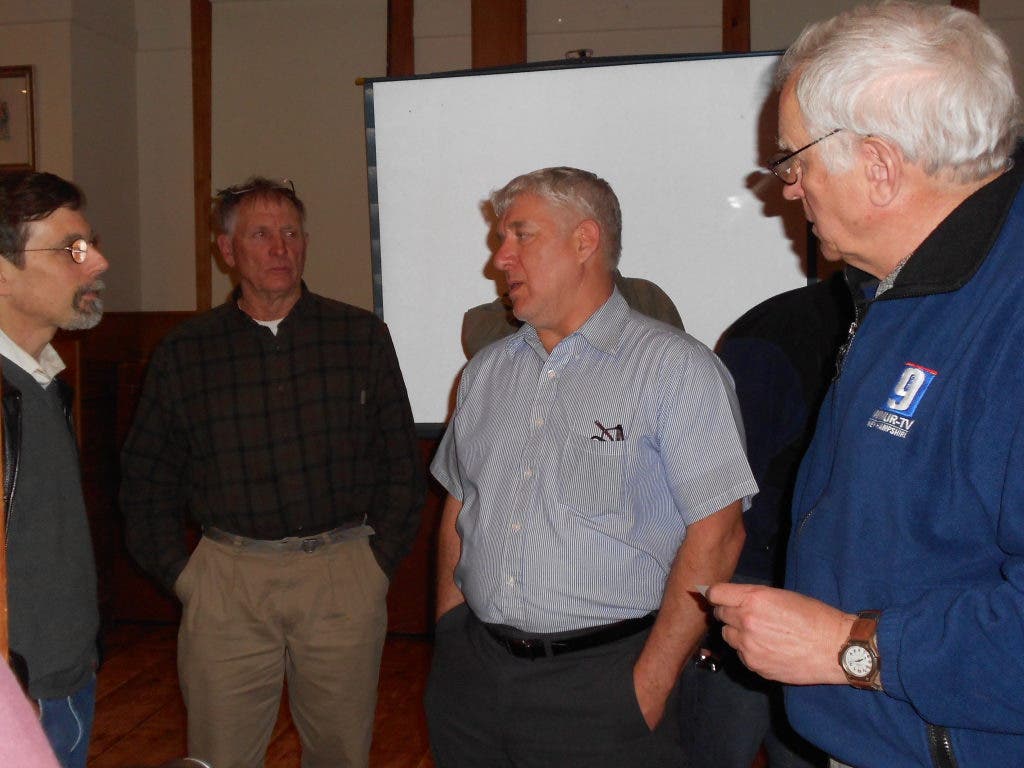

Jeff Dominick calls himself a newcomer, but seven years might as well be yesterday compared to the historically long-tenured compatriots at the MIT Lincoln Labratory and Lincoln Space Surveillance Complex.
He was on hand at the on Monday night to present a history of the place better known to locals as the "Haystack" after the observatory on the site.
Currently Dominick is the site manager of the facility, which spans 1,300 acres over Westford, Tyngsboro, and Groton.
Find out what's happening in Westfordfor free with the latest updates from Patch.
Originally built by MIT’s Lincoln Laboratories for the United States Air Force, MIT now owns the site with Lincoln Lab continuing to use it for research, employing about 120 professionals.
These facts were just a few of the things Dominick shared along with real and simulated images of the types of objects tracked and recorded by the three radars on the site, stories of the construction of the field site that started in the late 1950s, and the important game-changing technology developed there.
Find out what's happening in Westfordfor free with the latest updates from Patch.
Lincoln Lab engineers and scientists have used the three radars on the site—Millstone, Haystack, and Haystack Auxiliary—to support the efforts of the Department of Defense and NASA.
It was from Haystack that the Sputnik was detected and the moon’s surface was first analyzed for the US moon landing.
Haystack was also used extensively to engineer the “Star Wars” cutting-edge technology touted during the Reagan era. This technology was retired but has since been resurrected in the past few years.
One of Haystack radar’s biggest jobs is to monitor orbital debris for NASA. Lincoln Lab engineers are now working to predict collision of debris in space.
Dominick says that scientists at Haystack have done and continue to do mind-stretching research on black holes, radio arrays, and space weather, and that not long ago physicists at Haystack proved Einstein’s general theory of relativity by using radar echoes.
And what type of energy consumption is needed to power these amazing discoveries? Try a cool million dollars per year in electricity costs alone.
Haystack is hosting a tour on Tuesday, May 1 at 6:30 p.m. with an introduction to Haystack followed by a tour of the radio telescope.