Crime & Safety
Wilmington Police Recall D-Day On Anniversary Of Invasion
World War II forced the Wilmington Police Department to appoint an auxiliary police force whose members had to pay for their own uniforms.


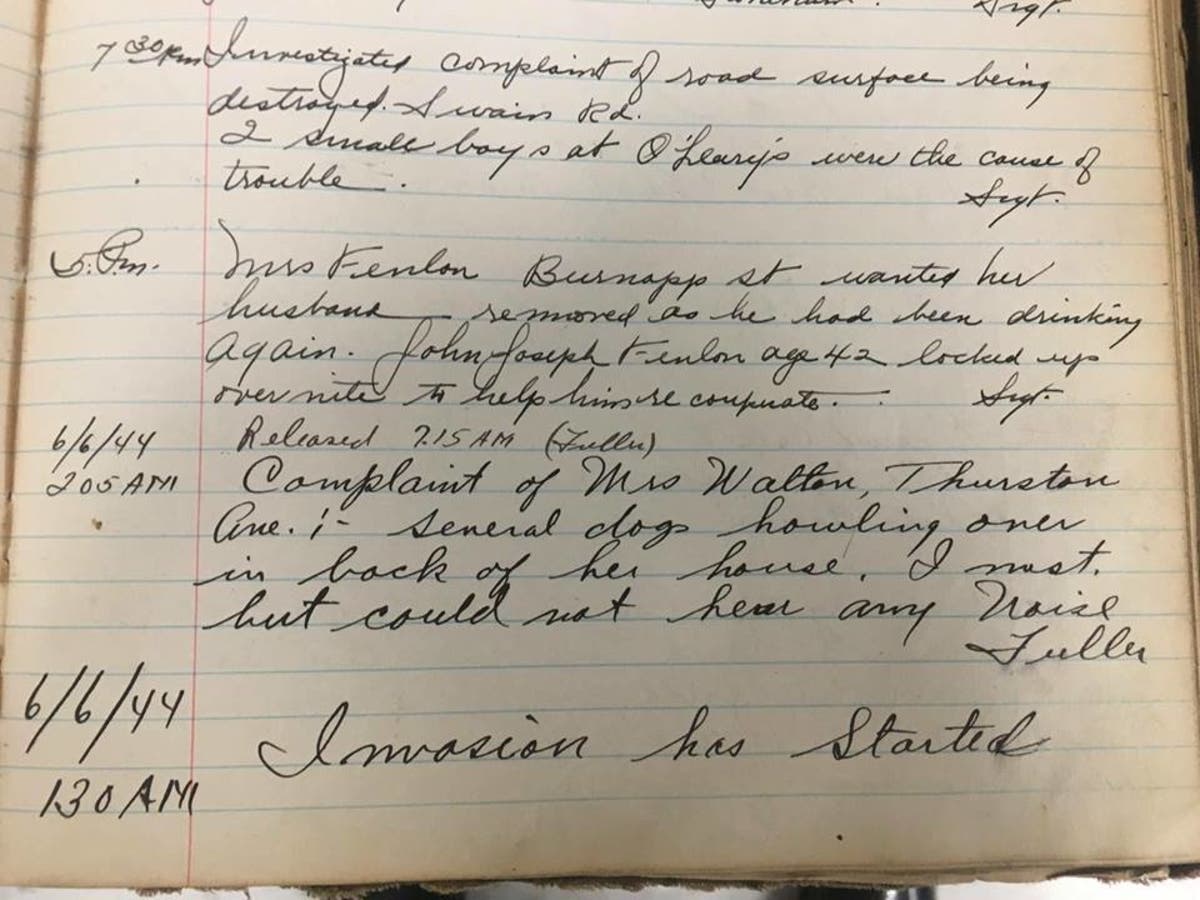
WILMINGTON, MA -- Aside from being handwritten instead of computer-generated, the entries in the Wilmington Police log for June of 1944 look a lot like the entries for June of 2018. Late on the night of June 5 a woman called and asked for her husband to be removed from the home because he had been drinking again. At 2:05 am on June 6, a Thurston Avenue called to complain about her neighbor's dog howling.
But one entry is starkly different from anything you'd find in a present-day police log. At 1:30 am on June 6, 1944, a handwritten note in the log reads "Invasion has started." Wilmington Police posted a photo of the notation on the department's Facebook page Wednesday to mark the anniversary of the D-Day invasion at Normandy that would end up being the turning point of World War II in Europe.
The Wilmington Police Department as its known today was relatively young in 1944. Up until 1930 the only full-time police officer was the chief. The town continued to rely on appointed on appointed constables for several years after the department began appointing permanent, full-time police officers in 1930.
Find out what's happening in Wilmingtonfor free with the latest updates from Patch.
In 1942, the first full year the U.S. was involved in World War II, Wilmington Police Chief Ainsworth appointed an auxiliary police force of 40 men. The auxiliary police officers were given department-issued badges and night sticks but had to purchase their own uniforms. They were given weekly assignments, including patrolling various parts of the town, enforcing dim-out and blackout regulations at night, and acting as air raid wardens.
By 1943, with more full-time police officers enlisting into the armed forces, the auxiliary police officers were appointed special police officers so they could perform the duties of regular police officers, according to a history of the department on the Wilmington Police Website. Myrtle Shaw and Viola Staveley were also named the department's first police matrons.
Find out what's happening in Wilmingtonfor free with the latest updates from Patch.
In 1944, the year of the D-Day invasion, a new radio was installed in Wilmington’s police cruiser and calls are relayed through the Reading Police Department’s radio system. The department had hoped to purchase the new radio in 1943 but couldn't because of wartime shortages.
Wilmington Police officers worked 48-hour work weeks in the 1940s and had one day off per week. Chief Ainsworth was paid $38 a week, or $541 in 2018 dollars, while patrol officers received $36 per week, or $512 in today's dollars.
Subscribe to Wilmington Patch for more local news and real-time alerts.
Photo by Wilmington Police Department.
Dave Copeland can be reached at dave.copeland@patch.com or by calling 617-433-7851. Follow him on Twitter (@CopeWrites) and Facebook (/copewrites).
Get more local news delivered straight to your inbox. Sign up for free Patch newsletters and alerts.