Schools
An Apple (iPad) for the Student... and Teacher
See how students and staff at Shamrock School are using iPads to help with speech and language skills.
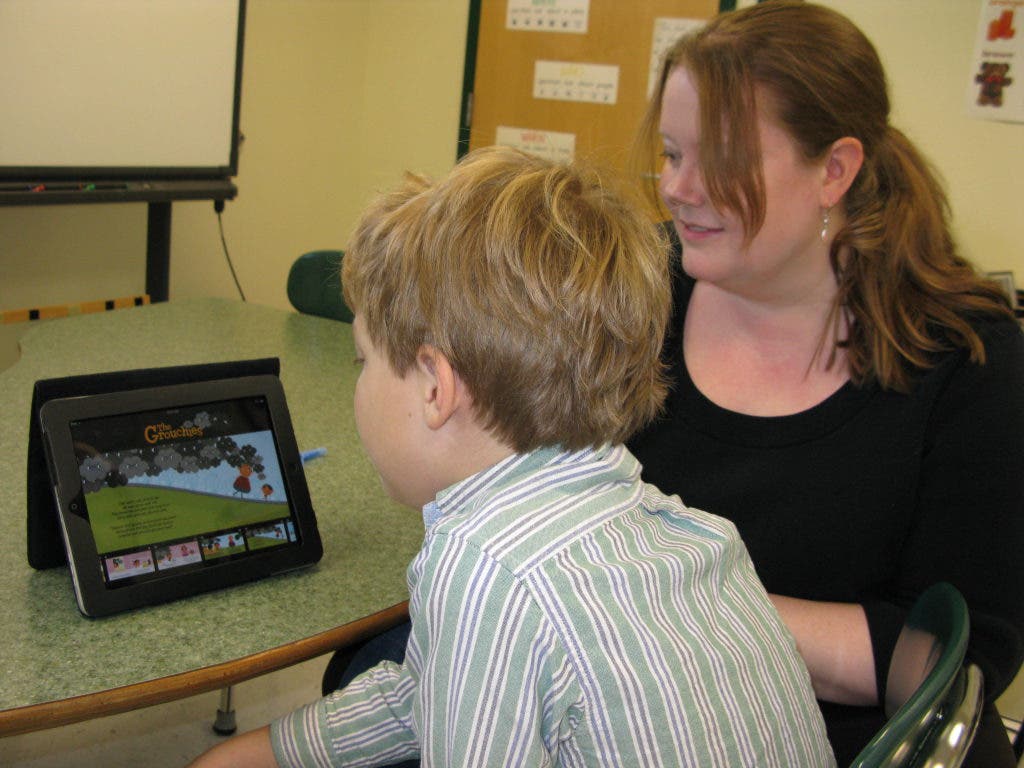


Nicholas Albanese sat down at school with his teacher, picked up an iPad and skimmed through applications. He settled on “Cookie Doodle.”
By pressing icons, the student began to add ingredients to a bowl, including chocolate chips. The egg made a “craaack” sound. Nicholas physically shook the iPad to mix in some salt. He "rolled" the dough with his finger; selected a cookie cutter shape—a pilgrim hat for fall—cut the dough, baked it and chose the frosting color—blue.
Using another app, Nick had a conversation with a girl who owns a horse, prompted by questions and comments on the screen.
Find out what's happening in Woburnfor free with the latest updates from Patch.
All elementary schools in the city are using iPads to help students who need special help with their speech and language skills.
The iPad apps are fun for students to use, according to Becca Johnson, speech and language pathologist for grades kindergarten through five at the Shamrock School.
Find out what's happening in Woburnfor free with the latest updates from Patch.
They're "cool," she said, and students want to use them. They also teach.
“We ‘sneak’ a lot of language in,” Johnson told Woburn Patch yesterday, as well as social and emotional skills. Like the back-and-forth of conversation and using “The Grouchies” to deal with dark-cloud feelings. The recipe app teaches students to follow directions and how to sequence, do things in order, she explained.
Mark Kulubya constructed sentences on an iPad about fall and Halloween, using icons customized for him. After the iPad “read” each sentence, the Shamrock School student read it, too. Johnson handed him a picture of each item he chose, to attach to a picture of a scary house and add another dimension and feel to the lesson.
Aaliyah Jean-Baptiste uses an iPad at the Shamrock School to let people know what she likes and wants.
The iPads and apps help students communicate, reinforce what they’ve learned and even help them calm down, summarized Susan King, a special education teacher at the Shamrock School.
The Shamrock’s Becca Johnson and Tara Karebian, a Shamrock pre-school speech and language pathologist, have been leading the effort to incorporate iPads at the Shamrock School, they told Woburn Patch earlier this school year. Besides holding students’ attention and building their skills, iPad apps can even record and track students’ progress, they said. They are devoted fans of the language-building Proloquo2go app, for its features and, Karebian, said, its fairly affordable price of under $200. Other devices cost over $1,000, she said.
Johnson and Karebian now train other teachers and staff on how they can use the iPads with students. Teachers want to use the devices as much as students, Johnson observed.
The Shamrock School got seven iPads to be used by its special education staff at the beginning of the last school year and seven more since school started this school year, according to Shamrock Principal Wayne Clark. The Shamrock has a preschool with six classes and a total of more than 100 preschoolers, he said. The school also has five iPads for students in its Title 1, federally-funded reading and math basic skills program, Clark said.
“They’re perfect,” Clark said, “for small-group intervention.”
The iPad effect has carried over to some students’ homes, according to the mother of one of the Shamrock students. Laura Albanese-McIntyre, Nicholas’ mother, got an iPad this past Christmas. It was Nicholas, she said, who took it out of the box and figured out how to use it.
“It’s so visual,” she said. “That’s how he thinks.”
Nicholas has the recipe app on his iPad at home, according to his mother. He also has “The Grouchies,” UNO, iBooks and an iPod app, she said; the school recommended several apps for him.
At home, “He’ll go for the app he needs,” she said.
No, students don’t play “Angry Birds” at school.