Schools
Hands-on Learning at Science Fair
Students and visitors learn at St. Charles School science and academic fair.
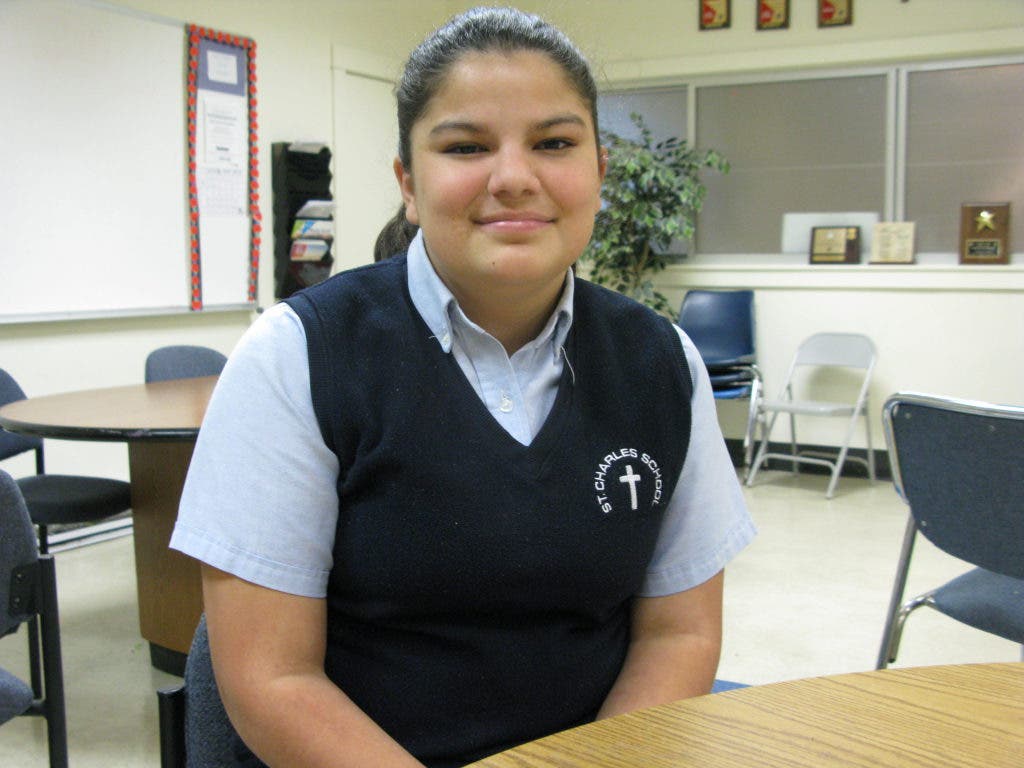

Blubber. No, not to cry. That fatty substance that keeps certain cold-water swimmers warm.
Elyse Masandi turned blubber—OK, Crisco—into an award- winning science fair project.
Find out what's happening in Woburnfor free with the latest updates from Patch.
The seventh grader at took first place in her grade.
Masandi made “blubber gloves” for visitors at the science fair to test.
Find out what's happening in Woburnfor free with the latest updates from Patch.
People who braved the “eeew” factor found that they couldn’t feel the cold water they plunged their gloved hand into at all, according to the Woburn resident. Some hockey players told Masandi that, she said, they’d use her device for hockey.
The purpose of the fair is for students to test educated guesses, or hypotheses, with experiments, St. Charles School teacher Denise Trueira told Woburn Patch. Even if their hypotheses don’t pan out, Trueira, the science fair team leader, explained, students don’t fail the project—if they understand and explain why they got their results. Students had to submit a typed paper, a log book and display board.
Back to Masandi. Originally, she wanted to test the hypothesis that listening to music helps you learn better.
“I listen to music when I study,” she said. But that project proved too complex.
A teacher mentioned blubber and its insulating property, Masandi said. She researched seals, whales and blubber, a combination of fat, connective tissue and blood vessels. She tried vegetable oil. Too thin. Crisco was the perfect consistency.
“People were disgusted by the feel,” she said, even though their hands stayed separate from it, protected by a zip-lock baggie.
First she had people put their bare hand in cold water. Very cold water. Masandi monitored the temperature. Then they tried the “blubber glove.”
In fifth grade, Masandi experimented with the effect of color on mood for the fair.
“I like science,” she said, because “you can test stuff out.” She wants to work in the medical field, maybe as a pediatrician. “My pediatrician inspired me,” she said.
Another experiment in this year’s science fair also used fat, but in a much different way. Eighth grader Fallon Barnes-Guzman saw a video on line of milk reacting with a drop of dish detergent. To make the experiment more visual, a drop of food coloring was added to the liquid.
The on-line video didn’t explain the why of what happened, Barnes-Guzman said. The Woburnite had to figure that out herself.
She tested milk and water. The milk reacts, she explained, because of its fat content. Whole milk creates a stronger reaction than skim milk, she noted. Her work earned her second place in her grade.
The food coloring “made it look cool,” she said.
Like Masandi, Barnes-Guzman designed her science fair project for visitors to try.
Barnes-Guzman said she likes the school’s science fair because “it’s fun and you can see other people's experiments and what they found out.”
Last year she tested how water, milk and sports drinks affected plants’ growth. Water worked best, she said.
Did she expect her experiment this year to take a top honor?
“No,” she said.
The names of the winners, based on judges’ scores, for students in grades five through eight:
Grade Five
Grade Six
Grade Seven
Grade Eight
1st Place
Agustin Busse
Tim Maguire
Elyse Masandi
Christopher VanCamp
Woburn
Burlington
Woburn
Burlington
2nd Place
Payton Mazza
Allyson Giso
Marissa Langlois
Fallon Barnes-Guzman
Burlington
Woburn
Woburn
Woburn
3rd Place
Riley Donovan
Alex Soper
Michael Jacobs
Lindsay Donahue
Billerica
Wilmington
Woburn
Wilmington
Teacher
Mrs. Trueira
Mrs. Trueira
Mrs. Flemming
Mrs. Dolan