Schools
Students at Altavesta School Build 'Fundations' for Reading
Program may expand to all of the city's elementary schools.
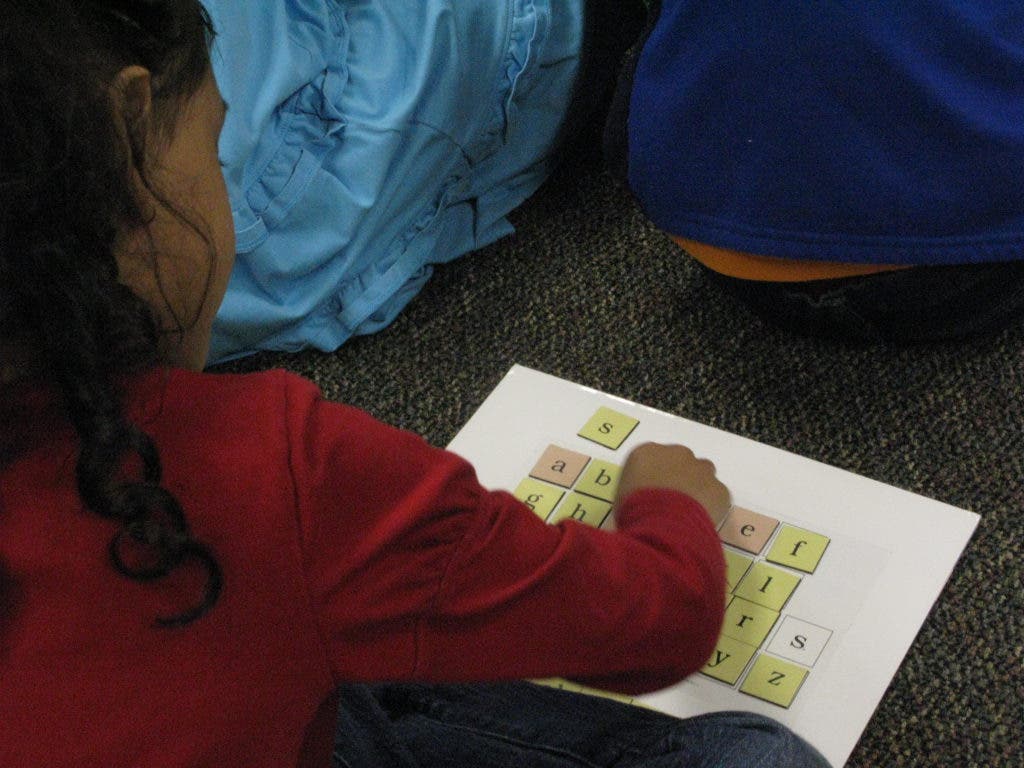


A dozen first-graders sat cross-legged on the floor in front of their teacher. Each held a board of magnetic letters.
First they reviewed the letters of the alphabet and the sound each letter makes by saying them, following the lead of their teacher.
Then their teacher asked them to make their own word by putting a letter before the letters “all.”
Find out what's happening in Woburnfor free with the latest updates from Patch.
Several students moved their magnetic “f” to make “fall.” Some made “ball.” With their teacher’s encouragement, they shared their words with each other. No one added an “m,” to make what school Principal Wendy Sprague told the students was her favorite “_all” word: mall.
Some groups of letters are tricky, teacher Kristy Russell pointed out, like “wh” that sounds like “w.”
Find out what's happening in Woburnfor free with the latest updates from Patch.
For the second school year, students in grades kindergarten through grade three at the are working, as part of the process of learning to read, to “code” and “decode” language by using letters and their sounds.
Upstairs, a smaller group of students took turns reading words from cards—and trying to read more each round before a timer rang.
Students in grades kindergarten through three spend between 20 and 30 minutes a day with teachers working on the “Fundations” program, Sprague explained.
By learning the structure of the English language, including the sounds letters make and how letters make words, students who use this program also learn to spell many more words—and exceptions to spelling rules—according to Sprague and the Fundations website.
Another advantage of the program, Sprague said, is that “it’s quick.” In half an hour or less a day, teachers assess what students are learning and intervene, if necessary, to help. This program helps teachers find students’ weaknesses “before it becomes problematic,” Sprague explained.
Students have fun with the program, Sprague said.
Ultimately, students work in one of three groups, explained second-grade teacher Christie Nickerson. Those who reach the skills goal for their grade practice them. Those who need extra help work in groups based on their skill level, not their grade. Students who exceed the “benchmark” do enrichment work so they don’t get bored.
While first-grade teacher Kristy Russell worked with first graders last week, Nickerson worked with students from several grades on their fluency. Each child in the circle around her had to read a printed word. The words ranged from the days of the week and months of the year to “eye” and “carry” and “thought”—tricky with the silent “gh.” They seemed to enjoy the game and working to read more words each round. Teachers take turn doing intervention sessions, Sprague said.
The Altavesta School started the program a year ago, Sprague said. Teachers are doing an “awesome job” with it; “they see its benefits.”
Based on the program's success at the Altavesta School, school administrators are looking to bring it into all Woburn elementary schools, Dr. Gary Reese, assistant superintendent for curriculum and assessment, told Woburn Patch.
Altavesta kindergarten teacher Joyce Russis offered a succinct summary of the program. Students benefit, she said, because they get the attention they need to learn the foundations of literacy.