Schools
Students Reach Milestone in New English/History Project
Joyce Middle School eighth-graders have completed interviews and are working on rough drafts in new interdisciplinary journalism project.
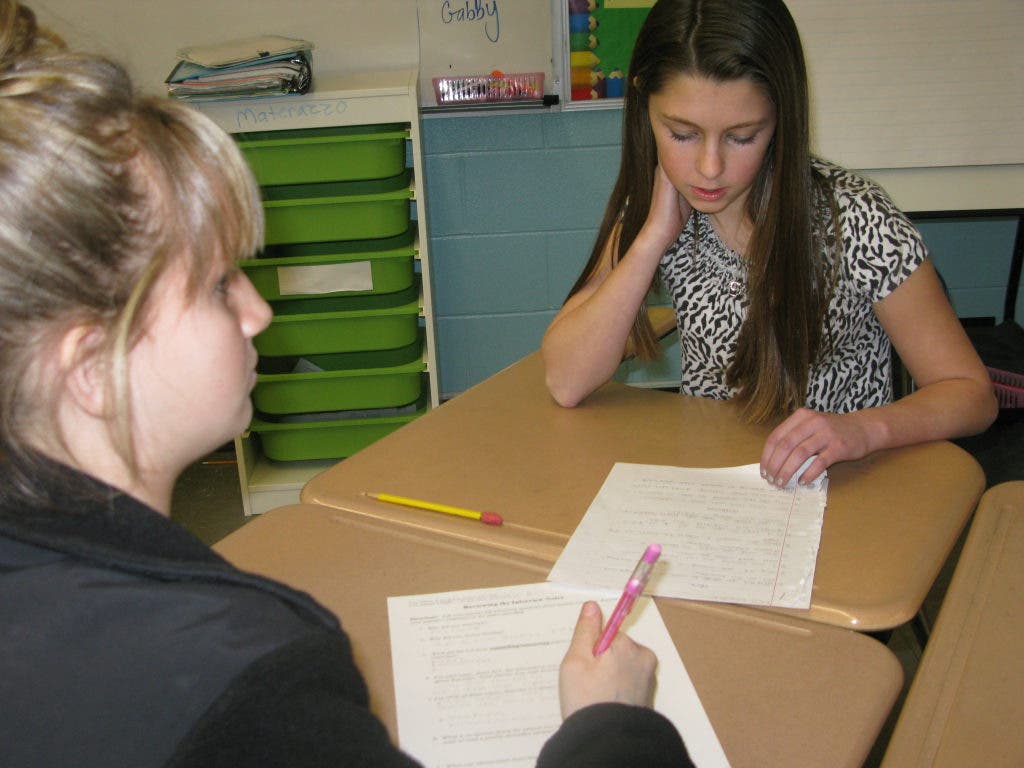
Shayla Brady and Megan Meuse sat opposite each other in teacher Kathryn Materazzo’s classroom and Megan began to ask Shayla a list of questions.
“Who did you interview?”
“About what?”
Find out what's happening in Woburnfor free with the latest updates from Patch.
“What more might you want to know about the person you interviewed?"
Megan took notes.
Find out what's happening in Woburnfor free with the latest updates from Patch.
Then Shayla asked the same questions of Megan and recorded her answers.
Interviewers became interviewees—at least for one period—in a new intended to tie English and history together for eighth graders at the .
The English classes of Materazzo and history classes of Rob Tropea have been working together on a project that calls for students to interview a Woburn resident and write a feature about that person. Materazzo developed the idea for the interdisciplinary project at a summer literacy program. She, Tropea and their students are all navigating their way through the project for the first time.
Students have reached a milestone in the project: they have interviewed their subjects.
The goal of their most recent class exercise: To develop follow-up questions for their interview subjects.
Many students chose to interview a parent, according to the teachers.
Like Megan Meuse. She interviewed her father, Bill. “I like to talk to him,” she explained in answering a question from the questionnaire. Most interesting to her about the interview, she said, were his childhood and career. Both her father and mother moved separately to Woburn at the same time, when he was 13, she recounted.
To follow up on her first interview, she wants to know more about the sports he played, she said.
Shayla chose a different interview subject: her gym teacher, Barbara Locke.
“She’s like my second mom,” Shayla said, explaining why she chose Locke. “She gives me advice about everything.” Shayla asked Locke about her work and childhood.
“I asked why she decided to work at the Joyce,” Shayla said. There was an opening there. Shayla wants to know more about the sports Locke coaches.
“She’s known all over Woburn,” Shayla said.
At another table, Jarred Hogan and Cesar Cruz were completing the same interview questionnaire. Cesar interviewed his English as a Second Language teacher, Christine Maddelena. Cesar spelled her name.
She decided to become a teacher because she loves kids, Cesar told Jarred. He listed in detail some of her background: the high school and college she attended, even that she took 4 1/2 years to finish college because she spent a semester in Europe and that she was a straight-A student.
He chose to interview her, he said, because “she went to college, is patient—very patient—with students and I like her.”
So far, students have learned “process,” that is, to plan different parts of the whole project, Materazzo explained, from developing interview questions to choosing an interview subject to interviewing someone—a daunting task for some students.
“I feel they got over their fear of interviewing,” Materazzo said, and “learned to listen and take notes in a different way than they would in class.”
“In this day and age, with texting and Facebook, people don’t think about conversation,” according to Materazzo. Even with a list of interview questions, some students wonder, she continued, where to go from there?
The teachers are learning along with their students. Materazzo and Tropea had planned to have students incorporate some history into the project. When students practiced their interviewing on him, he told them he was a member of the first eighth-grade class at the Joyce Middle School. His class got to vote on the school colors: green and blue.
City-wise, Tropea told the students about a tract of land, Blueberry Hill, behind Fulton Street, before houses were built there. When it was wooded, “It was ours,” he said. He and friends would hang out there, he said, and listen to music.
He offered students some books to help with the history part of the project. This time around, students seemed to focus on the interview. Tropea will focus more on tying history into the project with the next class, he said.
Now students face their next milestone: writing their features. Tropea is expecting students to turn in a two-page long feature, double-spaced.
As for grading the project, Materazzo said she will look at all the parts: the students’ interview questions, interview notes and interview questionnaires as well as the feature itself. She is going to look for facts, she said, and ask, “Did they did deep enough?”
Woburn Patch is keeping an eye on the project because it’s new, launched this school year, and involves interviewing, writing and history—some local history. At Materazzo’s invitation, reporter Nadine Wandzilak sat in on two project classes, and offered some tips on interviewing and writing.
The students’ rough drafts are due in about four weeks.