Schools
Students Tackle the Scientific Method
20 students receive top honors at the science and academic fair at St. Charles School last Thursday.
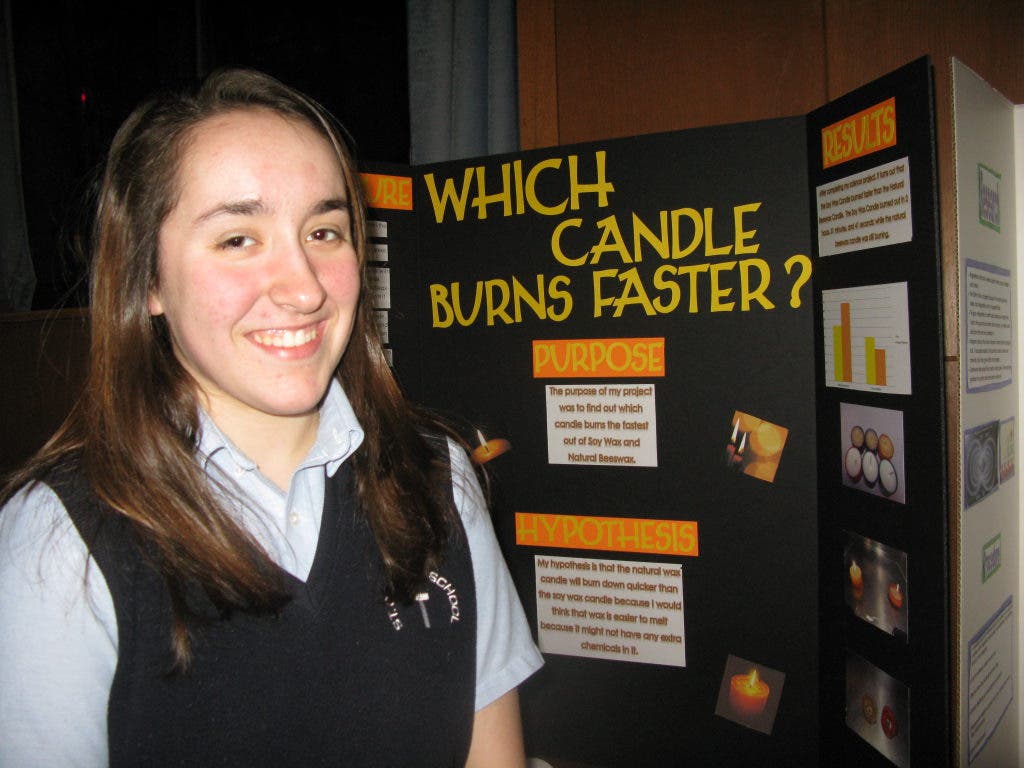


Kathleen Flemming’s science project was for the birds—and it won her first place honors for her grade in her school’s science fair.
Literally for the birds.
Kathleen, a fifth grader at , used the scientific method to answer the question, "Does the type of bird seed in a feeder affect the type of birds who feed there?"
Find out what's happening in Woburnfor free with the latest updates from Patch.
She hypothesized—or made an educated guess—that smaller birds would eat smaller seeds; larger birds, larger seeds; and all birds would eat suet.
To test her hypothesis, Kathleen watched birds at the feeder at her home in Woburn for about 30 minutes every morning around 7 a.m. for a month and recorded her observations.
Find out what's happening in Woburnfor free with the latest updates from Patch.
Her journal documenting her observations impressed fair judge Patricia Piazza, a substitute teacher at the school.
One of the aims of the fair is to teach the scientific method, Piazza explained: formulate a problem; make a hypothesis or assumption about what will happen when the hypothesis is tested; establish a test procedure; collect data; compile the results and come to a conclusion.
Judges use a rubric, or a process with a series of questions and point values, to evaluate each project. They look at creativity, whether the student has used the scientific method and presentation.
St. Charles School was a hive of activity Thursday evening when students in all grades displayed their projects. Parents, siblings and grandparents elbowed through classrooms and other display spaces.
Projects ranged from mold to magnets to plant growth to extending the life of a glow stick.
A total of 20 students in grades five through eight won special recognition for their projects. Their names, grades and awards follow the story.
Two Amadeo siblings from Woburn brought home high honors: sixth-grader Alex took first place with a project on energy discharge; eighth-grader Rachel received honorable mention with an examination of whether soy wax candles or beeswax candles burned faster. Her poster was particularly eye-catching.
Rachel took home an honorable mention last year with her project on, “How much water is in an orange?” according to her father, Ron. For a while he stayed near Rachel, while his wife remained with Alex. During the course of the fair, the parents switched places.
Science fair season in the Amadeo home means, Ron said, that every flat surface is covered by works in progress.
Eighth-grader Christopher Flemming from Woburn took an honorable mention for his “Siege Engine.” He built a trebuchet and examined how adding weight to the counterweight affected the distance the trebuchet would launch an object. He was inspired, he said, by friends who participate in “Punkin Chunkin’” events, just like the TV show of the same name.
Students start in November to pick a topic for their project, explained Amy McDonough, who teaches seventh and eighth grade science at St. Charles School. A lot of parents ask why they start so early, according to McDonough. It’s so students can change their minds, she said, after doing some initial research on a topic. She tells students to choose a subject that interests them and that they want to learn about, she added.
In one fourth-grade classroom, students who were studying science now produced science projects and those who were studying social science each researched a state.
Bryn Siegel of Woburn produced a display board about Utah. Originally, Utah wasn’t Bryn’s top choice, her mother, Helene, said. But as Bryn did research, she found that the state was known for its skiing, rafting, fishing and hiking, according to her mother. Its residents are the most educated in the nation, Helene added. Bryn was most interested to learn that the Great Salt Lake is so salty people float in it.
In the classroom adjacent to Bryn’s was a treat for the nose: a project by fourth grader Jake Moore on how storage temperature affects the popping of popcorn.
So how accurate was Kathleen Flemming’s hypothesis for her bird project? She was generally correct, she said, that small birds eat small seeds and large birds eat large seeds. But between chickadees and sparrows, which are the same size, one preferred nuts and berries and the other chose small seeds. Only a few birds ate the suet. Birds only came to the feeder on sunny days, and squirrels kept the birds away.
Judges look for projects developed from students’ own ideas.
Regardless of her project, Kathleen said she likes to put out bird seed.
“It’s my job in winter,” she said.
The names of the science and academic fair winners in grades five through eight follow. Awards are made only to students in those grades.
Grade 8
1st place—Heather Piazza
2nd place—Joseph Lyons
3rd place—Christopher Flemming
Honorable mention—Rachel Amadeo, Julianne Hulin and Elizabeth Cornel.
Grade 7
1st place—Benjamin Pacek
2nd place—Jennifer Buckley
3rd place—Nathan Domingos
Honorable mention—Lindsay Donahue
Grade 6
1st place—Alex Amadeo
2nd place—Christopher Moniz
3rd place—Jason Le
Honorable mention—Michael Jacobs
Grade 5
1st place—Kathleen Flemming
2nd place—Jonah Barnes-Guzman
3rd place—Robert Aurilio
Honorable mention—Sean Brennan, James Kennedy and Kevin Kennedy