Neighbor News
NASA To Launch Worcester Academy Students' Experiment Into Space
Ingenuity and originality of Project wins NASA Tech Rise Challenge

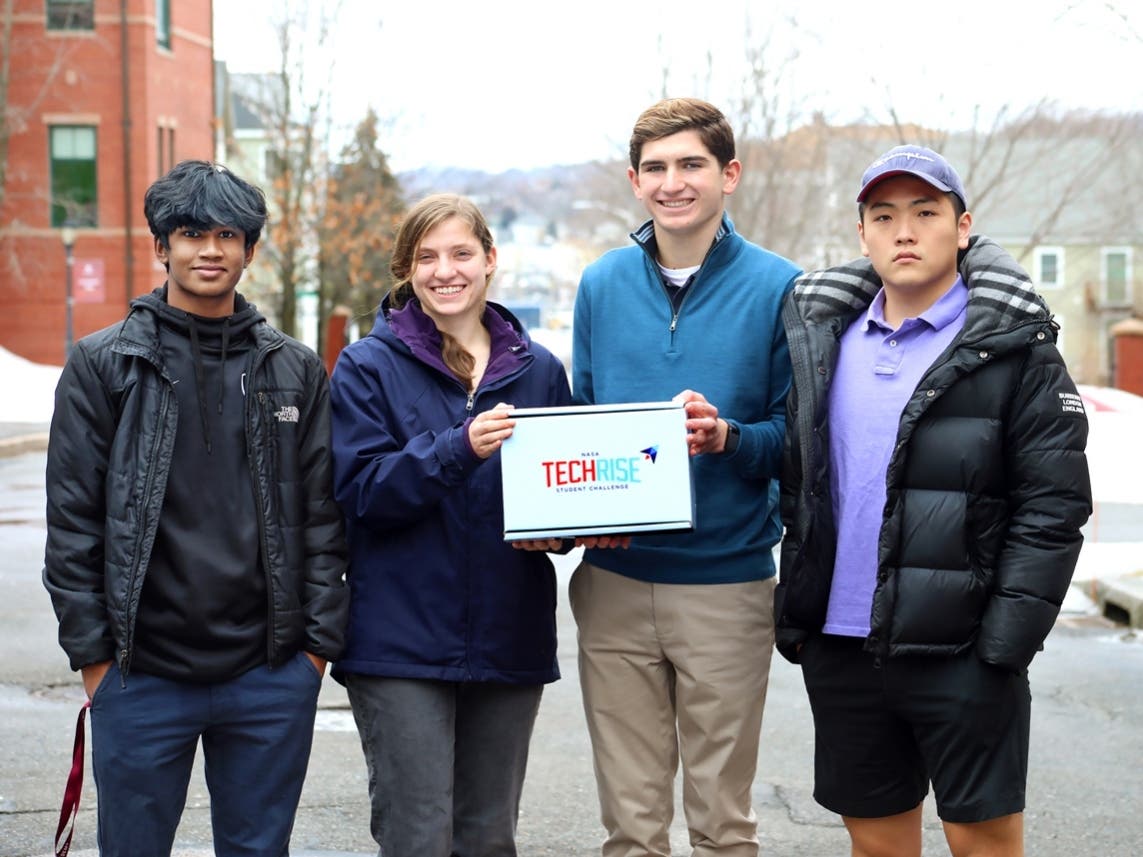
WORCESTER, Mass. — The ingenuity and originality of a Worcester Academy team science project is taking STEM achievement to new heights. NASA has selected the group’s Academy project as a NASA TechRise Student Challenge winner.
The win, in the NASA Challenge’s Suborbital Rocket category, greenlights
the team of four students to include their engineering project on a NASA rocket to be launched in 2023, date to be determined.
Find out what's happening in Worcesterfor free with the latest updates from Patch.
Among the winning Worcester Academy students are sophomore Donovan Sappet of Sterling (team lead and project innovator), juniors Katie Adiletta of Bolton and Ritvik Chand of Shrewsbury, and senior Junhyuk Choi of South Korea.
The Worcester Academy project, “Exploring the Effectiveness of Photo-Analysis Threat Identification in Microgravity,” was one of 37 projects nationwide that NASA selected to be launched into space by suborbital rocket. The rocket, which will launch some time in 2023, will achieve a height of higher than 100 kilometers.
Find out what's happening in Worcesterfor free with the latest updates from Patch.
Donovan, whose initiative jump-started and continues to drive the project, recently attended a NASA summer camp. It energized him to begin thinking about a career in physics or aerospace, maybe even at NASA, the pinnacle of the space industry.
Inspired, he joined with three other WA students to take up the NASA TechRise Challenge and to further explore their interests in space and engineering.
“By winning the NASA TechRise Challenge, we have the amazing opportunity to be mentored by NASA-affiliated scientists and engineers,” says Donovan. “This project allows us to utilize our Worcester Academy classroom and personal learnings and apply them to a real-world challenge.
“It is very exciting to take our initial concept and work through all the issues and challenges to ultimately construct an end product that will be launched into space,” he says. “This is going to be a really great learning opportunity that will allow us to flex our academic muscle.”
He says the project, “Exploring the Effectiveness of Photo-Analysis Threat Identification in Microgravity,” will test the effectiveness of different photo-analysis algorithms at identifying threats in several conditions in microgravity. The hope is that their project’s data will be able to support future implementation of technology onto satellites to increase reaction time against space debris and avoid catastrophic damage.
ENGINEERING AND PHYSICAL SCIENCE CHALLENGE
WA Science faculty member Russ Ruthen has high praise for Donovan and the rest of the Worcester Academy students. Mr. Ruthen is mentoring the students, while Science Department Chair Chris Aguiar reviewed the application and has been handling the administrative details, including a grant of $1,500.
“The overall challenge is engineering but has a heavy component of physical science as students need to understand the mechanics of space debris,” Mr. Ruthen notes. “The rocket provides power for the experiment and maintains reasonable pressures and temperatures, but the team will need to figure out how to keep their system operating at 18 times gravitational force—that’s about double the acceleration of the world’s best fighter jets.”
Other challenges include simulating the motion of the debris inside the box, which is smaller than a shoe box, he says.
“They will use lights and cameras, and a computer processor will track the motion of the debris,” Mr. Ruthen says. “Given commercially available and inexpensive cameras, they will explore the limits of how small, how fast, and what types of materials they can detect.
According to the NASA TechRise Student Challenge website, winners were judged on the following criteria, among other things.
- Originality of the Flight Experiment Idea
- Impact on Education and/or Society
- Quality of the Build Plan and Compliance with the Design Guideline
● Timeline Feasibility
You can find the Worcester Academy project listed here at https://www.futureengineers.org/nasatechrise. Look for it under Suborbital Rocket Winners heading.
ABOUT WORCESTER ACADEMY
Founded in 1834, Worcester Academy is an independent day and boarding school for boys and girls in grades 6 to 12 (and postgraduates). Located in the thriving city of Worcester, the Academy provides an exceptional and time-befitting educational experience that fosters personal growth, nurtures a sense of belonging and well-being, and develops intellect and understanding through authentic community engagement and real-world experiences. Students, who are joyful and curious, define what it means to “Achieve the Honorable” and are equipped to honorably impact the world wherever they go.
For information about the Worcester Academy students’ NASA TechRise Challenge project, or about the Academy curriculum, contact Neil Isakson, director of external communications, at 508-459-6918 or e-mail him neil.isakson@worcesteracademy.org