Health & Fitness
WPI Researchers Aren't Making A Dip With Their Spinach; They're Growing Heart Tissue
Researchers turn to the vascular system of plants to solve a major bioengineering problem blocking the regeneration of human tissues.


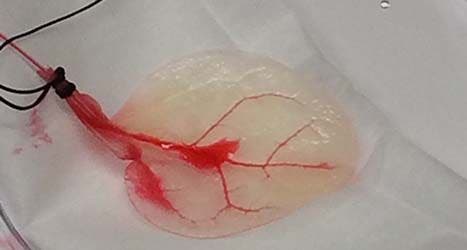
WORCESTER, MA — While you're putting together a spanakopita with your spinach, researchers over at WPI is growing heart tissue on their spinach leaves.
According to a release sent out by the college, researchers face challenges as they seek to scale up human tissue regeneration from small lab samples to full-size tissues, bones, even whole organs to implant in people to treat disease or traumatic injuries: how to establish a vascular system that delivers blood deep into the developing tissue.
That does sound tough. Bioengineering techniques that are being used such as 3-D printing can't fabricate the branching network of blood vessels that one needs to deliver nutrients, oxygen and essential molecules that are needed for tissue growth.
To solve this problem, a multidisciplinary research team at Worcester Polytechnic Institute (WPI), the University of Wisconsin-Madison, and Arkansas State University-Jonesboro have successfully turned to plants, according to an announcement from the college.
They report their initial findings in the paper “Crossing kingdoms: Using decelluralized plants as perfusable tissue engineering scaffolds” published online in advance of the May 2017 issue of the journal Biomaterials. “
In a series of experiments, the team cultured beating human heart cells on spinach leaves that were stripped of plant cells. They flowed fluids and microbeads similar in size to human blood cells through the spinach vasculature, and they seeded the spinach veins with human cells that line blood vessels. These proof-of-concept studies open the door to using multiple spinach leaves to grow layers of healthy heart muscle to treat heart attack patients.
“We have a lot more work to do, but so far this is very promising,” said Glenn Gaudette, PhD, professor of biomedical engineering at WPI and corresponding author of the paper, said in the release. “Adapting abundant plants that farmers have been cultivating for thousands of years for use in tissue engineering could solve a host of problems limiting the field.”
In addition to Gaudette, the WPI research team includes Tanja Dominko, PhD, DVM, associate professor of biology and biotechnology, who studies molecular mechanisms of human cell development; Pamela Weathers, PhD, professor of biology and biotechnology, a plant biologist; and Marsha Rolle, PhD, associate professor of biomedical engineering, who focuses on vasculature tissue engineering. The collaborative team also includes human stem cell and plant biology researchers at Wisconsin and Arkansas.
Photo Credit: WPI