Politics & Government
Democratic Divisions Could Hurt El-Sayed, But Trump's Economy May Matter More
Rogers' success on election night could also depend, in part, on his work in the Black community.

October 23, 2026
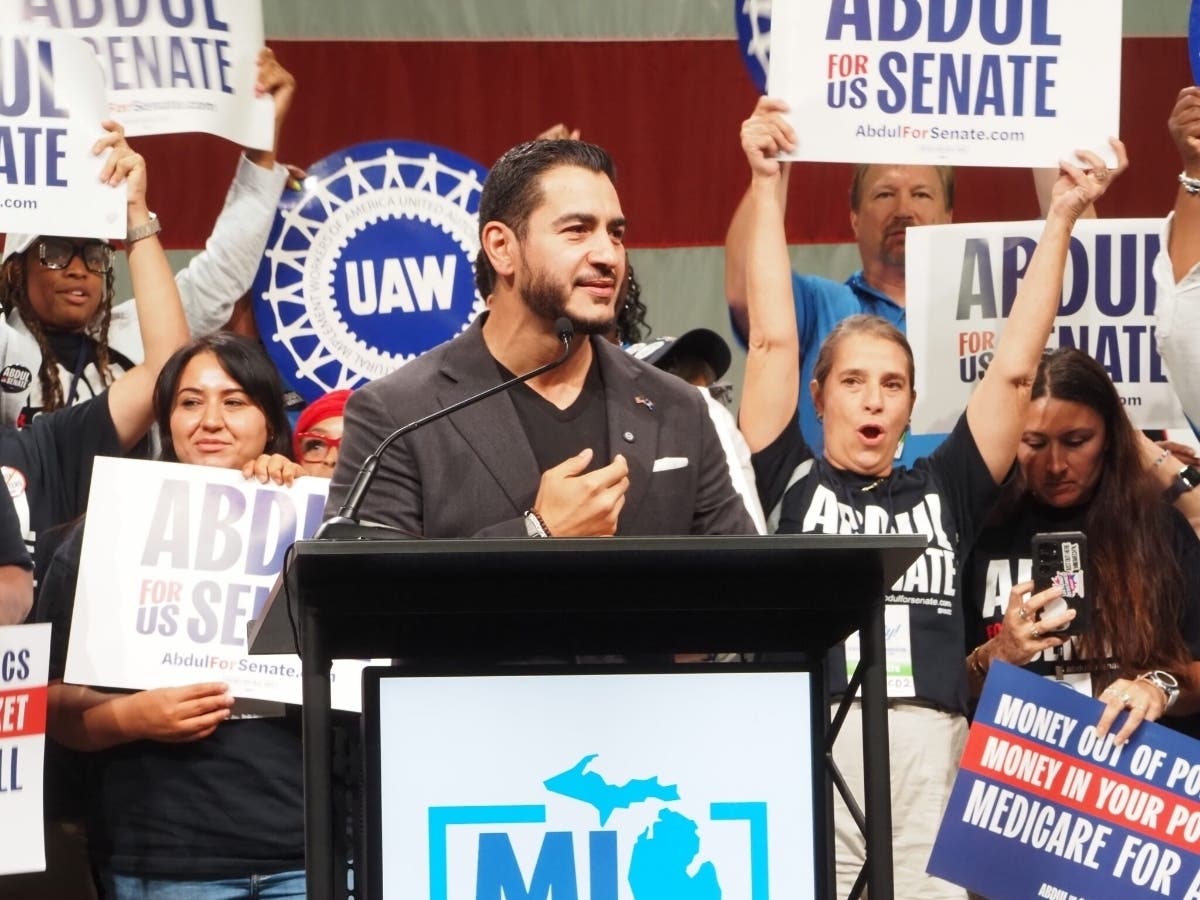
With voters still up for grabs in the final weeks of the U.S. Senate race, Abdul El-Sayed and Mike Rogers are campaigning in unlikely places as both candidates seek to chip away at the other’s base.
Find out what's happening in Across Michiganfor free with the latest updates from Patch.
El-Sayed, the Democratic nominee, still faces an uphill battle to unify segments of the party’s base, while Rogers, the Republican nominee, is attempting to extract potential supporters from those very same segments; Democratic Jewish and Black voters, two communities that supported U.S. Rep. Haley Stevens (D-Birmingham) in the primary.
But the worsening economy under President Donald Trump could outweigh those efforts in determining voter turnout on Nov. 3.
Find out what's happening in Across Michiganfor free with the latest updates from Patch.
“I don’t think it matters anymore,” Adrian Hemond, a Democratic consultant and CEO of Grassroots Midwest, told Michigan Advance. “The president ran the economy into a ditch with tariffs and a war of choice in the Middle East, and this administration and Republicans more broadly seem absolutely committed to the bit of replaying the mistakes of the end of the Biden administration. … We have inflation running rampant through the economy, and you have the party in power that’s telling you everything’s fine.”
Even as economic woes dominate the narrative, El-Sayed’s issues with Jewish voters persist, and Rogers’ associations with Trump may very well deter him in his quest to convert those voters.
Jewish voters only make up 1% of the state’s population, but a big shift in how that community votes might be an equally strong factor as the economy, said Charles Gaba, a Democratic fundraiser and a member of Michigan’s Jewish community.
“What we lack in numbers, we make up for in activism and organization and volunteering and fundraising,” Gaba said.
Rogers has been boastful about his efforts to make inroads with Democrats. He created a coalition to court Black and Jewish voters and opened a field office in Detroit, while being supportive of Nonnegotiable Michigan, a group of “rabbis, cantors and synagogue lay leaders” who have demanded that El-Sayed recognize “Jewish sovereignty in Israel,” among other baseline affirmations for the community.
“There is a reason why more Democrats voted against him than voted for him,” Rogers said after a debate hosted by WOOD-TV earlier this month. “They understand that we’re for real, we’re going to help their problems, and actually have solutions to their problems.”
Rogers’ success on election night could also depend, in part, on his work in the Black community.
While The Bulwark recently reported that his “Democrats for Rogers” coalition was made up of and primarily funded by Republicans, Hemond said it was apparent that Rogers has been working in Detroit, and he expected Rogers to do better with the city’s voters than he would have otherwise.
However, El-Sayed’s efforts with those communities have been a major plotline throughout the campaign. He spent time over the last few weeks in Detroit, holding rallies, visiting churches and attending events. President Barack Obama is scheduled to rally with him this weekend, while former U.S. Rep. Andy Levin has come in to help him with Jewish voter outreach.
El-Sayed has also spent significant time in West Michigan and up north to sway independent voters and disaffected Republicans fed up with Trump.
“When you’re getting 1,300 people in Marquette, 500 people in the eastern and western Upper Peninsula, he really has base problems,” El-Sayed said at this week’s WXYZ-TV debate. “He’s going to make a show out of things and needs something to grasp on … but we are actually campaigning.”
Rogers hoping for strong Black support
Among Rogers supporters in the Black community are Damari Covington-Woods and Beulah Walker.
Covington-Woods, a 25-year-old entrepreneur and bricklayer from Auburn Hills, said he was supporting Rogers because the candidate and his wife were heavily involved in a literacy program, Beyond Basics, that helped him advance in his education. Rogers has touted his personal support for Beyond Basics on the campaign trail and on the debate stage. Covington-Woods, who has appeared in an ad promoting Rogers, said he only met the Republican candidate a year ago, but was impressed with how he carried himself, and how much he listened when he visited Beyond Basics.
“It can’t be overstated, literacy is at a crisis, man. It’s an existential crisis,” Covington-Woods said. “I’ve had solid conversations with Mike. I know what he stands for.”
Walker is an activist for access to clean water, both in Flint and in Detroit. She said she was a longtime Democrat and a member of the party’s Black Caucus until she met Rogers a few months ago. Walker said she heard Rogers speak about his housing plans and his rhetoric about Democrats failing Black voters over the last century on things like clean water, poverty and disenfranchisement.
Walker accused El-Sayed of using the Black community as political capital and invading their spaces as he sought their support in 2018, when he ran for governor, during the 2026 primary and now the general election. She also denounced his work as the health officer and executive director of the Detroit Health Department, associating his decade there with former Mayor Mike Duggan’s initiative early in his first term to shut off water to city residents with unpaid bills. Duggan ended up reversing that effort in 2014, a year before El-Sayed took over the health department.
Despite tensions, El-Sayed still garnering Black support
Walker also cited decades-long friction between Middle Eastern and Black communities in southeast Michigan as a reason why she believed some Black voters might reject El-Sayed.
“This is why Black Americans are at this point with Dr. Abdul,” Walker said. “This ain’t just a one-off with the Arabic or Chaldean community and people of color who are not Black. We are talking about decades of disrespect and misuse.”
When Michigan Advance asked whether her comments could be perceived as racist toward Middle Eastern and North African residents in or near Detroit, Walker stood by her remarks.
“We’re at the bottom of the caste system economically. So, if anything, the Arabic and Chaldean community is above us when it comes to economics and resources,” Walker said. “The Arabic community has power over us. They own the grocery stores, the liquor stores, and the gas station. They run our core things that we need in life, basic essentials.”
Hemond noted that the tensions between Black and Middle Eastern residents in and around Detroit were real, but had existed well before El-Sayed began his career in politics.
Despite those hangups, some Black voters who supported Stevens in the primary have said they are with El-Sayed, and that they were excited to support him.
“We’re on these doors, so we know exactly what people care about,” said I’Ron Wilson, a member of the UNITE HERE labor union representing hotel and hospital workers. “Healthcare, housing, and cost of living are the top of the list. Black folks are looking for someone with solutions that will actually make their lives better.”
Another El-Sayed ally, Benton Harbor Mayor Marcus Muhammad, has continued to express support on social media.
Despite tensions, El-Sayed still garnering Black support
David Kramer, a Democratic fundraiser and a signatory to the Nonnegotiable Michigan petition, said he still hopes El-Sayed will address their concerns, but feels the prospect has dimmed.
Kramer and former Michigan Democratic Party Chair Lon Johnson co-authored an op-ed in The Detroit News this week urging Jewish Democrats to leave El-Sayed’s section of the ballot blank.
“There is, at least in my experience, a fairly small percentage of Jewish Dems who I talk to who say, ‘I feel so strongly about voting for Democrats with everything at stake,’” Kramer said. “But the majority of people I talk to are either voting for Rogers or leaving it blank.”
Gaba said some people within his circle, who were loud in their support for El-Sayed, have recently stopped encouraging other Jews to support him — mostly because of his unwillingness to say that Iran was a bigger threat to the U.S. and the world than Israel.
Kramer said many Jews identify as Zionists, and that El-Sayed trying to separate Zionism and Judaism in his political rhetoric has turned them off.
“In my synagogue I go to, when you walk in, there’s an American flag and there’s an Israeli flag,” Kramer said. “There’s a prayer for the state of Israel that you recite during the high holidays. … They’re so intertwined that you can’t separate them out and basically say, ‘Well, I’m supportive of Jews, but not Zionist Jews.’”
A survey earlier this year by the Jewish Federations of North America found that while more than 70% of American Jews felt “emotionally attached” to Israel, only 37% considered themselves to be Zionist.
Kramer was unsure if a movement to withhold support would signal to Democrats that they risk alienating Jewish voters. He did express concern, however, about the message an El-Sayed victory without substantial Jewish support could send to the party.
Progressive Jews, Black voters still showing up for El-Sayed despite defections
Pamela Shifman, president of Democracy Alliance, a group of progressive donors, is publicly urging Democrats to donate to El-Sayed’s campaign. Shifman is Jewish and said she is proud to support him.
“Abdul shows up. He is willing to engage in conversation, and I think it is really clear that Abdul is getting most Jewish Democrats behind him,” Shifman said. “Dana Nessel, Elissa Slotkin, they’re now campaigning with Abdul. I think they understand the stakes of the election and the existential threat that Mike Rogers poses.”
Gaba began supporting El-Sayed after he secured the nomination, but he was all-in on Stevens after state Sen. Mallory McMorrow (D-Royal Oak) dropped out. Gaba made a commitment to support the nominee and he’ll do so even if he, like Kramer, is not actively encouraging other Jews to support El-Sayed.
“It will have some effect, but I think he’s going to win anyway, if for no other reason that the environment is just so completely toxic for Republicans right now,” Gaba said.
Hemond agreed, and said that the voting bloc issues in play were not going to change the fact that residents were likely to punish Trump and the GOP over the economy.
“I think it’ll be most pronounced with Jewish Democrats, but I think that there are a lot of centrist Democrats that are Abdul skeptical. … A decent number of them are not going to vote for him,” Hemond said. “But it’s always the economy and people’s vibes about the economy closest to them, and that’s all wretched now, including in Detroit and with Black voters, just like all the other voters.”
The Michigan Advance, a hard-hitting, nonprofit news site, covers politics and policy across the state of Michigan through in-depth stories, blog posts, and social media updates, as well as top-notch progressive commentary. The Advance is part of States Newsroom, a national 501(c)(3) nonprofit supported by grants and a coalition of donors and readers.