Politics & Government
Democrats Aim To Emulate Republicans In Building State Power
"One of the things the right has known for decades is that by moving state policy, you move national policy," activist Gary Goldstein said.

August 28, 2026
Progressive activist Gaby Goldstein thinks her opponents are brilliant.
Find out what's happening in Across Michiganfor free with the latest updates from Patch.
Despite her deeply held liberal politics, she admires the work of conservative groups that for decades have built influence in state governments across the country.
“We on the left have left a huge amount of power on the table,” said Goldstein, the founder and president of State Futures, a nonprofit launched last year that coordinates hundreds of Democratic lawmakers across the states.
Find out what's happening in Across Michiganfor free with the latest updates from Patch.
Few on the right have been as influential as the American Legislative Exchange Council, or ALEC. Founded in 1973, ALEC touts over 2,000 lawmakers as members — nearly a quarter of the country’s total state lawmakers. Despite fierce criticism, the organization has made an indelible mark on state policy by pushing hundreds of pieces of model legislation that have reshaped public education, state labor laws and taxation.
“One of the things the right has known for decades is that by moving state policy, you move national policy,” Goldstein said.
State Futures is among a growing number of progressive groups looking to combat the influence of groups such as ALEC. Experts say the left has years of work ahead if it wants to match the prowess of the organized right, which coalesced more readily around a few core issues. But the second Trump administration has rallied Democrats across the states seeking to oppose federal policies. This year, State Futures has worked with lawmakers who proposed nearly 250 bills in state capitols seeking to place limits on federal immigration efforts.
Attention on state policymaking has only heightened as Democrats see the potential to flip hundreds of state legislative seats this November and chip away at the GOP’s hold on American politics.
But Goldstein and other organizers say the left needs to make significant investments in state politics and policy that outlast any individual election cycle. In working to build Democratic power across the states, she’s studied the ALEC playbook. Aside from its relentless focus on state capitols over the years, she compliments the organization’s work of nurturing relationships that connect conservative lawmakers coast to coast.
“These are real people who are real friends,” she said. “I admire ALEC very much. I admire a lot about the right.”
For its part, ALEC says it welcomes more attention on state policy — even from those on the other side of the aisle.
Jonathan Williams, the organization’s president and chief economist, says more people are concurring with ALEC’s belief that changing policy starts with the states.
“There’s lots of groups out there that have tried to replicate ALEC from the left,” he said. “And there is some irony … that a lot of the left wanted to take ALEC out there for many years, and now they want to join in and try to replicate it.”
Williams said new progressive groups have often sprouted up with massive war chests focused on specific areas of policy.
In contrast, ALEC has built a strong base of support from conservative and free-market lawmakers and consistent funders including businesses, nonprofits and trade associations.
“You just don’t see years and years of concentrated and growing support from a wide base of supporters,” he said of progressive groups. “Some of these groups come out of nowhere, it seems.”
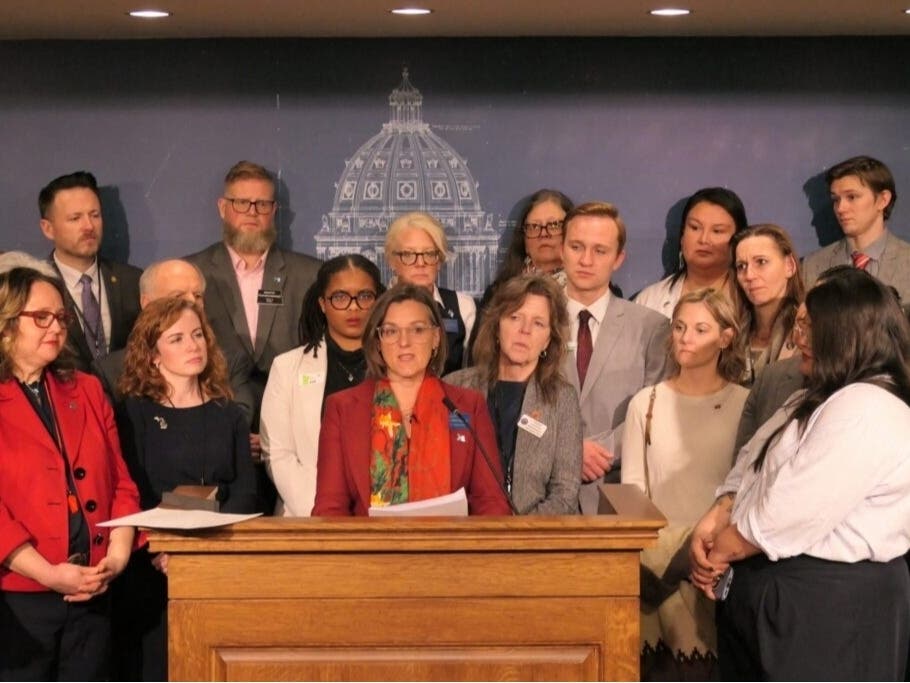
California Democratic Assemblymember Sade Elhawary said state lawmakers increasingly recognize the power of working across state lines. Sometimes, that’s done through pushing similar pieces of legislation. But other times it means just showing support — such as January’s gathering of Democratic lawmakers from more than a dozen states in Minnesota following a large deployment of federal immigration officers there.
“We are so much stronger together,” she said. “We shouldn’t be doing it on our own, because then we can get attacked on our own.”
Elhawary is among the 112 lawmakers from 35 states working on federal response issues with State Futures. She said the national Democratic Party is losing the messaging war as it struggles to mount an opposition to President Donald Trump. But she said state lawmakers have the ability to articulate a clearer vision for voters by working on issues that matter most to their constituents.
“When we can organize beyond our state, I think we can organize folks on the ground,” she said. “This is not about just the legislators. This is about community.”
Connecting state lawmakers
Liberal groups have sought to offset the growing influence of conservative movements for years.
A group with the acronym ALICE, the American Legislative and Issue Campaign Exchange, in 2012 aimed to counter ALEC’s national influence.
Liberal activists started the group in Wisconsin in direct response to the hotly debated policies of Republican Gov. Scott Walker, a former ALEC member. In 2011, Walker signed highly publicized legislation eliminating collective bargaining rights for most public employees, a policy championed by ALEC.
ALICE in 2014 merged with the Progressive States Network and the Center for State Innovation, creating what is now known as the State Innovation Exchange, or SiX. The group, which says it includes about 1,800 state lawmakers across 50 states, helps legislators to strategize on legislation that can reshape policy across state lines.
While the group does work to counter the organized right, Executive Director EJ Juárez said it employs different tactics than conservative groups like ALEC. He said lawmakers work with their communities to craft legislation that is responsive to current needs — not just a wish list from outside interests.
“It’s not just, ‘Pass this bill because we wrote it and we think it’s good,’” he said.
ALEC maintains that its model legislation is crafted and debated by member lawmakers.
Last month, SiX unveiled a national push for legislation to hold federal immigration officers accountable by allowing residents to sue agents for constitutional violations.
Democratic lawmakers in Colorado, Illinois, Michigan, Minnesota, Montana, Utah and Washington said they would work to rewrite state laws to make it easier to sue federal agents. They cited recent laws passed by Connecticut, Maryland and Rhode Island in announcing their broader effort.
To date, the American Civil Liberties Union says no federal immigration agent has ever been convicted of criminal wrongdoing while on duty.
“This is about using all the tools that are granted to the states to create the accountability and democracy that we deserve,” Juárez said.
He said enthusiasm is rising among state Democrats looking to respond to Trump administration policies. But Juárez said the left still doesn’t have the sustained political infrastructure touted by the right at the state level.
“When you look at the organization of infrastructure on the left, it is completely different,” he said. “It is much more responsive, and it is much more reactive. And what that does is it robs many great efforts of the ability to scale to true nationwide-changing power.”
All eyes on elections
While national Democratic groups have spent months organizing in opposition to federal immigration policies, many are now turning their sights to November’s midterm elections.
In July, Democratic lawmakers from 15 states met ahead of the National Conference of State Legislatures’ summit in Chicago to discuss not just politics, but how states should prepare for the potential of federal election interference.
Those lawmakers said they were more determined than ever to exert their inherent state authority as they look to oppose Trump.
“None of us are in this alone,” said Pennsylvania Democratic state Rep. Leanne Krueger. “There are so many things coming at us that hearing best practices from other places is really helpful.”
That meeting was hosted by the States Project, which was founded in 2017 to elect Democrats and build power at the state level. Most state lawmakers are employed part-time, making it difficult to research policy matters and connect with lawmakers across the country, said Mandara Meyers, the executive director of the organization.
But those needs have only accelerated during the second Trump term.
“We’re just in an unprecedented moment, right?” she said. “I think states are dealing with a different kind of challenge and a different kind of federal interference than they ever have before.”
The States Project is one of the largest outside spenders on Democratic state legislative races. But that work is viewed as more crucial this cycle as Democrats have a path to flip several Republican-held legislative chambers and break GOP supermajorities in states across the country this November.
But Meyers acknowledged that groups on the left are still building out the organizations needed to win and sustain power in states. And despite a renewed appreciation for the power held by states, many still view state legislative races as the “kids’ table” of American politics.
While Democrats are poised well in state races this fall, they still have a long way to go in building out the kind of institutional power the right has enjoyed in states, said Peverill Squire, a political science professor emeritus at the University of Missouri who has researched state legislatures for years.
Even in this favorable midterm cycle, it’s unlikely that Democrats can capture the majority of legislative seats in states. GOP lawmakers currently hold nearly 55% of the nation’s 7,386 state legislative seats and Republicans have control of all chambers in 28 legislatures.
With groups like ALEC, Squire said, Republicans and corporate interests have benefited from pushing a fairly straightforward agenda centered on deregulation and tax cuts. But he said the left has a wider range of policy interests that could make it difficult to push model legislation in states.
“My guess is that it would take considerable time and effort for them to coalesce on a common platform in the same way Republicans managed to do over the last two decades,” he said.
The Michigan Advance, a hard-hitting, nonprofit news site, covers politics and policy across the state of Michigan through in-depth stories, blog posts, and social media updates, as well as top-notch progressive commentary. The Advance is part of States Newsroom, a national 501(c)(3) nonprofit supported by grants and a coalition of donors and readers.