Politics & Government
Immigration Street Sweeps Led To More ‘Collateral' Arrests Of Noncriminals
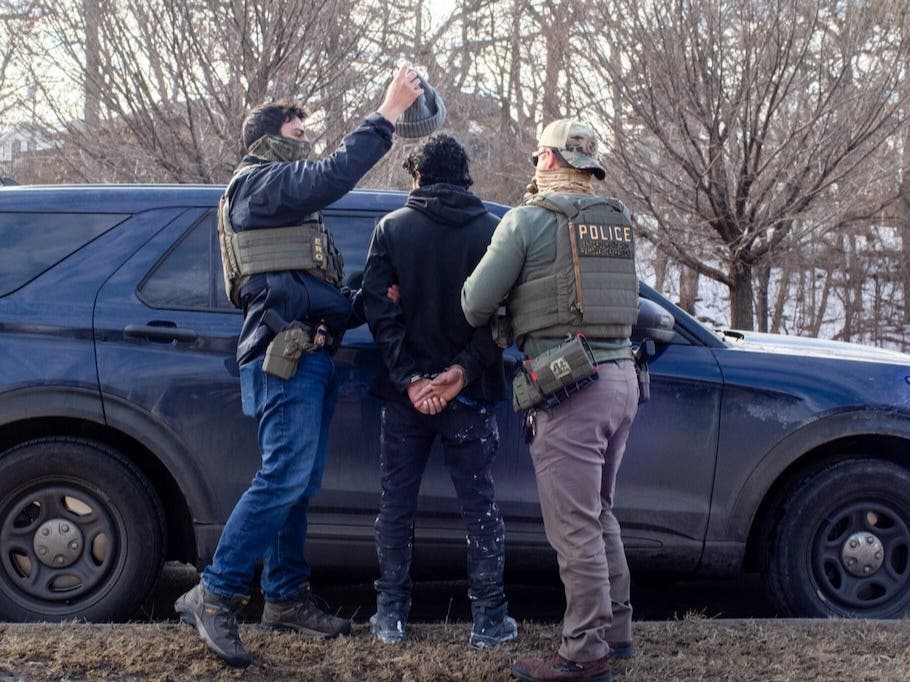
Collateral arrests result from street sweeps and raids; a person is singled out based on their appearance, or someone wanted on a warrant.

April 30, 2026
A quarter of immigration arrests since August were labeled by U.S. Immigration and Customs Enforcement as “collateral,” a type of arrest and detention that’s been challenged in court as an end run around civil rights.
Find out what's happening in Across Michiganfor free with the latest updates from Patch.
Public outrage and lawsuits over the arrests may be tamping down the large-scale sweeps that foster them, but tens of thousands were arrested this way between August and early March.
Immigration arrests are usually based on warrants obtained ahead of time, showing either a removal order from immigration court or evidence of a crime or charge that makes the person subject to deportation.
Find out what's happening in Across Michiganfor free with the latest updates from Patch.
But collateral arrests can result from street sweeps and raids in which a person is singled out for questioning based on appearance or proximity to someone wanted on a warrant. That person could be taken into custody if agents think they may be subject to deportation and also likely to flee if released.
Labeled for the first time ever, the collateral arrests are reported from August to early March in ICE arrest data obtained by the Deportation Data Project and analyzed by Stateline. In that time there were about 64,000 collateral arrests, a quarter of the 253,000 total arrests by ICE.
About 70% of the collateral arrests were for people with immigration-related crimes or violations alone, compared with 41% for arrests with warrants. Less than 2% of those with collateral arrests were convicted of a violent crime, one-third the rate of other arrests, and only 18% were convicted of any crime, compared with 33% for other arrests.
The collateral arrests contributed to an overall pattern of lower and lower shares of arrests for serious crimes, and more for immigration offenses alone.
Arrests climbed from about 12,000 in January 2025 to more than 40,000 in December, but fell back to 30,000 this February. The share of people with only immigration-related crimes and violations rose to more than half in December and January, the peak months for collateral arrests, and the share of violent criminals fell from 10% to 4% of arrests in that time.
ICE announced a new policy in January to issue warrants in real time if agents think an immigrant is deportable and “likely to escape,” though that policy faces a court challenge.
Total arrest and collateral arrests have been falling since December, whether because of the new policy or because of cutbacks in the large-scale street sweeps that tend to produce them.
One factor is public outrage over raids sweeping up noncriminals in places like Minneapolis and Chicago, said Colleen Putzel-Kavanaugh, an associate policy analyst for the nonpartisan Migration Policy Institute.
“The sort of large operations within big cities, as they were occurring, seems to have subsided somewhat,” Putzel-Kavanaugh said. “After the kind of public outcry following Minneapolis, it seems as though, at least for now, that tactic has kind of been paused.”
The Trump administration’s focus on mass deportation opened the way for more collateral street arrests with less investigation, she added.
“If it’s a more targeted arrest, they would take the time to sort of essentially have an investigation. It’s a pretty resource-intensive way that just would not yield the kind of numbers ICE was being told to produce,” she said.
The new policy was filed in court papers in February as a response to a lawsuit over ICE sweeps in the District of Columbia last year, alleging ICE agents “have flooded the streets of the nation’s capital, indiscriminately arresting without warrants and without probable cause District residents whom the agents perceive to be Latino.”
The case resulted in a preliminary injunction in December requiring a halt to warrantless arrests without establishing probable cause that the person is living here illegally and is a flight risk.
One plaintiff in the class-action case, José Escobar Molina, said in the lawsuit that agents in two cars pulled up to him as he approached his work truck on Aug. 21, grabbing him by the arms and legs and handcuffing him without asking any questions. Escobar, 47, said in the court papers that he’s lived in the district for 25 years and has had temporary protected status as a Salvadoran native the whole time. He was held overnight in Virginia before being released.
Other lawsuits are also challenging collateral arrests, such as an incident in Idaho in which agents with warrants for five people ended up arresting 105 immigrants at a Latino community event in October.
In North Carolina, four U.S. citizens and a visa holder sued in February, saying they were arrested in the Charlotte’s Web immigration crackdown in November without warrants, as is typical of collateral arrests.
“I have a lot of fear that this will happen to me again. I was essentially kidnapped based only on the color of my skin. That really weighs on me,” said Yoshi Cuenca Villamar, one of the citizens and a North Carolina native, in a statement announcing the lawsuit. He said he was doing landscaping work Nov. 15 when agents pushed him to the ground and handcuffed him, then held him in a car before releasing him.
One Illinois case that started in the first Trump administration challenged warrantless arrests and traffic stops used as a pretext for immigration arrests. A 2022 settlement required ICE to document “reasonable suspicion” of illegal status before arresting somebody. The case continues since a judge found in February that the new ICE policy of issuing warrants in real time after a detention violates the consent decree.
In the months since August where collateral arrests are now labeled, the District of Columbia and Illinois stand out with high shares of collateral arrests. More than half the arrests in the district were collateral, as were 41% of those in Illinois. There were eight states in which at least 30% of arrests were collateral: Alabama, Maryland, West Virginia, Arizona, Pennsylvania, New Hampshire, Maine and Minnesota.
West Virginia, where there was a “statewide surge” of immigration enforcement in January with state and local cooperation, stands out for its high rate of total arrests as well as a large share of collateral arrests.
For the eight months between August and early March, West Virginia had 1,831 arrests, or 1 in 10 of the state’s noncitizen population as of 2024, the latest data available. That’s by far the largest share in the country, followed by 7% in Wyoming (where truck drivers were targeted for immigration arrests in February) and 4% in Mississippi.
West Virginia Republican Gov. Patrick Morrisey, in a statement, cited the cooperation of state and local agencies with ICE through the 287(g) program that assists with immigration enforcement. He praised ICE, saying “they have removed dangerous illegal immigrants from our communities and made our state safer for families and law-abiding citizens.”
Few of those arrested in the surge were violent criminals, however. More than half of those arrested during the surge were collateral arrests, and only 1% — nine immigrants — had a violent crime conviction, according to the Stateline analysis. More than three-quarters, about 500 people, had only an immigration-related violation or crime.
Judges didn’t always agree that collateral arrests and detentions in the West Virginia surge were legal under the U.S. Constitution. U.S. District Judge Joseph Goodwin, a Clinton appointee, ordered two detainees released in January. He noted that “similar seizures and detentions are occurring frequently across the country” without any evidence they’re necessary as required by the Constitution.
The Michigan Advance, a hard-hitting, nonprofit news site, covers politics and policy across the state of Michigan through in-depth stories, blog posts, and social media updates, as well as top-notch progressive commentary. The Advance is part of States Newsroom, a national 501(c)(3) nonprofit supported by grants and a coalition of donors and readers.