Politics & Government
Lawyers For Man Killed By Grand Rapids Police Officer Raise Questions About Investigative Reports
"Everything about this case raises alarm bells," said Ben Crump, one of the lawyers representing Da'Quain's family.

March 26, 2026
Having reviewed a redacted copy of multiple documents of a Michigan State Police report into the fatal shooting of Da’Quain Johnson by a Grand Rapids police officer in February, the lawyers representing Johnson and his family say that the report “does nothing but open even more inquiries.”
Find out what's happening in Across Michiganfor free with the latest updates from Patch.
“Everything about this case raises alarm bells,” said Ben Crump, one of the lawyers representing Da’Quain’s family.
One notable detail in the reports, which were obtained after a Freedom of Information Act request, concerns the contents of the magazine that police claim was Johnson’s, a 9mm pistol recovered from the scene.
Find out what's happening in Across Michiganfor free with the latest updates from Patch.
In the original incident report created by Michigan State Police Detective Sergeant Dillard Hayes, the investigative officer in this case, included in the evidence collected is “One (1) Taurus G2C S/N: [REDACTED] two-tone tan and black 9mm pistol recovered from the ground in the SE corner of parking lot. The pistol was loaded with eight (8) rounds in the magazine and one (1) round chambered.”
Meanwhile, in the lab report coming out of the Grand Rapids Forensic Laboratory, the report states that included in the evidence received was “1 – 9mm Luger caliber, Taurus, model G2c, semiautomatic pistol, serial number [REDACTED], with an empty magazine.”
Asked why the magazine contents are different between the two documents, Spl/Lt. Pat Agema, the public information officer for the Michigan State Police’s Sixth District, which includes Grand Rapids, said that police unload firearms and magazines and store ammunition separately as a part of an investigation.
“It is standard procedure to secure a firearm by removing the magazine and unloading the weapon,” Agema wrote to the Michigan Advance. “In officer-involved shootings, a team of detectives is assigned to thoroughly investigate the scene.”
But Crump and Ven Johnson, the other lawyer for the family, said that in their opinion, it would not be standard procedure for transporting a firearm to a forensic lab for police to empty the magazine.
“If Mr. Crump and I move forward with the lawsuit, which at this point certainly looks likely, one of the many depositions that we’ll be taking in this case are the laboratory folks that analyze those,” Johnson said in an interview with the Advance. “I agree with Ben, something’s off here. I don’t get what they’re trying to do.”
But if the magazine had been removed, Johnson continued, “There is no way that happened here, by the way, zero, and if it did, I think Mr. Crump would agree, that’d be the biggest screw up of all time in investigation history.”
Since Da’Quain’s shooting on Feb. 18, his family and community members, as well as both lawyers for the family, have disputed a police narrative that he was reaching for a gun or pointing it towards the police officers when he was shot three times in the back.
Grand Rapids police released a limited amount of body camera and dashcam footage the day after the shooting, but bystander footage seemed to dispute whether or not he actually was reaching for a gun.
The questions generally center around where Da’Quain’s right arm was when he was shot — it’s not clearly visible in many of the videos, which one video review in the investigation states. His left arm, multiple video angles show, was in the mouth of a K-9 dog that was with the officers at the shooting.
Another interviewed witness, whose name is redacted, “later clarified that she believed the male’s left hand was behind his back but that his right arm was out of view.”
Now, the investigative report might offer some further insight into that question. A review of apartment complex parking lot video footage by the state police reads, “The K9 appears to latch onto his upper left arm as Ofc. [REDACTED] approaches with his pistol drawn. Daquain’s right elbow appears to flare outward consistent with pulling an object from his waistband area. Ofc. [REDACTED] then appears to step on Daquian’s right arm with his left foot.”
The Grand Rapids Police Department deferred answers to questions about the report to the Michigan State Police, and MSP declined to comment on this detail so as not to “compromise the integrity of the investigation.”
But Ven Johnson noted that, “if the gun’s not pointed, they’re not in imminent fear. They’re not in reasonable and imminent fear for their own life or safety of others, and they make the arrest, they take him to jail, and the process works.”
“If they had the pointing of a gun, we’d have seen it. We know it,” he continued. “And then you could say it’s justified, but that’s because they know if the gun is underneath him or in his hand, or both, but it’s not being pointed at anyone, then they can’t shoot him. It would be excessive force, and they just need to come out and admit it, and they won’t.”
Both lawyers also raised concerns about the level of redaction in the copies of the report that were released to the Michigan Advance.
“Why is it all redacted?” Johnson asked. “What are we hiding? Obviously, they have no problem listing my client’s name. Obviously, they have no problem listing what they believe my client’s previous record to be. They don’t have any problem listing much, except if it has to do with the officers involved.”
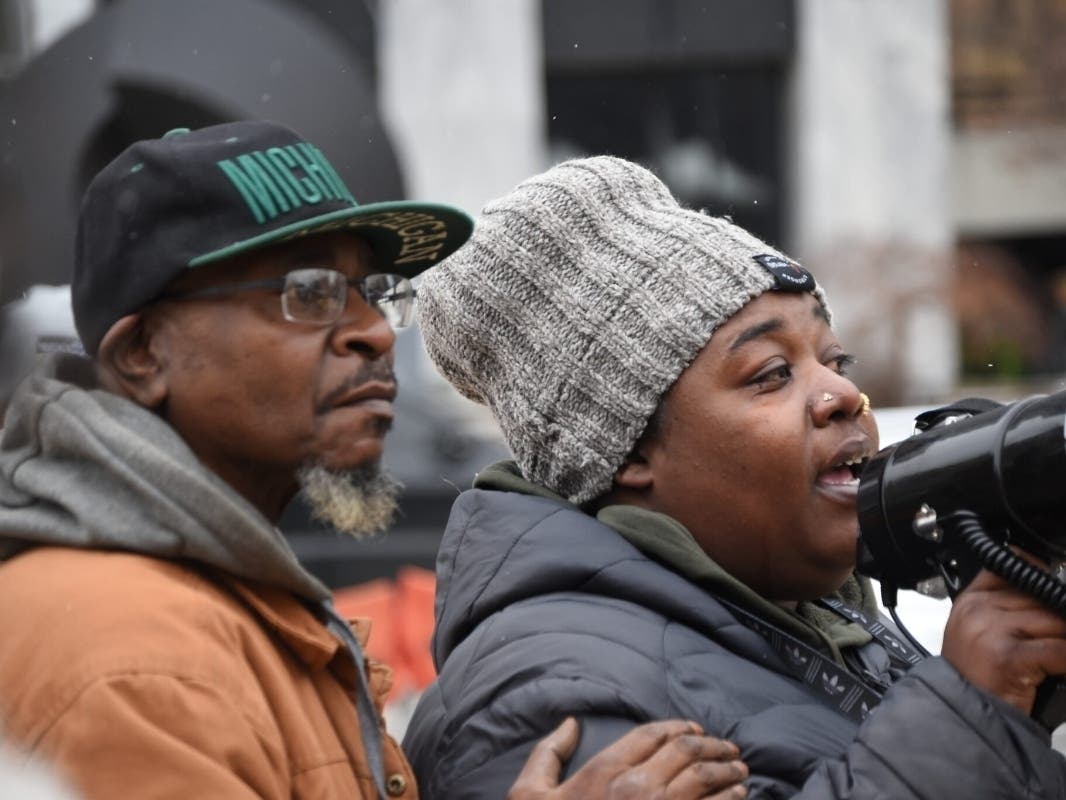
Included in the redactions are the names of the officers directly involved in the shooting, which have not been released despite calls from Angelica Johnson, Da’Quain’s mother, for transparency since his death.
“If they were proud of what they had done, they would own it,” Crump, who along with Johnson also represented the family of Patrick Lyoya, who was fatally shot by Grand Rapids police in 2022, said of the decision not to release the names of officers. “If they could justify what they have done, they would own it. If this was within policy of what they had done, they would own it.”
Johnson added that, going forward, the lawyers will seek out at least two former police chiefs or decorated officers to serve as experts, likely one from Michigan and one from elsewhere, as well as likely a third expert on K-9 tactics, to assist in their investigation into whether excessive force was used by the Grand Rapids police officers.
The final decision on whether to charge the officers involved in the case will be up to the Kent County Prosecutor, Christopher Becker.
“These investigations are complex, unbiased, and conducted with a thorough review of all the facts,” Agema said.
But the implications of this case — and the response to the results of the investigation — go beyond Grand Rapids, according to Crump, who has also represented the families of a number of victims of police killings, including Trayvon Martin, Michael Brown and Breonna Taylor.
“Everywhere in America, you see these extreme, excessive use of force videos that are being sanitized by investigating agencies,” he said. “And it’s troubling on so many levels, because what it leads many of us in our community to conclude is that these are just extrajudicial killings, because if the state is condoning it, then it is by inference giving permission to police to keep doing this, and certainly in Grand Rapids, it seems that they’re giving permission to the Grand Rapids Police Department to use excessive force and shoot black men in the back.”
The Michigan Advance, a hard-hitting, nonprofit news site, covers politics and policy across the state of Michigan through in-depth stories, blog posts, and social media updates, as well as top-notch progressive commentary. The Advance is part of States Newsroom, a national 501(c)(3) nonprofit supported by grants and a coalition of donors and readers.