Politics & Government
Michigan Senate Committee Hears Proposal To Lift State's Same-Sex Marriage Ban: ‘We Cannot Go Back'
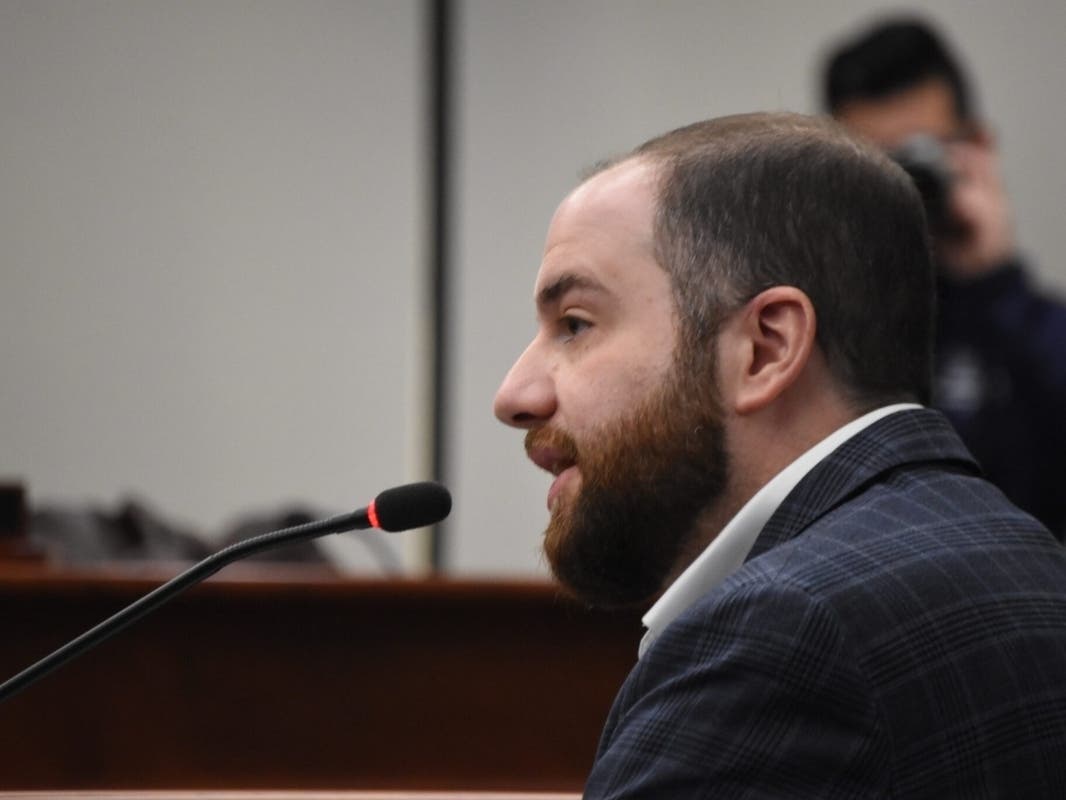
"Michigan's constitution exists to guarantee that every Michigan resident has the same opportunities and dignity," Kaplan said.

March 19, 2026
Lawyers and advocates overwhelmingly on Thursday urged members of the Michigan Senate Civil Rights, Judiciary and Public Safety Committee to pass a resolution that would put a constitutional amendment to overturn the state’s ban on same-sex marriage on the ballot.
Find out what's happening in Across Michiganfor free with the latest updates from Patch.
The resolution, introduced by Sen. Jeremy Moss (D-Bloomfield), would seek to repeal Section 25 of Article 1 of the state’s constitution, which strictly states “the union of one man and one woman in marriage shall be the only agreement recognized as a marriage or similar union for any purpose.”
That language was put on the ballot and approved by voters in 2004, and functions not just as a marriage ban but a civil union ban as well —meaning Michigan, along with Virginia, has one of the strictest marriage equality bans in the country, Moss explained.
Find out what's happening in Across Michiganfor free with the latest updates from Patch.
And while the state’s ban on same-sex marriage has been unenforceable since the June 2015 U.S. Supreme Court decision in Obergefell v. Hodges, which nationally legalized same-sex marriage, some current justices, especially conservatives Samuel Alito and Clarence Thomas, have expressed a desire to overturn that decision.
“If Obergefell is overturned, Michigan snaps back to the language in our state constitution banning same sex unions,” Moss said. “The Respect for Marriage Act requires Michigan to recognize existing marriages and those from other states, but no new same sex marriage licenses would be issued in the state of Michigan.”
“Article 1, Section 25 is an outdated, unpopular, unconstitutional and at the moment, unenforceable provision,” said Sam Bagenstos, a law professor at the University of Michigan.
Jay Kaplan, a staff attorney for the ACLU of Michigan’s LGBTQ+ project, explained that, if this ban were to go back into effect, impacts on same-sex couples in Michigan would be far-reaching — from health care and insurance to parental rights to rights in the case of one partner’s death.
He also explained that the national wave of legislative attacks on the LGBTQ+ community, which has disproportionately targeted transgender people — 740 anti-trans bills have been introduced nationwide in 2026, according to the Trans Legislation Tracker — is part of a larger move to attack the rights of all LGBTQ+ people in the United States.
“These attacks are part of a trajectory, to attack transgender people first and then move on to gay and lesbian people to strip them of the right to marry and those benefits and protections of marriage,” he explained.
And on top of legislative attacks on the LGBTQ+ community, attempts from conservative lawyers and activists to get marriage equality back to the U.S. Supreme Court are becoming more prevalent — though the nation’s top court declined to take up a case out of Kentucky at the end of 2025, other efforts are making their way through the federal courts.
“It doesn’t matter that these efforts are taking place largely outside of Michigan. If they succeed and the Supreme Court overturns Obergefell, our state’s constitution and its provision discriminating against gay and lesbian couples will spring back into place,” Bagenstos said. “If Obergefell goes, Article 1, Section 25 returns automatically, and it will return even though the polls show that Michiganders would not vote for that provision today. That’s why it’s especially important that the Legislature adopt this joint resolution.”
Those testifying emphasized the popular support for same-sex marriage in Michigan and nationwide — in 2025, a Gallup poll indicated 68% of respondents were in favor of same sex marriage, and only 29% against, Moss said.
“Michigan’s constitution exists to protect everyone, to guarantee that every Michigan resident has the same opportunities and dignity,” Kaplan said. “Michigan’s marriage amendment is a stain on that promise. It singles out LGBTQ people for discriminatory treatment.”
The resolution would need two-thirds support in both chambers of the Legislature to make it to the ballot. Thus far, top Republicans have not indicated whether or not they would support the resolution if it comes to a vote.
Sen. Jim Runestad (R-White Lake Township) questioned the decision by Moss to include an amendment to Article X, Section 1 to remove gendered language from statutes around the financial and legal status of married women, and seemed to potentially indicate his opposition to the resolution at large.
“You’ve conflated these two in your resolution, a different constitutional amendment with this dowry amendment, and why did you put those together in the resolution?” Runestad asked Moss, seeming to indicate his support for changing the language in Article X. “The other one I have issues with. I don’t want to get into all that. But it’s just a shame that we can’t clean up this dowry issue, which completely makes no sense at all.”
Neither Runestad nor Sen. Ruth Johnson (R-Groveland Township), the two Republicans on the committee, expressed any other concrete stances on the resolution, but Moss told reporters after the hearing that he believed Runestad’s comments might indicate an openness to the resolution.
“It actually signaled that he did view this marriage ban as archaic,” he said. “So I would love to hear the members of the minority party on the committee, what their take is on this resolution. We’ll find out when there’s a vote.”
But despite the high threshold required to put this measure on the ballot through the Legislature, Emily Barr, an election law attorney in Michigan, said in support of the resolution, expressed support for that route compared to a citizen-initiated ballot proposal, which she says “can run out of steam, even when everybody in the state wants to see this done.”

Sen. Jim Runestad (R-White Lake Township) questioned Sen. Jeremy Moss (D-Bloomfield) on his resolution to put language lifting Michigan’s same-sex marriage ban on the ballot. March 19, 2026. | Photo by Katherine Dailey/Michigan Advance.
“It’s not as if Michigan taking this step would be stepping out in front of where progress really is. This is in keeping with the times. This is in removing an outdated, unnecessary provision from Michigan’s constitution, and it conforms to federal law,” Barr said. “Taking the legislative route still gives voters the choice. It’s not like you’re taking a voice away from voters in the state of Michigan. This still gives them the choice, but it just doesn’t put this unnecessary burden on them to go through all of this process, when the legislature can do it.”
The impact on the LGBTQ+ community in Michigan was clear throughout the hearing.
“I was 18 years old in 2004,” Moss said. “Those 11 years robbed me and people like me of possibilities for our futures. We cannot go back to that dark era.”
Corrine Rockoff, chair of the Ruth Ellis Center in Highland Park, who has been married to her wife since 2020, said that she believed the change would simply bring Michigan “up to speed with reality.”
“It’s the only thing that makes sense in modern Michigan to make sure that our constitution for the state reflects that and reflects where we are already,” she added.
April DeBoer, who, along with her wife Jayne, was a part of the case that became Obergefell, said that they don’t want to go back to being “second-class citizens.”
“Our marriage, in the last 10 years, has not affected anybody but us. It has done no harm to anybody,” she said. “It’s a legal contract between two consenting adults that state they want to be together and, in our case, raise a family together. I don’t know how that harms anybody in the state of Michigan.”
The Michigan Advance, a hard-hitting, nonprofit news site, covers politics and policy across the state of Michigan through in-depth stories, blog posts, and social media updates, as well as top-notch progressive commentary. The Advance is part of States Newsroom, a national 501(c)(3) nonprofit supported by grants and a coalition of donors and readers.