Politics & Government
New House Committee To Examine Signature Verification Sampling Process For Ballot Initiatives
A new select committee in the Michigan House was established to examine the rules and procedures of the Board of State Canvassers.

August 27, 2026
A new select committee in the Michigan House was established on Wednesday to examine the rules and procedures of the Board of State Canvassers and the Bureau of Elections — specifically the sampling process used to verify signatures for ballot initiatives.
Find out what's happening in Across Michiganfor free with the latest updates from Patch.
Michigan House Speaker Matt Hall (R-Richland Township) introduced a resolution to establish the committee, which passed along party lines. The vote came two days after the Board of State Canvassers deadlocked on a vote on whether to approve a ballot petition to establish strict voter ID laws in the state — meaning the measure will not be on the November ballot.
The decision was made on the margin of just a handful of votes. Based on the more than 709,000 signatures submitted, compared with the required 446,198, at least 629 signatures in the 1,000-signature sample needed to be valid.
Find out what's happening in Across Michiganfor free with the latest updates from Patch.
After reviewing information provided by lawyers both in favor and opposed to the proposal, and voting on a number of individual signatures, the four-member Board of State Canvassers had identified 626 valid signatures — just three signatures below the needed threshold. A number of those decisions were contentious, many ending in a 2-2 vote — meaning that those signatures did not count towards the needed 629.
That decision is likely to hold for the November ballot, unless an appeal filed Thursday with the Michigan Supreme Court were to prevail. The appeal was made by Americans for Citizens Voting, which backed the measure. Because the Bureau of Elections also does not have the power to overturn the decision of the Board of State Canvassers, only a court order could put the initiative on the ballot.
However, with absentee ballots for the general election becoming available starting Sept. 24 and Michigan law requiring that the ballot must be finalized by Sept. 4, the committee — which is “expected to begin its work in the coming weeks,” according to press releases from various Republican members — will likely not have time to change the outcome for this proposal on the 2026 ballot.
“We can’t let this stand. What Jocelyn Benson has done here to disenfranchise the voice of hundreds of thousands of people who signed this petition for very political reasons. It’s just a disgrace what’s happened, and I hope you get to the bottom of it,” Hall said in a press conference on Wednesday evening, referencing state Rep. Mike Harris (R-Waterford Township), who will chair the committee.
Harris said the goal of the committee will be ensuring that the rules of signature verification were followed and appropriate, and that people’s voices are heard.
“I think we owe it to the people of Michigan to accomplish that,” Harris said. “We have almost 700,000 people that I feel have been disenfranchised by this decision to deny this ballot initiative, and I think it’s important we get them answers on what that process actually is and what it looks like.”
Michigan has used a form of a sampling process for signature verification since 1980, though that process has changed over time. It was reviewed in 1990 and again in 2022, after which it was updated.
“The Bureau of Elections fulfills its nonpartisan administrative and advisory role to the Board of State Canvassers in accordance with Michigan law,” Angela Benander, a spokesperson for the Michigan Department of State, said in a statement. “Legislators who are unsatisfied with the current longstanding process have the power to propose bills to change the law.”
The sampling process allows the Bureau of Elections and Board of State Canvassers to determine whether enough signatures are valid without examining every signature individually, since petitions generally contain hundreds of thousands of signatures.
“Practically speaking, the board’s view for decades is that it’s not really practical to review, in this case, over 700,000 signatures individually,” Jonathan Brater, director of the Bureau of Elections, explained about the sampling process during Monday’s meeting of the Board of State Canvassers.
In 2024, a package of bills introduced by Democrats passed both chambers of the Legislature but were vetoed by Gov. Gretchen Whitmer; the bills would have amended Michigan’s election law to allow the Board of State Canvassers to use a statistical random sampling methodology when reviewing petition signatures for authenticity, among other changes to the petition filing and review process.
Those bills stemmed from a lack of statutory guidance for the Board of State Canvassers when reviewing petitions from five gubernatorial candidates, who were disqualified over signature fraud, and sought to codify the recommendations from a working group on the process.
However, Whitmer said in her veto letter that the bills’ effort to utilize statistical sampling “move Michigan in the wrong direction” as opposed to “requiring exhaustive review of signatures to ensure no fraud exists.”
Currently, according to Michigan Department of State guidance, “the selection of random signatures is completed utilizing a custom-designed computer program.” After that selection takes place, “sampled sheets are face reviewed for validity, then signatures on valid sheets are compared to the Qualified Voter File.”
Along with Harris, four other Republicans will be members of the committee — Majority Floor Leader Bryan Posthumus (R-Rockford) will serve as the majority vice chair of the committee, alongside Reps. Ann Bollin (R-Brighton), Rachelle Smit (R-Martin) and Jason Woolford (R-Howell).
In a press release about his placement on the committee, Posthumus emphasized that members of the Board of State Canvassers or Bureau of Elections “don’t have to like the proposal to agree that 709,841 signatures deserve a serious look.”
“This is a lot bigger than a spreadsheet or a sample of signatures. More than 700,000 Michiganders signed their names, and they deserve a straight answer about what happened,” he said. “Maybe everything was done exactly right. I want to see the process, see the numbers, and let the facts speak for themselves.”
Two Democrats will also be on the committee: Rep. Denise Mentzer (D-Mount Clemens) was named minority vice chair, and Rep. Mai Xiong (D-Warren) will also serve as a member.

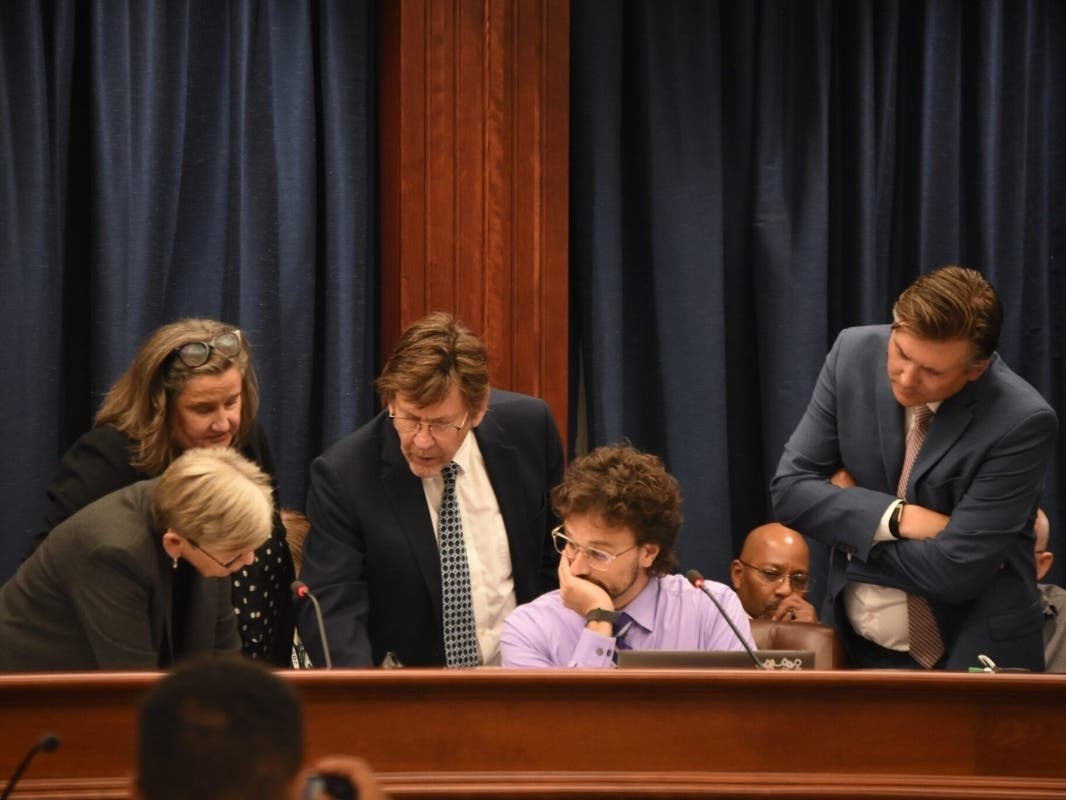
Sean Dutton, a lawyer supporting the citizens-only voting ballot petition, provides information to Jonathan Brater, the director of the Bureau of Elections, at a Board of State Canvassers meeting on Aug. 24, 2026. (Photo by Katherine Dailey/Michigan Advance)
“My goal is for this committee to provide the public with a clear and accurate understanding of the signature verification process. The discussion is not simply about the total number of signatures submitted, but also about their validity. What I question is why they’re only raising these concerns now,” Mentzer said in a statement to the Michigan Advance. “I have a long track record of working across the aisle, and I intend to approach this committee in the same spirit. Michiganders deserve a transparent, consistent, and fair process.”
Hall also indicated his belief that partisan bias played a role in the board’s decision not to put the petition on the ballot.
“They’re rejecting other proposals over the years, and they seem to be only one-sided,” he said. “Whenever a Republican-affiliated group submits something on the ballot, it takes months and months and months to review it, and then they always figure out a way to disqualify it. If it’s a Democrat group, they review it much quicker, and they always find a way to approve it, even if it’s suspect.”
Some of that sentiment came out of the approval for the Michiganders for Money Out of Politics proposal, which did pass through the signature verification process in July.
Benander rejected this idea and emphasized that the Bureau of Elections is nonpartisan and follows the same process for every petition.
“The final determination is made by the Board of State Canvassers, which is comprised of two Republicans and two Democrats,” she wrote. “The ACV petition got the exact same treatment as MMOP. While the outcome was different, the signature sampling and verification rules were the same. The Board of State Canvassers uses the same standards to verify the validity of signatures as clerks do when they verify signatures on ballots.”
The Michigan Advance, a hard-hitting, nonprofit news site, covers politics and policy across the state of Michigan through in-depth stories, blog posts, and social media updates, as well as top-notch progressive commentary. The Advance is part of States Newsroom, a national 501(c)(3) nonprofit supported by grants and a coalition of donors and readers.