Politics & Government
State Of The Race: Democrats Line Up Behind Benson, Republicans Face Off In Brutal Two-Way Primary
Starting with a relatively crowded field, the race is down to two: U.S. Rep. John James (R-Shelby Township) and businessman Perry Johnson.

July 29, 2026
The race to replace term-limited Gov. Gretchen Whitmer as Michigan’s next governor has heated up on the Republican side, but stayed cool for the Democrats.
Find out what's happening in Across Michiganfor free with the latest updates from Patch.
The Republicans
Having started with a relatively crowded field — six candidates filed with the Michigan Bureau of Elections in the Republican primary — the race is down to two: U.S. Rep. John James (R-Shelby Township) and businessman Perry Johnson.
Find out what's happening in Across Michiganfor free with the latest updates from Patch.
James and Johnson have been throwing campaign barbs and attacks at each other since Johnson entered the race at the start of 2026 — including a lawsuit Johnson filed in April that forced James to alter his campaign logo, as well as signature challenges traded between the two campaigns after the candidate filing deadline.
Those attacks have only escalated as the primary approaches. Johnson has criticized James for taking campaign donations from both utility companies and data center developers, and has called him a liberal, tying him to U.S. Rep. Hillary Scholten (D-Grand Rapids).
Meanwhile, a James-aligned PAC launched a website on Monday highlighting Johnson’s weaknesses, from his failed presidential campaign in 2024 to his 1998 divorce filings.
The core policies of James’ and Johnson’s campaigns largely align — lowering taxes, shrinking state government and supporting Trump’s agenda, as well as limiting data center development.
How exactly to achieve those plans is where they differ. Johnson has proposed totally eliminating the state income tax, while James has proposed a 20% to 25% income tax cut based on slashing the state budget. And Johnson has proposed an overall one-year data center moratorium, while James has focused his messaging on local control over data center development.

John James (left) and Perry Johnson (right) delivering their gubernatorial petition signatures to the Board of Elections in Lansing. | Photos by Katherine Dailey/Michigan Advance
Johnson is almost entirely self-funding his campaign, having put nearly $30 million of his own money into the race, which he argues will make him less beholden to corporate interests should he be elected.
Johnson brought in $30.8 million since Jan. 1 and spent $29.6 million, leaving him with just over $1 million cash on hand, according to campaign finance filings. He also has around $38.1 million in campaign debts.
James’ financing is far more modest — he brought in $3.1 million in the period starting Jan. 1, and spent $4.2 million. That leaves him with a similar cash on hand balance — around $1.4 million. Mission Michigan, the super PAC backing James, brought in $2.2 million and spent $3.9 million, meaning both spent more than they raised during the reporting period.
Of those who have dropped out of the race, two will remain on the ballot. Former Michigan Attorney General Mike Cox and Senate Minority Leader Aric Nesbitt both suspended their campaigns after the withdrawal deadline from the ballot. Former Michigan House Speaker Tom Leonard dropped out of the race prior to the withdrawal deadline, while pastor Ralph Rebandt did not submit enough valid signatures to make the ballot, so neither of their names will appear.
President Donald Trump has also been a constant presence in the race. Trump endorsed James in late June, but that has not stopped Johnson from tying himself to the president — even in ways that have gotten him in hot water with Trump’s team.
That came to a head in advance of Trump’s visit to Michigan on Monday — speaking alongside James at a Milford rally held around 10 minutes away from where Johnson and his supporters were gathered for a “Trump Tailgate,” branding that led to Trump’s official campaign X account calling him a “NEVER TRUMPER who ran against @realDonaldTrump in the 2024 election.”
Both Cox and Nesbitt cited Trump’s endorsement of James in their decision to drop out of the race — Nesbitt suspended his campaign and endorsed James just hours after Trump announced his endorsement, while Cox said in his announcement that Trump had “ordained his primary victory” for James.
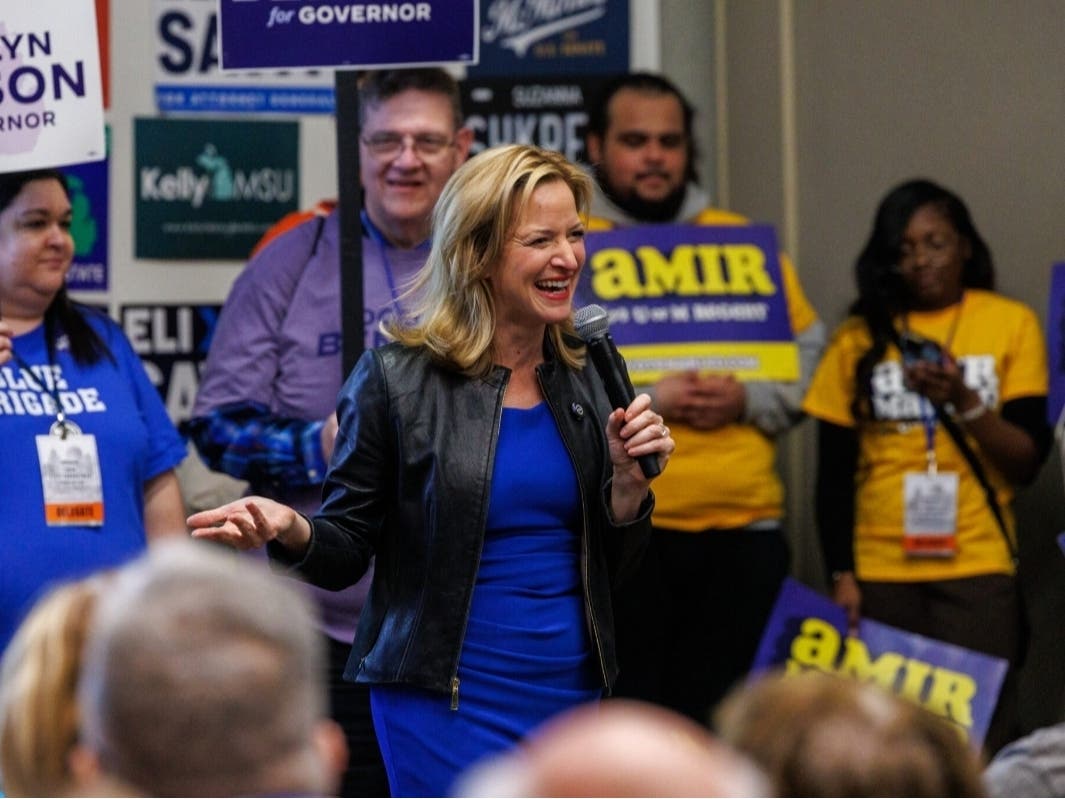
On the Democratic side of the race, members of the party establishment have largely aligned behind Secretary of State Jocelyn Benson, though she faces a primary challenger in Genesee County Sheriff Chris Swanson.
Most recent polling shows Benson with a commanding lead — polling from earlier in July gave her a 60-point margin over Swanson.
Swanson’s main backing comes from labor unions, where he has racked up endorsements from a number of key groups, including the nationwide Teamsters and statewide IBEW and Iron Workers Local 25 unions. But he has struggled to gain traction in both fundraising and polling.
During the reporting period beginning Jan. 1, he raised just over $722,000 and spent around $806,000, leaving him with about $187,000 in cash on hand.

Genesee County Sheriff Chris Swanson announces that he is seeking the Democratic nomination for governor during a rally in Flint, Mich., on Feb. 6, 2025. (Photo by Andrew Roth/Michigan Advance)
Benson, on the other hand, raised $4.9 million and spent $2.1 million, and has over $6.4 million in cash on hand heading into the general election.
Both candidates have centered their platforms around affordability in Michigan, including lowering utility costs, as well as improving educational outcomes in the state.
And while the Republicans have spent months attacking each other, the Democrats have not — Swanson has described Benson as “an option, not an opponent” in the primary, while Benson has largely not mentioned Swanson in her campaign stops.
Benson has, however, faced criticism from both Republicans and progressive Democrats for her family’s ties to data center developers — specifically, the fact that her husband, Ryan Friedrichs, works for Related Companies, a subsidiary of which is developing a large data center in Saline Township.
Related Companies has repeatedly denied that Friedrichs has made money off of the Saline Township data center, and Natalie Ravitz, Executive Vice President of Corporate Communications at Related Companies, told Michigan Advance that as of February, Friedrichs is in a role where he is “no longer working on any of Related’s projects in Michigan.”
Despite that, Johnson used that tie in an attack ad against Benson in March, and he has raised the issue repeatedly since then at press events. But the development of data centers — which Benson has proposed putting guardrails in place to limit — is also unpopular among progressives in her own party, making her family’s ties even more politically fraught.
A poll released on Tuesday by the Michigan Education Association and Business Leaders of Michigan shows both Benson and Swanson up over both James and Johnson in a series of hypothetical general election scenarios — though Benson’s margins are much higher.
The general election was initially expected to be a three-way race, with former Detroit Mayor Mike Duggan running as an independent, but he dropped out in May. Though he had been pulling support from both Democrats and Republicans, some had been concerned about him playing spoiler for the Democrats in a general election, given the fact that Duggan was a Democrat for all 12 years in the Detroit mayor’s office.
But with Duggan no longer in the picture, the two parties are entering next Tuesday’s primary on very different footing, racing toward a gubernatorial election that will decide what direction Michigan takes in the latter half of the 2020s.
The Michigan Advance, a hard-hitting, nonprofit news site, covers politics and policy across the state of Michigan through in-depth stories, blog posts, and social media updates, as well as top-notch progressive commentary. The Advance is part of States Newsroom, a national 501(c)(3) nonprofit supported by grants and a coalition of donors and readers.