March 31, 2026
Ann Arbor’s annual rally highlighting cannabis-focused activism will be back for its 55th year in early April, but organizers of Hash Bash said it will look and feel different than it has in years past, having dealt with multiple threats to its operating permit this year and a potentially heavy law enforcement presence from the university that has hosted the event for decades.
Find out what's happening in Across Michiganfor free with the latest updates from Patch.
Hash Bash, set for April 4 at the University of Michigan Diag, will be operating this year without the popular yet unaffiliated adjacent Monroe Street Fair, which typically draws patrons to Hash Bash with art and other craft vendors. The festival itself was not permitted for additional vendors at the Diag, shifting the event to a more bare-bones vibe.
There will also be an increased law enforcement presence from the university’s public safety arm, which has sounded warnings that it will issue citations if it catches attendees consuming, distributing or selling marijuana on campus. In a statement issued weeks after the 2026 event was approved, public safety officials at the university said that cannabis’ status as an illegal drug at the federal level means it cannot be consumed on campus grounds. Additionally, U of M Public Safety warned rally goers that it would issue citations or make arrests for any “disorderly conduct, traffic obstructions, or other criminal offenses.”
Find out what's happening in Across Michiganfor free with the latest updates from Patch.
That warning in particular has led at least one of the rally’s organizers to be concerned for Hash Bash’s attendees generally, given that law enforcement from the city of Ann Arbor or the university itself typically looked the other way as cannabis-addled merriment took over the Diag in past iterations. That was especially true after medical marijuana was legalized statewide in 2009, and when recreational use and sales were implemented in 2020.
As of last week, concerns for the rally even happening this year grew when the university imposed changes to its insurance requirement, but organizers were able to negotiate with the university and secure the necessary insurance. If that hadn’t been the case, the university threatened to cite or arrest rally-goers who were not registered students as potential trespassers, further raising the potential for law enforcement clashes with Hash Bash attendees.
In an interview with Michigan Advance, organizer Josey Scoggin also said she was concerned for attendees if the focus of the day turned from the usual pro-cannabis activism to any sort of impromptu anti-war demonstrations, which would fit Hash Bash’s decades-long reputation as a counterculture venue for progressive political thought.

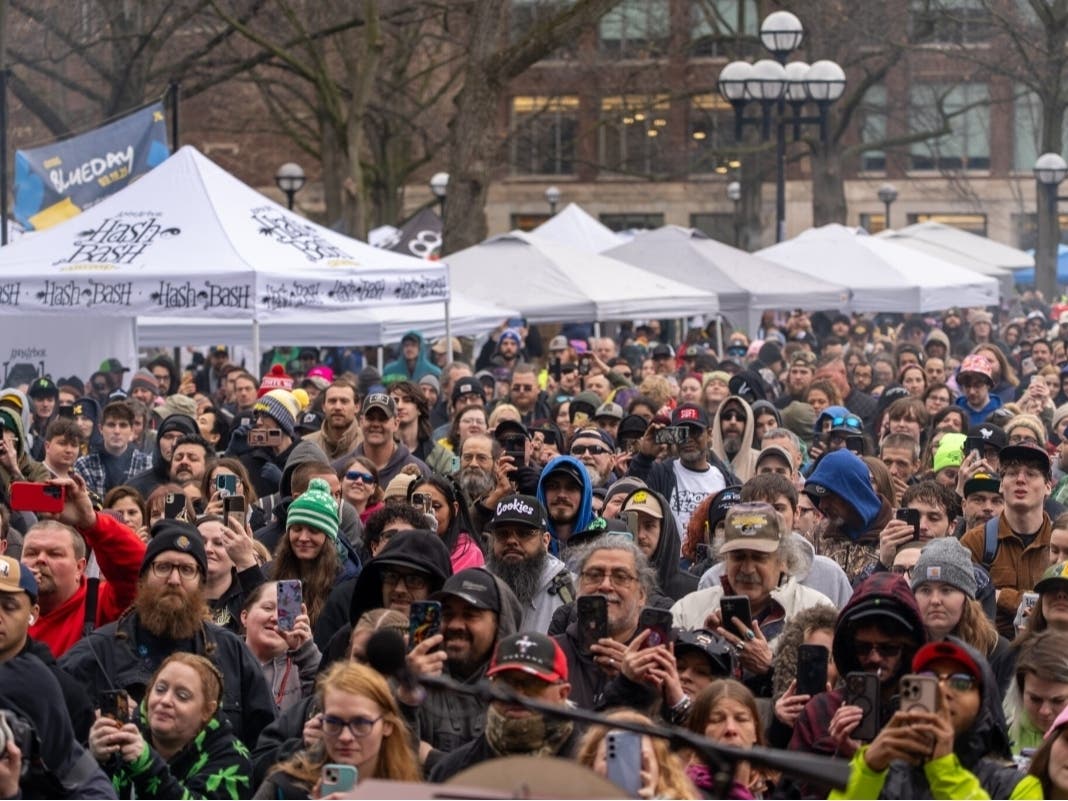
2025 Hash Bash on The Diag at the University of Michigan in Ann Arbor. | Photo courtesy of Isaac Cooper/The Gas Station
Organizers alarmed by shift from past enforcement norms
Scoggin’s concern was tied to how the university handled the controversial pro-Palestine protests in 2024, and the student disciplinary procedures that followed, the fairness of which have been widely questioned by students, advocates and others.
“I’m approaching this in a completely different way,” Scoggin said. “They arrested a couple of folks in 2018, but in the city of Ann Arbor, not necessarily the Diag. I’ve been here for over 10 years, and they have never said that before.”
The university approved the events permits in early March, but there was some trepidation over the approval, considering that the university had last year denied a permit for a psychedelic mushroom festival on campus. The Michigan Court of Claims intervened and in 2025 ruled that the university must allow what has come to be known as “Entheofest” to take place on the Diag.
Weeks after the Hash Bash event was approved, Scoggin said university public safety officials called organizers to an urgent meeting to discuss safety protocol. Scoggin said organizers asked if officials planned to crack down on the event, with security details checking bags, issuing tickets or making arrests.
The university denied that it would issue citations or make arrests, but it had asked organizers to put up no smoking signs and reiterated that it would enforce the no vending rules.
That changed, Scoggin said, when the U of M Police Department on March 20 issued a statement that signaled a much heavier enforcement regime than what was initially relayed to event organizers.
“While marijuana is legal under Michigan state law for individuals 21 years of age and older, it remains a federally controlled substance and may not be used or possessed anywhere on University of Michigan property, including university buildings and outdoor spaces governed by university policy,” the statement said.
University police went on to say that “violations related to unlawful sales or distribution, unpermitted events, public consumption in restricted areas, disorderly conduct, traffic obstruction, or other criminal offenses may result in citations or arrest.”
Although the event was granted a permit in early March, the university last week imposed another hurdle: an unreasonably high insurance policy demand.
Writing on the Hash Bash World blog, which serves as a main communications outlet for the event, Scoggin wrote on Saturday, March 28, that the university requested a $3 million liability insurance policy and an additional $5 million aggregate policy. The university also gave organizers a little over a week to have that secured before April 4.
There were reports that indicated the event was cancelled or that Hash Bash would be operating without a permit this year, but Scoggin quickly put those fears to bed.
Within a few days, organizers were able to work out a deal where they only had to carry $1 million in liability insurance with a $2 million aggregate policy. Scoggin wrote that the insurance cost came to over just $2 million, and that they were able to get it done.
Scoggin worried that the university might have charged rally-goers with trespassing had they not secured the insurance and if the permit had been revoked.

2025 Hash Bash on The Diag at the University of Michigan in Ann Arbor. | Photo courtesy of Isaac Cooper/The Gas Station
Crackdown fears tied to past Gaza protest response
The turn in the university’s stance was troubling, Scoggin said, considering the fact that she and other organizers had unwavering support from local area groups who helped make the case to the university about the importance of Hash Bash as a cultural destination event for the city of Ann Arbor. Organizers also made tight inroads with Ann Arbor police, the Washtenaw County Sheriff’s Office and the city.
University police declined to be interviewed for this story. Deputy Police Chief Melissa Overton, who also serves as the department’s public information officer, did respond to questions sent via email.
The Advance asked Overton if the university was indeed planning to arrest people for publicly consuming marijuana on campus that weekend. The Advance cited the growing fear that the university was planning to take steps that were more forceful than state law, and ones that bucked the precedent of more recent Hash Bash events.
Overton did not answer the question directly, but rather cited U of M’s authority under state law to issue civil infractions. She also noted that state law prohibits smoking in a public place or on employer properties, which can restrict or prohibit smoking.
Scoggin surmised that the university may have been under pressure to start clamping down on anything resembling a student protest considering that the administration of President Donald Trump has made sweeping threats to public universities that received federal funding if they allow student protests with a focus on foreign affairs — namely, Israel’s war with Hamas.
Hash Bash is a kind of ongoing student and community protest event that has been heavily associated with the anti-war movement as much as it has been with the pro-cannabis movement.
At last year’s Hash Bash, a platform was given to an individual who drew attention to Israel’s war with Hamas in Gaza, which a United Nations independent commission has labeled as a genocide, as has Amnesty International.
That may have drawn Hash Bash into further scrutiny, considering that the university clamped down on the 2024 pro-Palestine encampment at the Diag.
Scoggin said some of her fellow organizers are less concerned than she was about a potential crackdown, given that there hasn’t been a major clash between attendees and university police since the 1990s.
But Scoggin said being the younger of the event’s organizers gives her a different perspective on Hash Bash’s more radical past and boundless expressions of free speech. It also gives her pause if the event does turn into an impromptu anti-genocide or anti-Iran war demonstration.
“This isn’t about kids smoking weed at the Diag,” she said. “It’s about these kids being able to say f**k that genocide, f**k the president or f**k the king when that happens in five years. … They classified these students as antisemitic and I just don’t understand. I went to some of these rallies. They weren’t anti-Israel and it surely wasn’t pro-Hamas.”
The Advance asked Overton if the university plans to employ the same type of law enforcement tactics it did in 2024 against the campus’ pro-Palestine movement, again citing the fear that things could get ugly on its end.
Overton said the University of Michigan Police Department does not base its response on the subject matter or viewpoint of a protest or gathering.
“Our approach is guided by ensuring public safety, supporting lawful free expression, and enforcing applicable laws and university policies,” she said. “Each situation is assessed individually based on the specific circumstances at the time, including factors such as safety risks, crowd size, behavior, and compliance with the law. Our goal is always to facilitate a safe environment for all members of the community while respecting individuals’ rights to assemble and express their views.”
Overton went on to say that the university works closely with its partners and local law enforcement to plan for “a range of scenarios and to respond in a manner that is measured, appropriate, and focused on safety.”
Scoggin said she was actively seeking advice on how to handle the situation if the university does indeed crack down in a similar fashion, and was working with partners to build a legal defense fund. While she still has hope that it won’t come to that, Scoggin said she needs to be ready.
”That’s what I mean when I say that I don’t think we can separate Palestine from this, because I think they went so overboard with Palestine, they have to do the same thing to us,” Scoggin said. “I don’t think they’re gonna tear gas us, but I mean, what if they do?”
The Michigan Advance, a hard-hitting, nonprofit news site, covers politics and policy across the state of Michigan through in-depth stories, blog posts, and social media updates, as well as top-notch progressive commentary. The Advance is part of States Newsroom, a national 501(c)(3) nonprofit supported by grants and a coalition of donors and readers.