Health & Fitness
How to Survive a Traffic Circle
Three helpful tips on surviving a traffic cicle. Drive safe. Drive in circles.
When traffic circles first came to the U.S. from Europe, drivers and pedestrians in the Great Lakes State were spared. Traffic circles showed up on the East Coast and the West Coast where people don’t really care about their cars, or how they’re driving, or the effect knocking off a few pedestrians or bicyclists might have on the paint job. Here in the shadow of the Motor City we love our cars and we love that we love our cars and I think it’s fair to say that we resent traffic laws because, let’s face it, we invented driving; we don’t need traffic laws telling us what we can and can’t do behind the wheel. We know on instinct.
Nevertheless, these Turn Styles of Terror have come our way and our fair, well shouldered, yet heavily pot-holed streets have been forever changed; along with the way we drive.
Find out what's happening in Brightonfor free with the latest updates from Patch.
We resented the change and even though we’ve lived with these Circles of Death for a couple years now the resentment has not abated. These Roundabouts of Rage may be foreign to every driving instinct we hold dear, but like it, or not, they are here to stay and we have to learn to live with them. Thanks to MDOT we have a way.
I came across this helpful article from the Michigan Department of Transportation that should answer all of our questions and get traffic moving in a safe, friendly, and community building manner. There’s a lot of boring technical mumbo jumbo so I’ll cut to the highlights.
Find out what's happening in Brightonfor free with the latest updates from Patch.
- “With the use of yield signs Instead of stop signs or traffic signals, vehicles are able to enter the roundabout when there are adequate gaps in the traffic flow.” Adequate gaps? What are we calling an adequate gap these days because I’m not convinced that everyone is using the same standard for ‘adequate gap.’ Let me put it this way; if I can make out the fear on your face when you pull out in front of me, it’s not an adequate gap.
- “Modern Roundabouts create a safer environment for pedestrians and bicyclists than signalized intersections. At a signalized intersection, pedestrians/bicyclists must be aware of turning vehicles and vehicles running the red.” Because, of course, no one is turning on a Roundabout and while drivers have no fear of running a red light they’ll think twice before zipping past a yield sign.
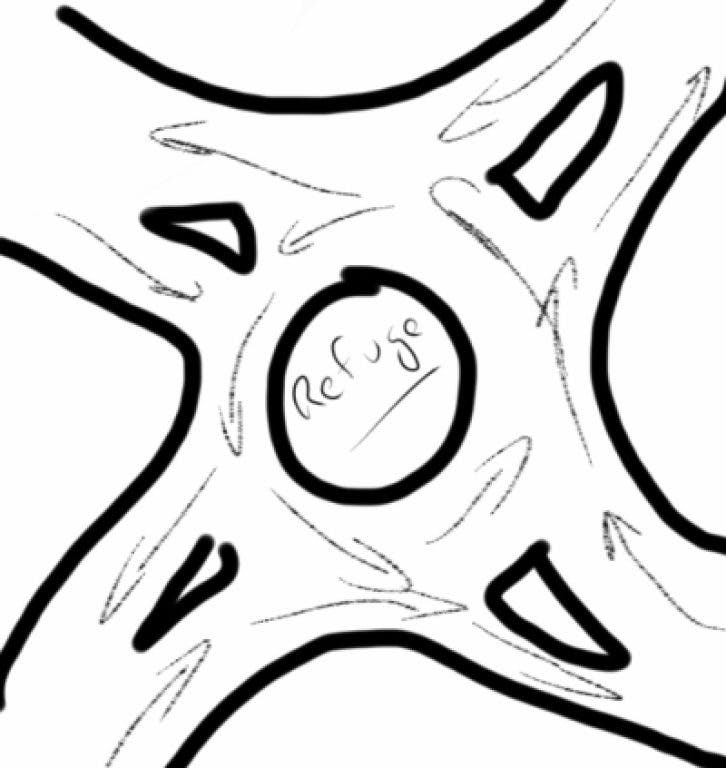
- What about pedestrians? “The splitter island in the middle creates a ‘refuge’ for pedestrians before they begin to cross the other direction of traffic.” I wonder why they put quotes around refuge.
- What about trucks? “Trucks require more room to turn and may use the mountable truck apron, the raised pavement around the centralized island, for additional space.”
I think I just figured out why they put refuge in quotes. If you happen to be driving a large truck in a Roundabout and you hear screaming, don’t worry, it’s just the pedestrians taking ‘refuge’ on the centralized island you’re driving over.
Michiganders, we can do this. No matter how many times we have to make a left from the right lane, or stop in the middle for lack of an ‘adequate gap,’ or drive to the next exit ramp on US-23 because the Roundabout signs look like primitive wiring schematics, we can do this.
Drive safe. Drive in circles.