I find is so disheartening how far removed most individuals are from the earth, especially the younger generation that have a tech-savvy background; young adults that know how to maneuver our new fangled smart phones and other time-saving gadgets.
I picked up the May 2013 issue of the National Geographic Magazine and started reading the article titled, "Our Fertilized World" which discusses how many countries need to meet the demands for food to feed their growing populations. They feel the only way they can do this is by throwing billions of extra pounds of synthetic nitrogen fertilizer with phosphorus onto fields planted with GMO, high yielding seed varieties.
Many farmers are part time with jobs in the city. The amounts of fertilizer that they are utilizing are well beyond the needs of their crops (30-60% more). A great deal of this elemental nitrogen runs off into regional streams and lakes. These water bodies are becoming eutrophic with toxic cyanobacteria blooms which are killing the aquatic vegetation, invertebrate and animal biodiversity, leaving behind dead zones.
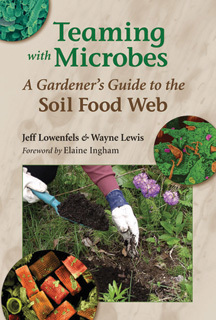
This reminds me of a very good book that I read when I first started teaching Master Composter Class in 2010 called "Teaming with Microbes; A Gardener's Guide to the Soil Food Web" that was written by Jeff Lowenfels and Wayne Lewis.
The authors remind us where the idea of synthetic and bioengineer seed came from; the end of World War 2. There was no need for the chemicals of warfare any longer so scientists and engineers were utilized for their sophisticated knowledge to grow more food with less resources, thus creating synthetic chemical fertilizer laden with heavy salts and tons of chemicals, one of which is nitrogen.
Lowenfels and Lewis remind us about the diversity of the whole soil food web starting from the smallest microbes in the soil, bacterium and fungi, working up to those species that we see everyday but take for granted, such as the raccoon, squirrels and the birds.
To maintain good health, our bodies require that we eat healthy food that is grown in healthy soil with a vast array of diverse microbes. By allowing these species to coexist in our gardens, in our dirt and compost, we are giving our vegetable plants (and other vegetation) the chance to attract beneficial organisms to themselves to fight diseases and ward off adverse organisms. We are also giving ourselves, and our offspring, a chance at a much healthier, nutrient based diet.
When we utilize synthetic (chemical) fertilizers, we offend those unseen but very much needed microbes. The chemicals and salts dry out the bodies of bacterium and fungi in the soil; protozoa, nematodes, arthropods, earthworms and gastropods will leave the area of this type of application. Without these macro and microbes being present, reptiles, mammals and birds will leave the area as well thus leaving the soil food web in disarray.
There is something very healing, almost therapeutic when I garden. I feel connected to nature when I run my hands over the plants, my fingers into the black, healthy soil when plant seedlings. I know that there is something needing my protection in there, and I realize that I need to respect those miniscule life forms .
By respecting the limits of mother nature, we must remember our humble beginnings; our earth. We should provide it with the respect that it so deserves. If we don't, we might not be able to easily recover from such over use and abuse.
Teaming with Microbes is a very good read, and one that will not disappoint!