Community Corner
Detroit Zoo Researchers Study 'Smiling' Turtles' Personalities to Learn Why They're Dying
Blanding's turtles can live to be 60 years old – if hatchlings can survive raccoons in the wild.


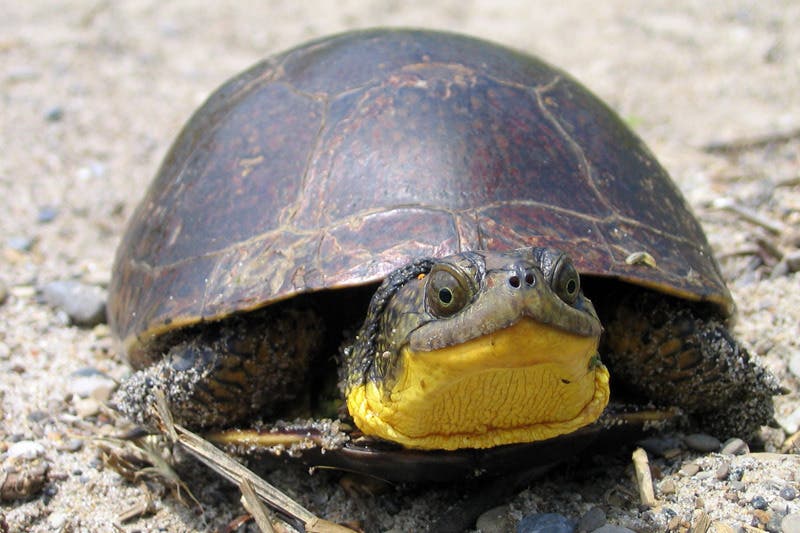
Maybe the “smiling turtle” – the moniker given the endangered Blanding’s turtle because its bright yellow lower jaw and underside makes it appear happy – just needs to come out of its shell a bit.
That’s the semi-serious conclusion of researchers at the Detroit Zoo in Royal Oak who are studying turtle hatchlings’ personalities to solve a very serious problem – their high mortality rates in the wild.
Blanding’s turtles, native to the Midwest, can live to be 50-60 years old, but their hatchlings, however, are often preyed upon, primarily by raccoons. The ICUN/World Conservation Union lists Blanding’s turtles as endangered.
Find out what's happening in Clawsonfor free with the latest updates from Patch.
Researchers at the Detroit Zoological Society’s Center for Zoo Animal Welfare (CZAW) have embarked on a new plan to study the hatchlings’ personalities to determine how the various traits relate to survivability.
“While reintroduction programs are typically concerned with helping to preserve an entire species, sometimes this comes at the expense of individual animals that may not survive,” said Jeff Jundt, the zoo’s curator of reptiles.
Find out what's happening in Clawsonfor free with the latest updates from Patch.
“It is for this reason that researchers have begun to delve further into the factors that may predict success in reintroduction programs,” he said. “It is believed that some behavioral factors such as locomotion, ability to acquire food, and personality may impact individual survival.”
By investigating the role of personality in individual survival, success rates for reintegration programs for the Blanding’s turtle could improve by maximizing the individual well-being of this ecologically important, but often underappreciated, species, zoo officials said.
“Such studies fall under the emerging field of compassionate conservation, which is concerned with recognizing the impacts of conservation practices on individual animals and minimizing harm,” said Stephanie Allard, the zoo’s director of animal welfare. “We are concerned with the well-being of individual animals in our care and committed to effective conservation.”
The study is a continuation of efforts by the zoo in partnership with the U. S. Fish and Wildlife Service at the Shiawassee National Wildlife Refuge and the University of Michigan-Flint to protect the nests of Blanding’s turtles, a project which began three years ago.
A head start program, aimed at helping the species thrive in a protected environment until they were less susceptible to predation, led to the release of 63 turtles back into their native habitat in 2011.
The following year, 69 animals were released, with transmitters affixed to the shells of 12 turtles in order to determine habitat use, dispersion and survivability following their release.
In 2013, 27 turtles were released and, so far in 2014, 24 turtles with transmitters have been released, with an additional 28 to be released at the end of August.
Besides its bright yellow smile, the Blanding’s turtle (Emydoidea blandingii) is also distinguished by a black, speckled, high-domed shell that reaches 9-11 inches in length.
Get more local news delivered straight to your inbox. Sign up for free Patch newsletters and alerts.