Health & Fitness
New Report Cites Troubling Statistics in Number of Pregnant Dearborn Women Smoking
Dearborn fares better than Wayne County and state of Michigan; decline in funding for education and programs is named culprit in trend.
DEARBORN, MI — Apparently, education matters when it comes to healthy habits in pregnancy. A new report shows troubling data in the number of Michigan women who are smoking while they're pregnant. The statewide rate increased by 18 percent between 2008 and 2014, according to a new report released Thursday. That same study shoes that funding has been reduced for education and smoking cessation programs during that time. Smoking during pregnancy is associated with premature births, babies with low birthweight, infant deaths and other complications.
There's a bright spot in this study for Dearborn. The chart below shows that numbers are not as grim here as in other parts of Wayne County.
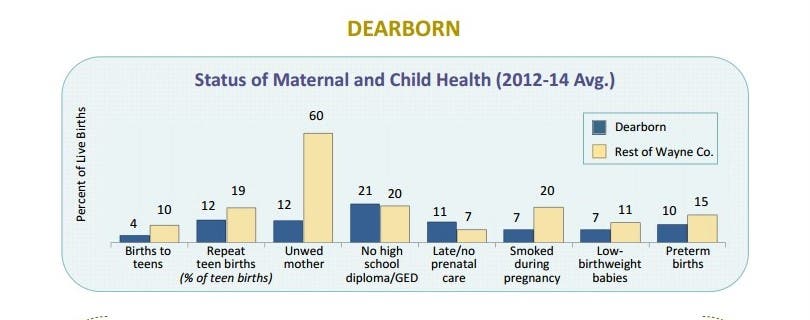
Not surprisingly, the number of premature births has also increased, by 20 percent statewide. Premature birth has long been associated with a number of maternal health issues, including smoking while pregnant. Premature and low-birthweight babies face immediate health concerns, but also suffer from long-term issues. Again, Dearborn fared better in this statistic than the rest of the county (see chart, above). The chart below shows more stats for Dearborn relative to statewide trends.
Find out what's happening in Dearbornfor free with the latest updates from Patch.
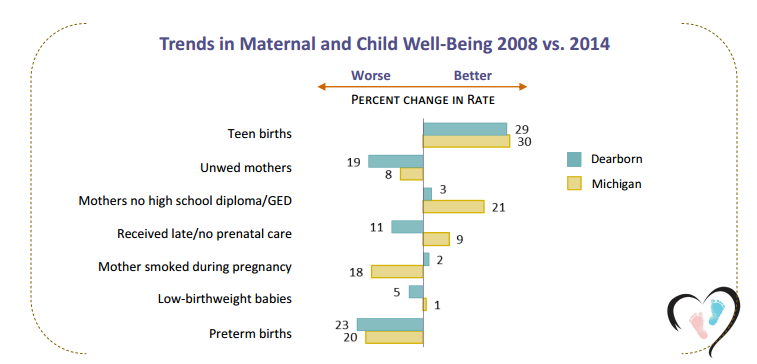
This information and other surprising data are found in the Michigan League for Public Policy’s Right Start: 2016 annual report on maternal and child health, which reviews eight indicators on maternal and child health from 2008 to 2014 for the state, by race, by county and for 22 of the state’s larger cities and townships. In 2008, 21,966 Michigan mothers, or 18 percent of all births, reported smoking during pregnancy. That number increased to 24,273 and 21 percent of births statewide in 2014.
The Wayne County Health Department offers a class on smoking cessation for pregnant women. The course includes information on child health and how to quit smoking.
Find out what's happening in Dearbornfor free with the latest updates from Patch.
The Wayne County Health Department also refers pregnant women to the Michigan Tobacco Quitline program, which helps all people across the state quit smoking. In 2013, Quitline introduced a text messaging and online service, allowing the program to serve a broader audience. During the 2015 budget year,
Quitline calls from Wayne County totaled 1,129.
The Quitline program also offers specialized services for pregnant women regardless of location, income level or insurance status. Services include a personal quit coach, a personalized plan and up to nine calls through the free telephone-coaching program during pregnancy and postpartum. After every call, women receive rewards that can be used to purchase necessities for their babies.
To access the Quitline, call 1-800-QUIT-NOW (1-800-784-8669) or 1-855-DEJELO-YA (1-855-335-3569).
“To ensure that Michigan kids count, we have to help them and their mothers get the right start, and this report shows that more needs to be done to promote and support healthy pregnancies” said Alicia Guevara Warren, Kids Count in Michigan Project Director at the Michigan League for Public Policy. “With all of the information out there on the risks of smoking, the increase in pregnant women who are smoking in this day and age is particularly startling. With these numbers, you would think it is 1986, not 2016. Funding and programming cuts clearly have consequences, and the state urgently needs to reinvest in evidenced-based smoking prevention and cessation efforts for pregnant women.”
Smoking and Race
While the rate of births to white mothers smoking during pregnancy remains the highest of the state’s three largest racial/ethnic groups (23.5 percent), the rate of births to Hispanic mothers smoking while pregnant increased the most—rising by over 46 percent between 2008 and 2014. The rate increased by 16 percent for African-American mothers and 17.5 percent for white mothers. Similarly, the rate of Latina mothers whose babies are born too soon rose by more than 26 percent over the trend period. The report also found that generally rural counties with smaller populations experienced the highest rates of mothers smoking during pregnancy.
Funding Factors
Reduced budget funding is a primary culprit in the lack of targeted outreach and services to help pregnant mothers quit smoking, resulting in the increase in pregnant women smoking and the number of preterm births in the state. In the 2017 budget, including state and federal funds (excluding Medicaid dollars), smoking prevention and cessation initiatives were funded at $3.78 million, which is down 34 percent from budget year 2008. Currently, there is $10,800 targeted to prenatal outreach, up $800 from the 2008 budget. These funds are for local and statewide programs and one goal is to eliminate disparities by race/ ethnicity, geography, income level, type of job and gender and sexual orientation.
There is some good news on maternal and child health in Michigan, as five of the eight indicators saw improvement across the state between 2008 and 2014. This included a 30 percent rate decrease in births to women under age 20 statewide, a 10 percent rate decrease in repeat teen births, and a 21 percent rate decrease in births to mothers with no high school diploma or GED. The other two areas of improvement were a nine percent rate decrease in the number of pregnant women who received late or no prenatal care and a one percent rate decrease in the number of low-birthweight babies.
A mother’s education level is one of the better predictors of whether she will access adequate prenatal care, smoke during pregnancy and be financially secure, which are all connected to both the mom’s and child’s well-being. The improvement in teen births is likely the result of a combination of factors, such as fewer teens having sexual intercourse, increased access to long-acting reversible contraceptives (LARCs), and an increase in the use of postpartum contraception. The 2015 Right Start report focused more in-depth on the state’s decline in teen births.
Photo by Freestocks.org via Flickr Commons