Politics & Government
Lake Erie Algae Blooms Spawn ‘Impaired Waterway’ Designation
Drinking water systems in Toledo, Ohio, and southeast Michigan shut down in 2014 because of toxic algae blooms. Farmers fear regulation.


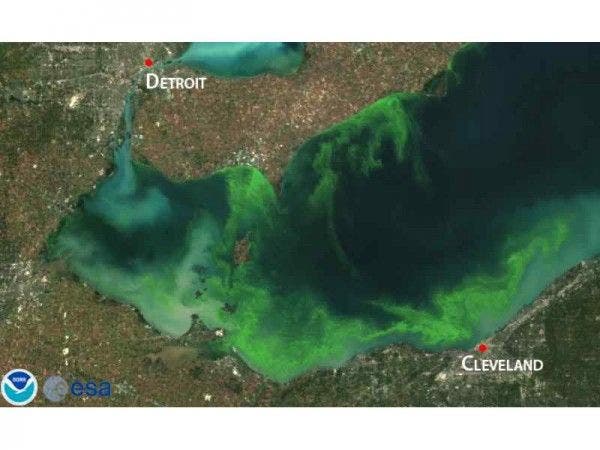
A small section of Lake Erie frequently covered with the green slime of algae blooms has been declared an “impaired waterway” by the Michigan Department of Environmental Quality. Algae blooms have been a growing concern on Lake Erie for the past couple of decades, and two years ago cut off drinking water to 400,000 residents of Toledo,Ohio, and in a small area of southeast Michigan.
The “impaired waterway” designation, which covers the 2 percent of the lake in the western basin that falls under Michigan’s jurisdiction, came after shoreline monitoring and an analysis of satellite imagery showed the lake doesn’t meet Michigan water quality standards.
When that happens, the designation is required under the federal Clean Water Act. It can result in stricter pollution controls, but Michigan officials said they aren’t seeking those fror the time being. Instead, the designation sends a symbolic message about agreements that are already in place to control phosphorus runoff, mainly from livestock manure and farming fertilizer, sparking alarm among some agribusiness leaders that farming could become impractical if not impossible in the area.
Find out what's happening in Detroitfor free with the latest updates from Patch.
“Michigan’s portion of Lake Erie is small but, in making this determination, we signal the importance of our actions to date and our commitment moving forward to limit the incidences of severe algal blooms that impact aquatic life and wildlife in our waters,” Heidi Grether, director of the Michigan DEQ, told the Associated Press.
The “impaired waterway” designation sets the table for more burdensome regulations on farmers and is a veiled attempt to dismantle Michigan agriculture, Jim Byrum, president of the Michigan Agri-Business Association, said Thursday.
Find out what's happening in Detroitfor free with the latest updates from Patch.
“Today’s announcement that the State of Michigan has designated the Michigan waters of Lake Erie as ‘impaired’ does nothing to advance our understanding of current problems in Lake Erie, instead relying on the blunt force of government regulation in a misguided attempt to solve a very complex problem,” Byrum said in a statement.
Byrum said his group has pushed for plans that address huge challenges in nutrient management, such as those involving dissolved reactive phosphorus, as well as additional use of soil sampling and precision agriculture tools, coupled with research to ensure that plans are science-based.
“Instead of encouraging constructive solutions, today's announcement sets the table for even more government mandates, largely driven by fringe groups out to dismantle Michigan agriculture,” he said. “The announcement won't address the heart of the issue or achieve what's really needed: a full understanding of the problem and new, advanced solutions to solve it.”
Toledo Drinking Water Interruption
In 2014, toxic algae blooms on Lake Erie caused a water emergency in Toledo, Ohio, and also affected about 11,575 residents in four southeast Michigan communities in Monroe County. Affected residents couldn't drink tap water for two days.
Algae, a type of bacteria that can produce toxins as it did in 2014, is a pervasive problem on the lake dating to the 1990s. The Lake Erie bloom was the largest on record — it was approximately the size of New York City — in 2015. The blooms were smaller this year due to fewer storms to wash phosphorus-laden fertilizers into the lake, but the toxicity levels were higher, according to scientists with the National Oceanic and Atmospheric Administration.
Earlier this year, the U.S. and Canadian governments agreed to cut phosphorous runoff into Lake Erie by 40 percent in the lake’s central and western within two years, CBC News in Windsor, Canada, reported. The target, previously endorsed in an agreement between Michigan, Ohio and the Canadian province of Ontario, will primarily be reached by preventing municipal sewage treatment plant overflows and encouraging farmers to take measures and use practices that stop the flow of manure and fertilizers into tributary rivers that feed Lake Erie.
Scientists say municipal sewage treatment plants and failed septic systems contribute to the problem, but the primary sources of the type phosphorus that feeds harmful algae are fertilizers and livestock manure from the region’s farms.
U.S. Environmental Protection Agency Administrator Gina McCarthy said when the U.S.-Canada pact was signed that it was a “a first step in our urgent work together to protect Lake Erie from toxic algae, harmful blooms and other effects of nutrient runoff.”
“But establishing these targets is not the end of our work together,” McCarthy said in February. “We are already taking action to meet them.”
Environmentalists have said enforcing plans aggressive enough to achieve the phosphorus reduction goals in the U.S.-Canada agreement will be challenging.
"The U.S. EPA and Environment Canada must take a strong role in providing regional support and, when necessary, enforcement to ensure the states do what is needed to meet the targets," Molly Flanagan of the Alliance for the Great Lakes, told CBC News.
Photo of 2015 Lake Erie algae bloom, largest on record, via NOAA
Get more local news delivered straight to your inbox. Sign up for free Patch newsletters and alerts.