Health & Fitness
Michigan Brothers Diagnosed with Cancer 11 Months Apart
The Rickers' oldest son was diagnosed with DIPG, a rare brain cancer, early last year. Before the year ended, they were slammed again.


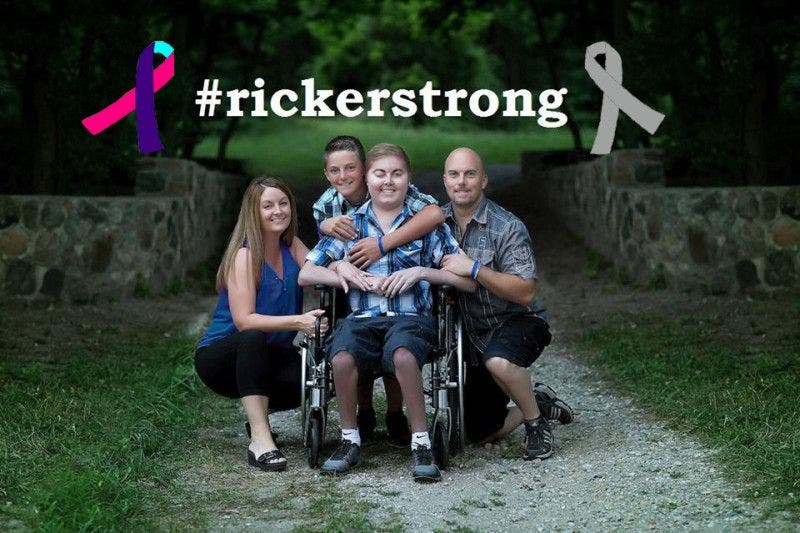
Kim and Brian Ricker got the first blast of devastating news last winter. The Michigan couple’s 16-year-old son, Brison, was diagnosed in January 2016 with a rare and inoperable brain tumor that doctors told them has a zero percent of survival.
“We were broken and shattered” by the diagnosis, Kim Ricker told Patch. Brison’s oncologist gave him nine months to live at most, and told the Rickers to take their son home, arrange for hospice care and enjoy the precious little time they had left with him.
Instead, the Cedar Springs family traveled more than 1,200 miles to Houston, Texas, and the Burzynski Clinic, which offers alternative treatments for diffuse intrinsic pontine glioma, or DIPG, and other brainstem tumors. The latest MRI showed the tumor had shrunk to one-third its size and is dying, and healthy tissue is growing around it.
Find out what's happening in Detroitfor free with the latest updates from Patch.
Then, with little time to celebrate the news and exactly 11 months after Brison’s diagnosis, came the second blow.
Two days before Christmas, the Rickers’ other son, Preston, 13, was diagnosed with thyroid cancer, which had spread to his lymph nodes.
Find out what's happening in Detroitfor free with the latest updates from Patch.
“There was no time for us to even rejoice in the good news before being slammed with yet another horrific diagnosis,” Ricker wrote on a GoFundMe campaign page created to help the family pay mounting medical bills.
“Having one very sick child is hard enough in every aspect, emotionally, physically, financially it is all so draining and most of the time you feel like you are drowning and now it is starting all over again,” she wrote.
On Jan. 9, Preston’s thyroid and 46 lymph nodes were removed. The survival rate of this type of cancer is 95 percent.
After watching the brave fight by his older brother, his role model throughout his 13 years, Preston confidently stated, “I can beat this,” his mother said.
The prognosis is good. Preston will be returning to school this week.
For Brison, things don’t look as optimistic, but he has come a long way from where he was when the oncologists at Helen DeVos Children’s Hospital sent him home last year. Not only did the tumor shrink, but the swelling in his brain has gone down and he has been able to stop taking the extremely high doses of steroids that were part of the treatment at Burzynski Clinic.
“They literally tore his body apart,” his mother said. “He didn’t gain weight, but he had huge stretch marks that opened to horrible wounds down to the meat part, and we had to take him to the wound clinic.”
The Rickers focus on the positive improvements they’ve seen.
“He’s stronger than he has been in 10 months, he’s starting to sit up — before, he could not get up to the side of the bed— and can stand up on his own, sit down on his on his own and he’s walking with his walker,” Ricker said.
Through it all, the Rickers have leaned on and have been bolstered spiritually their faith family at Tribes Church.
“We have to trust in God’s word, that God knows best and he’s going to get us through it,” Ricker said. “We lean on each other for support, definitely.”
But they are drowning financially. Their medical bills have topped $250,000, leading to the GoFundMe campaign. Treatments at the DeVos Children’s Hospital are mostly covered by insurance, but Brison’s treatment in Texas cost the family $150,000 in out-of-pocket costs. Monthly medical bills, again not covered by insurance, are about $17,000 a month.
The household income has dwindled to almost nothing, as both Kim and Brian are caring for their son. She is a Realtor and hasn’t worked since he was diagnosed. Brian is a truck driver. He works part-time, enough hours to keep his insurance but had to reduce his hours “when Brison got really bad.”
“He couldn’t hold his own head up, and couldn’t speak,” Ricker said. “He had no small motor skills. He’s 16 and 6 feet tall and 140 pounds. I couldn’t lift him, and my husband had to come home to help. Then when we got Preston’s diagnosis, his work said he should just come home.”
Though she’s optimistic her older son will recover, they’ve put school work off for now, concentrating instead on physical and occupational therapy.
Ricker says she’s conflicted.
“I don’t like to say out loud because I believe he is going to be cured,” she said. “If not, I don’t want him to spend his time on schoolwork that is never going to pertain.”
Genetic Testing
With two son with cancer diagnoses, the family looked to genetic testing to see if that explains the horrible coincidence. The results won’t be back for another month.
“We’ve been told that typically, only about 5 percent of cases are genetic,” Ricker said. “We had our water, the air in our house and radon tested, and we’re going through it all again.”
If the Rickers have learned anything in the past year, it’s to get a second opinion on everything, from the environmental tests at their home to the advice they get from doctors.
For other parents dealing with the same crushing news, Ricker offers some advice.
“First, be an advocate. Don’t take one doctor’s diagnosis, because they’re only human too,” she said. “Look for other options.”
When doctors told the Rickers to take Brison home and spend the time they had left with him, Ricker spent hours online researching options from natural treatments, diet modifications and supplements.
“I looked at every possible aspect to prolong his life — finding other clinics, clinical trials that were available,” she said, adding that she now follows 100 other families whose children have been diagnosed with DIPG, an aggressive and difficult to treat brain tumor found at the base of the brain.
Ricker hopes that sharing her family’s journey will increase awareness of childhood cancer. Childhood Cancer Foundation figures show that only 4 percent of all funds given to cancer research go to childhood cancer, and only 1 percent of that money goes to brain cancer, which is the No. 1 killing cancer in children.
“DIPG gets very little funding because it’s so rare,” she said, “but over 300 kids get it a year.”
» Click here to donate to the Rickers’ GoFundMe page.
Photo via GoFundMe
Get more local news delivered straight to your inbox. Sign up for free Patch newsletters and alerts.