Politics & Government
Michigan Could Be 3rd State To Raise Smoking Age To 21
Though well-intentioned, laws to raise the smoking age to 21 face opposition from critics who say they send a mixed message to young adults.


DETROIT, MI — Michigan would become the third state in the country to raise the legal smoking age to 21 under a package of bills introduced in the state Legislature last week. Rep. Tommy Brann, a Wyoming Republican, thinks escalating fines starting at $1,000 for an initial violation and $2,500 for a subsequent violation is a strong deterrent to stop teens from smoking.
Currently, only Hawaii and California have both raised the minimum legal smoking age to 21. Similar legislation passed both the New Jersey House and Senate, but Gov. Chris Christie vetoed it. Efforts have been made in at least a dozen other states, but haven’t gained much traction as lawmakers balance personal interests and the privacy of young adults to make their own choices versus public health concerns.
On a purely philosophical level, over 21 laws get knocks for sending another conflicting message to 18-year-olds that they’re not quite adults — responsible enough to vote, join the military and perhaps even die in a war, but not mature enough to make choices about drinking alcohol and smoking tobacco. Opponents also argue that raising the minimum age for smoking, though well intended, would supply new clientele for an already lucrative tobacco black market, already a $6.92 billion annual industry, according to the U.S. Centers for Disease Control and Prevention.
(For more local news, click here to sign up for real-time news alerts and newsletters from Detroit Patch, click here to find your local Michigan Patch. Also, like us on Facebook, and if you have an iPhone, click here to get the free Patch iPhone app.)
Brann, a former smoker, told WZZM-TV that he sees young workers at the restaurant he has owned for 46 years making the same mistake he did when he smoked his first cigarette at age 18. He thinks the Youth Tobacco Act “will save lives” and said “it’s the right thing to do.”
“If they’re going to start smoking, just like drinking, it should be 21,” Brann said.
Brann’s bills also raises the legal age for sales of chewing tobacco, e-cigarettes, cigars, pipes and hookahs. Tobacco cessation products like nicotine gum would be exempt. Those selling restricted tobacco products to people under 21 would also be subject to fines.
Tell Us: Do you think the legal smoking age should be increased to 21 or left at 18 in Michigan? Go to the comments and tell us what you think.
Dozens of cities have raised the legal smoking age to 21, including Ann Arbor. The Genesee Board of Commissioners passed a local ordinance, too, but both laws were scuttled by Michigan Attorney General Bill Schuette, who said in a formal opinion that state law preempts what are known as Tobacco 21 laws.
In all, 19 states have preemptive laws that stop local jurisdictions from setting their own legal minimum sales ages, according to the Preventing Tobacco Addiction Foundation, a nonprofit group known as Tobacco 21 that wants to raise the legal smoking age to 21.
Oregon lawmakers appeared ready to join California and Hawaii earlier this year, but Big Tobacco stepped in with a lobbyist, former state senator Margaret Carter, a Portland Democrat who was the first black woman to be elected to that state’s Legislature. Carter’s argument was that raising the legal age to purchase tobacco to 21 would give police more authority to racially profile young black men, Willamette Week reported.
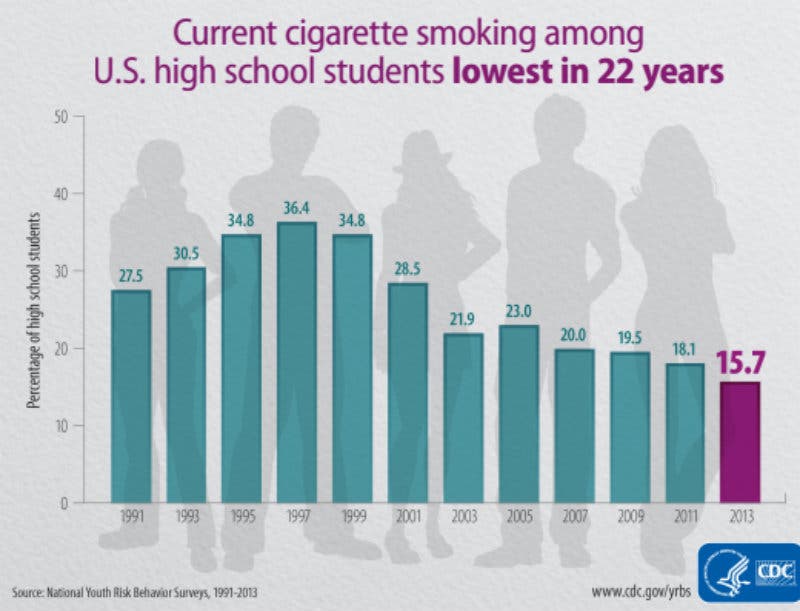
U.S. Centers for Disease Control and Prevention statistics show that teen smoking rates are tumbling without state assistance. In 2014, the last year it reported statistics, the CDC said teen smoking was at its lowest rate in 22 years. In Michigan, 29.1 percent of high school youths said they used tobacco products, including e-cigarettes, and 10 percent said they smoke cigarettes, according to the CDC’s National Youth Risk Behavior Survey.
In a 2015 report, the Institute of Medicine optimistically projected that the number of adult smokers would decline 12 percent under if the minimum legal age for buying tobacco products were 21 nationwide, but admitted there is no systematic research to back that up.
The Institute of Medicine said the benefit to public health “depends on the degree to which local and state governments change their policies.”
“Overall, in the absence of transformative changes in the tobacco market, social norms and attitudes, or in the knowledge of patterns and causes of tobacco use, the committee is reasonably confident that raising the (minimum legal age) will reduce tobacco use initiation, particularly among adolescents 15 to 17 years of age; improve the health of Americans across the lifespan; and save lives.”
Photo by DLSimaging via Flickr Commons
Find out what's happening in Detroitfor free with the latest updates from Patch.
Get more local news delivered straight to your inbox. Sign up for free Patch newsletters and alerts.