Health & Fitness
Ticks In February? Early Lyme Disease Spike Possible In Michigan
Blacklegged ticks' early emergence could jumpstart the season for Lyme disease, a bigger problem in Michigan than previously thought.


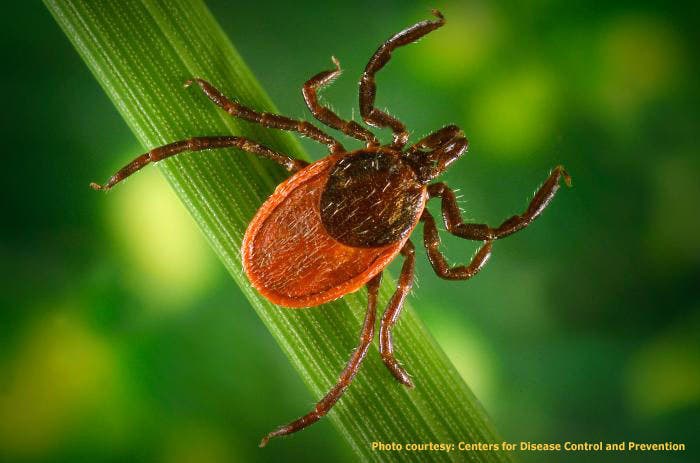
This is weird: It has been such an unseasonably warm February in Michigan that the ticks have made an early return, sucking the blood of dogs, horses and people, and infecting them with potentially debilitating Lyme disease. That blacklegged ticks have taken such a strong hold in the state is somewhat surprising to scientists, who for years thought Michigan was geographically insulated from the freckle-sized pests.
The early arrival of blacklegged ticks was documented last week when a student brought six he had just pried off his dog to the medical entomology lab at Michigan State University, according to Jean Tsao, an associate professor in MSU’s departments of fisheries and wildlife and animal clinical scientists.
The arachnids’ early retreat from the shelter forest floor cover is explained by springlike weather that in other years has eluded Michigan until April or even May. But that they’ve managed to establish such a stronghold in the state at all is what prompted Tsao and her colleagues at Oxford University to take a closer look.
Find out what's happening in Detroitfor free with the latest updates from Patch.
Though common along the East Coast, Lyme disease cases in Midwest states for years were mainly concentrated in Wisconsin and Minnesota. Those two states still report the highest incidence of Lyme disease west of the Mississippi River, but cases in Michigan increased five-fold from 2000 to 2013, according to research by Tsao and her colleagues recently published by Oxford Academic.
Lake Michigan stretches down the east and west coasts of Wisconsin and Michigan, but it’s not the impervious barrier to blacklegged ticks that scientists once thought it was, Tsao and her co-authors wrote in “Geographic Expansion of Lyme Disease In Michigan.”
Find out what's happening in Detroitfor free with the latest updates from Patch.
In 1988, the blacklegged ticks were established in five counties, four of them on the Upper Peninsula. They were also established in Berrien County in the southwest corner of the state. Now, established populations of ticks have been have been 24 counties, including all of those along the Lake Michigan shoreline. The ticks have been “reported” in another 18 counties.
“We know this is a real invasion,” Tsao told the Detroit Free Press.
If the ticks didn’t swim to Michigan — and they didn’t — how did they get to the state? The researchers determined ticks are hitchhiking across Lake Michigan on the wings of birds, grabbing a “nice blood meal” that will allow the female to lay up to 2,000 eggs, Tsao told the Free Press. Even if only one of the eggs survives, she said, a tick’s lineage can be continued.
“Over time, as the Wisconsin, Minnesota and Upper Peninsula populations grew, that pressure of ticks coming down to places where birds like to stop over would have increased,” Tsao said. “In the past, they could have come and died. But eventually, enough of them have arrived, survived the various life stages and began mating.”
And, with the same sandy coastal habitat and lush woodland that have allowed them to thrive in Wisconsin and Minnesota, the ticks can find an abundance of hosts to move across the state until they’re eventually found everywhere.
“I’m not trying to be fear-mongering,” Tsae told the Free Press “But if you look at Michigan and look at other states where Lyme disease-causing ticks are found, what kind of vegetation is there? What kind of animals are there?”
Lyme Disease In Michigan?
The spike in Lyme disease cases corresponds with their geographic movement. From about 2000 to 2004, fewer than 30 cases were reported a year. In 2013, the number had soared to 166, Tsao said.
Nationally, about 30,000 Lyme disease cases are reported annually, but the U.S. Centers for Disease Control and Prevention the actual number is likely 10 times higher because only a fraction of cases are reported.
Lyme disease is easily treated with antibiotics, but isn’t anything to take casually. Left untreated, it can lead to inflammation of the brain and spinal cord; shooting pains, numbness or tingling in the hands or feet; and short-term memory problems. In rare cases, it can cause death.
Because Lyme disease was long thought to be an anomaly in Michigan, some patients have been met with skepticism when they describe their symptoms to physicians.
Heather Feldkamp, 44, of Saline, told the Free Press initially thought the numbness she began experiencing in her right leg in January 2013 was the result of sciatica. Eventually, the symptoms occurred in her left leg, causing her to limp. A couple of sessions with her chiropractor didn’t provide relief, and her primary care physician referred her to a neurologist, who diagnosed and treated her for breast cancer. The numbness and other symptoms persisted, so Feldkamp went to a holistic doctor.
“She tests me and says, ‘You don’t have cancer in your nerves; you’re full of Lyme,’ ” Feldkamp told the Free Press.
The diagnosis was confirmed by lab tests, but her doctors never took her seriously, she told the Free Press. But when she shared her story on Facebook, others who had received pushback from their physicians began reaching out, she said.
Mary Fairweather of Thetford Township in Genesee County figures she carried Lyme disease for years after having picked it up while camping in northern Michigan, Wisconsin and Minnesota. Fairweather told The Flint Journal in 2008 that she was diagnosed with rheumatic fever as a child, but symptoms persisted to the point that she couldn’t raise her arm in first first grade.
Decades later, when Fairweather first heard of Lyme disease, her symptoms made sense.
“I knew as soon as I heard of it that that's what I had,” Fairweather told the Flint newspaper. “My symptoms matched exactly, and I knew I'd been bitten by ticks several times while growing up. I also was bitten on a camping trip in 1987. I saw the tick and developed an itchy rash on my ankle where it bit me.”
The first test for Lyme disease was negative. When Fairweather’s symptoms worsened in 1990 to the point that she had difficulty walking, doctors treated her for arthritis. Of all the doctors and specialists she consulted no one, not even the experts at Mayo Clinic thought she might have Lyme disease.
Finally, in 2006, a physician familiar with Lyme disease diagnosed and prescribed two rounds of antibiotics to treat it. Fairweather said began to “feel human again” after a few months, but by then, the disease had already damaged her feet and legs.
“Chronic Lyme Disease” Questioned
Fatigue, pain, or joint and muscle aches can persist for several months, according to the CDC, which said the lingering symptoms are properly known as “Post-Treatment Lyme Disease Syndrome,” or PTLDS, rather than “chronic Lyme disease.”
Most medical experts believe lingering symptoms are the result of residual damage to tissues and the immune system that occurred during the infection, similar to complications and auto-immune responses known to occur after other infections, the CDC says.
Most patients with PTLDS get better with time, though it may take a period of months, the CDC says. Long-term antibiotic treatment isn’t recommended, because that can cause serious complications.
To spread awareness of the growing threat of Lyme disease in the state, the nonprofit Michigan Lyme Disease Association organized the state’s first fully accredited medical conference on Lyme disease and other tick-borne illnesses in 2005. The group also supports research, including a study on the spread of Lyme disease in dogs throughout southeastern Michigan.
Resources
How To Prevent Tick Bites
If you’re going to be in areas that may be infested with ticks:
- Wear light colored clothing so ticks can be spotted more easily, and removed before they attach to your body.
- Wearing long sleeved shirts and pants tucked into socks or boot tops can be helpful in keeping ticks from reaching your skin.
- Ticks are usually located close to the ground, so boots or shoes and not sandals, are recommended.
- Applying insect repellents such as DEET (n,n-diethyl-m toluamide) to clothes and exposed skin, and applying Permethrin (which kills ticks on contact) to clothes can reduce the risk of tick attachment.
- DEET can be used safely on children and adults, but should be applied according to label guidelines.
Source: Michigan Department of Community Health
How To Remove A Tick
Never squeeze, crush or puncture the tick’s body. That may cause it to release potential infected fluids into the site of the bit. For the same reason, don’t twist or jerk the tick. Do not apply petroleum jelly, a hot match or other irritants, because doing so will irritate the tick and may cause it to accelerate the transmission of any diseases it may be carrying to the host mammal.
Instead, follow these tips:
- If a tick has attached itself, use fine-tipped tweezers to grasp the tick at the surface of the skin.
- Pull the tick straight up and out. Don’t twist or jerk the tick — this can cause the mouth parts to break off and stay in the skin. If this happens, remove the mouth parts with tweezers if you can. If not, leave them alone and let the skin heal.
- Clean the bite and your hands with rubbing alcohol, an iodine scrub, or soap and water.
- The person with the tick bite may get a small bump or redness that goes away in 1-2 days, like a mosquito bite. It’s not necessarily a sign of Lyme disease though.
Sources: Michigan Department of Community Health and Michigan Lyme Disease Association
Symptoms Of Lyme Disease
(Within 3 to 30 days of tick bite)
- Fever, chills, headaches, fatigue, muscle and joint aches, and swollen lymph nodes.
- Between 70 and 80 percent of infected persons will experience a rash, usually within seven days, but for up to 30 days. The rash can expand over a period of several days, up to 12 inches or more across; it may feel warm to the touch, but is rarely itchy or painful; it sometimes clears as it advances, resulting in target or “bull’s-eye” appearance; and it may appear on any part of your body. See examples.
(Days to months after the tick bite)
- Severe headaches and neck stiffness;
- Arthritis with severe joint pain and swelling, particularly the knees and other large joints;
- Facial palsy (loss of muscle tone or droop on one or both sides of the face);
- Intermittent pain in tendons, muscles, joints, and bones;
- Heart palpitations or an irregular heart beat;
- Episodes of dizziness or shortness of breath;
- Inflammation of the brain and spinal cord;
- Nerve pain;
- Shooting pains, numbness, or tingling in the hands or feet;
- Problems with short-term memory.
Source: U.S. Center for Disease Control and Prevention
Feature photo by Fairfax County via Flickr Commons
Get more local news delivered straight to your inbox. Sign up for free Patch newsletters and alerts.