Business & Tech
Saving the Earth on the Company Dime
Ferndale businesses use recycling to save environment and expenses.
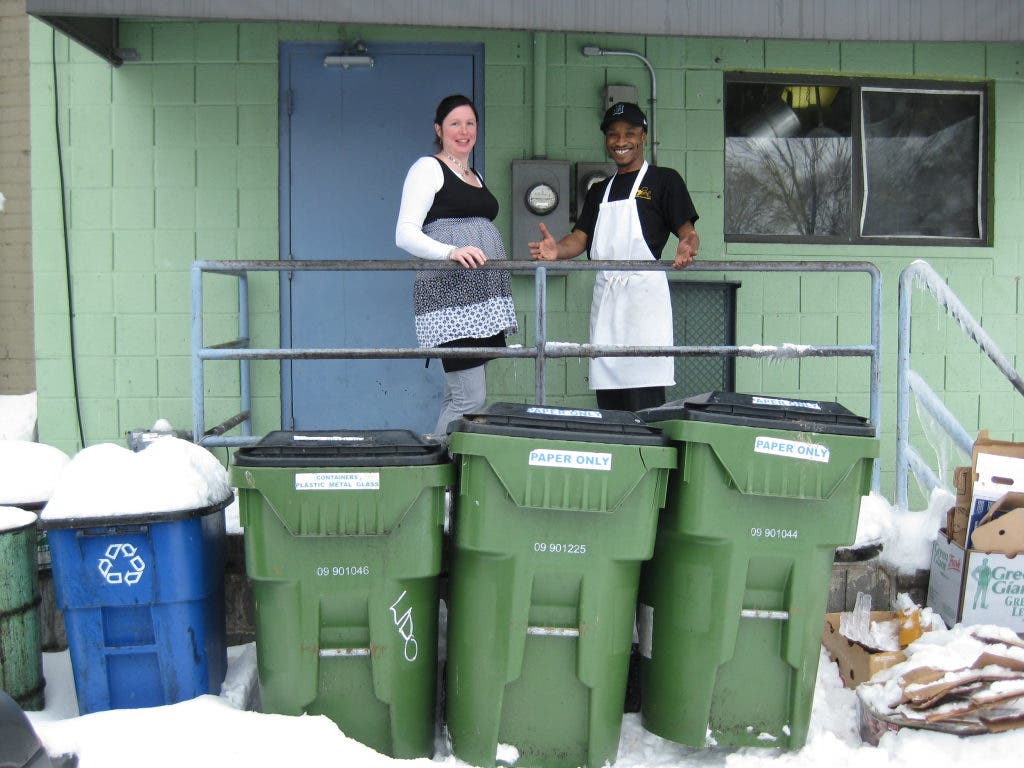


When Dejuane Johnson, 25, was hired at the 10 months ago as a prep-cook and dishwasher, he wasn’t expecting one of his duties to include washing and sorting items that would otherwise be thrown into the trash. But that is part of his job.
An increasing number of Ferndale businesses such as the Fly Trap are integrating recycling into their daily routine in an effort to save the environment and some cash.
“I’ve never worked at a restaurant where there was so much recycling,” Johnson said. “I feel like Ferndale is a good place for it though, because there’s already a recycling program in place.”
Find out what's happening in Ferndalefor free with the latest updates from Patch.
The recycling program is run by Southeastern Oakland County Resource Recovery Authority (SOCRRA) and is funded collectively by Ferndale and the 11 other municipalities it serves. SOCRRA offers free weekly pickup of recyclables at businesses using the same service as for residential customers. Jeff McKeen, general manager at SOCRRA, said the increase of recycling among businesses has been observed but not specifically tracked since SOCRRA tracks based on city tonnage.
Fly Trap owner Kara McMillian, 32, said the recycling routine was implemented about a year after opening the restaurant in 2003. Why do it? “Just being conscientious of recycling in general and the fact that most of the waste we produce is recyclable,” she said.
Find out what's happening in Ferndalefor free with the latest updates from Patch.
McMillian estimates 60 percent of the restaurant’s waste is recycled and she said the system is well worth the effort despite some initial challenges. Three 95-gallon carts are filled and set out behind the store for SOCCRA each week; a large amount to contend with for a store with relatively small square footage. McMillian said the restaurant's cardboard to be recycled often exceeds the amount of cart space and she hopes SOCRRA one day offers containers better suited for cardboard.
“It’s the storage problem, getting everyone on board with what’s recyclable and what’s not, washing out containers” she said. “Not that it’s that much work, so that’s why we actually do it.”
At , owner Lenny Lenaway, 67, said every week he rolls his SOCRRA cart purchased for $50 to the rear of his store full of paper that would otherwise add to the landfill.
“We called the city and they said, ‘You can pick up one of the curbside recycle containers,’ and I said, ‘No, no, no. That’s too small for what we want to do,” he said.
Smaller recycling cans are placed around the store for customers to use if they make copy- or scissors-related errors. He thinks more businesses would recycle if it became a habit.
“Time is a big factor for a lot of people,” he said. “And they don’t take the time to really do it.”
At , recycling and reusing has been streamlined into the system. Producing 100,000 pounds of salsa per day can result in a large amount of waste, but the company strives to be as “green” as possible in its disposal of it, said David Yono, 35, vice president of operations.
“We don’t want things going into a landfill that don’t need to be,” he said.
Three bales of cardboard per day that Yono estimates weigh 1,000 pounds each and one large bin of miscellaneous metal and plastic containers are picked up for recycling by a private company per week. Stacked outside near the bins are empty 275-gallon oil or vinegar totes and chemical barrels ready to be returned for reuse. The company sends a semi-truck full of used tomato totes back to its supplier every week or so in exchange for free shipping on its next order. Heaps of peppers, onions and cilantro that didn’t make the cut are tossed into a large container outside the warehouse and sent to Tuthill Farms in South Lyon for composting.
Yono said the recycling and reusing procedures have been in development since the business began in 1997 and as the company has grown, the relative magnitude of waste thrown into the garbage has decreased. Although concern for the impact the company has on the environment was a major factor in this development, so was the bottom line, Yono said.
“If you do the research and do the math you can turn something you’re paying for to be hauled off into money and you’re saving the environment at the same time,” he said. “It’s a win-win.”
McKeen said the strategy of businesses using recycling to save money is wise. “It allows the ability to reduce their trash costs in general. They can get away with smaller dumpsters or less frequent pickups,” he said.
SOCRRA does not track businesses in each community that are participating in the recycling program. “Each community is a little bit different. Ferndale’s probably sort of right in the middle,” McKeen said. “Clearly there’s a lot of room for improvement there.”
McKeen said he thinks more of the business community would participate if SOCRRA were able to better communicate the advantages, but there is of lack of funding. He said Berkely recently used an economic stimulus grant to pay for SOCRRA to market recycling to businesses and that since the program began in December, 41 businesses have signed up for recycling pickup.
“So we’ve made a lot of progress in a fairly short time,” he said.
The Ferndale Environmental Sustainability Coalition will be giving away the Ferndale Green Business Award on .