Health & Fitness
Make Some Beer With Me, Honey
I make a honey wheat ale on a cold, dreary mid-May day.
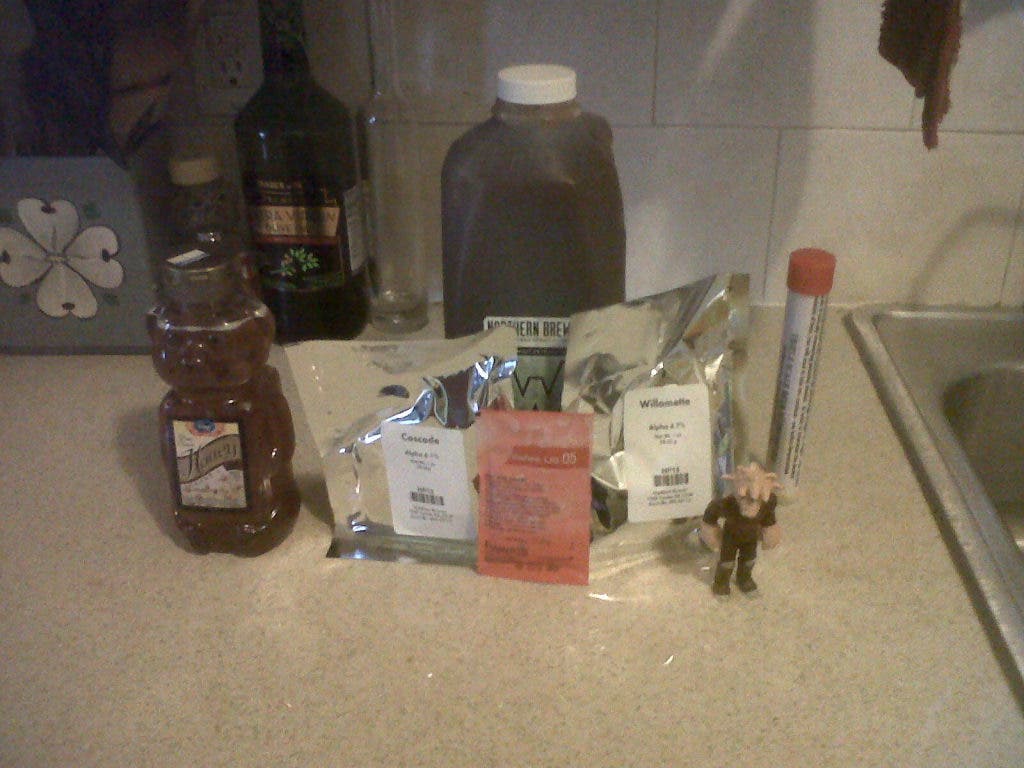

It was 43 degrees outside and pouring rain. My back yard was under water and the kids were making messes faster than I could clean them up. It was a very good time to make beer. I had been waiting for the right moment to make a honey wheat ale that will be great on a nice warm spring day, which apparently is only a few more months off.
Aligned on the counter were my materials: a 6 pound jug of malt extract that was 65% wheat sugar and 35% barley sugar; 1 ounce of Cascade hops and 1 ounce of Willamette hops, a package of Safale brewing yeast and a 24-ounce bear of clover honey I got at for $5 on sale. It was missing, perhaps, a half ounce because my son drank from it when I wasn't looking. Also, there was Ree-Yees, a belligerent three-eyed, goat-faced alien in Jabba the Hutt's court.
For this very easy recipe, I boiled the water, dumped in the syrupy malt, which tastes a whole lot like the inside of a malted milk ball, and poured in the honey. I then put in the Willamette hops, which added a small amount of bitterness. Late in the 1-hour boil I put in the Cascades, which add flavor and aroma.
Find out what's happening in Grosse Pointefor free with the latest updates from Patch.
The wort (unfermented beer) was cooled then I added a few more gallons of cold water to get to 5 gallons and put it in big white bucket. By using the hydrometer, I measure the density of the sugars in the wort and can tell what the potential alcohol content is. In this case, it's going to be around 6%. I will measure it again after fermentation. The yeast eat the sugar and produce alcohol and carbon dioxide, which is expelled through an airlock on top of the fermenter. At the end, the density will drop close to that of straight water. The higher the final density - known as gravity - the more sweetness the beer will have and correspondingly less alcohol. A Belgian ale frequently will have both very high alcohol and a big body, meaning it was made with a very large amount of sugars to start, while an American lager like Budweiser will be very dry - not sweet - and relatively low in alcohol.
Next I add the yeast, seal the top and wait two weeks for it to become beer. It will then be placed in a keg and carbonated. I could also put it in bottles with a bit more sugar and the bottles would self carbonate. If you buy a bottle of Bell's Oberon and notice the sediment at the bottom, that is yeast from bottle carbonation. I have actually harvested and grown that yeast to try to make a clone of Oberon, but it didn't turn out very well.
Find out what's happening in Grosse Pointefor free with the latest updates from Patch.
I use malt extracts, which can make very good beer. But all microbreweries and a lot of home brewers use the actual grains, steeping them in hot water to leach out the sugars. This process requires more time and more equipment than extract brewing, but gives the brewer much more control over the final product and is far cheaper in large volumes.
Check back in a few weeks and I'll give a report on the outcome.