Community Corner
Dodge Family Snubbed by Grosse Pointe Society
When the Dodge Brothers first started amassing wealth, long-time Pointers were not impressed.


I am very thankful when reader’s help me along in my quest to document and share Grosse Pointe history in the form of a weekly column. A friend recently introduced me to and let me borrow a book The Dodge Dynasty: the Car and the family that Rocked Detroit because inside there is a picture of the . He wanted me to see that they looked remarkably similar to the , which were designed by Albert Kahn.
Why are they similar? Curious Pointers will be appeased: the reason why the gates of both Rose Terrace and Beverly Road look remarkably similar is because they were both designed by Kahn.
With that little mystery resolved, I started flipping through the 338 page monograph. I had never before realized the extraordinary level of tragedy experience by the Dodge family.
Find out what's happening in Grosse Pointefor free with the latest updates from Patch.
I had recalled reading that the Dodge brothers were not immediately welcomed into Grosse Pointe and Detroit Society, despite their wealth. I found my worn copy of Grosse Pointe 1880-1930 by Madeleine Social and Suzy Berschback and flipped through it until I found the sentence I had remember reading years ago for a paper on Grosse Pointe I wrote for a Michigan History course at Albion College.
Socia and Berschback write, “when the Dodge brothers' rowdy reputation precluded Horace’s immediate acceptance into the Country Club of Detroit, he reportedly evened the score by purchasing the adjoining property…noted industrialist architect Albert Kahn was then commissioned to build a mammoth early-English-Renaissance mansion to dwarf the neighboring clubhouse.”
Find out what's happening in Grosse Pointefor free with the latest updates from Patch.
I had recounted this story to friends and family many times because I thought it was the most fabulously sneaky and clever revenge new money could buy. This story was further confirmed and enhanced by longtime Grosse Pointe resident Hugo Higbie, who told me that he had remembered stories from family that the original Rose Terrace had a twelve-car garage that was purposfully faced the Country Club property line. In that way, there was a constant stream of loud engines running while the Pointers who snubbed the Dodge family attempted to concentrate on their swing.
Although I don’t think there is any proof that Rose Terrace or the Dodge family had anything to do with the Country Club relocating to its current location in 1922, when the private club moved the Dodge family was quick to acquire the additional acreage.
The Dodge Dynasty is “The definitive biography of the Dodge family” according to book flap, and was co-authored by Caroline Latham and David Agresta. It was published in 1989. There are two copies that can be found through the Grosse Pointe Public Library, one is at Grosse Pointe South and one is at the Woods branch. But for those of you who are not inclined to read a lengthy monograph on the Dodge family, I will recount some of the story here. All of the quotes to follow are from The Dodge Dynasty.
New money
As it turns out, the Dodge Brother’s themselves weren’t as preoccupied with being accepted into society as their wives were.
However, Anna Dodge, wife to Horace Dodge, was particularly obsessed. After years of marriage to Horace and plenty of money to show for it, she was weary of the many years of being written off as new money. Therefore, “she had concluded that the only way to get to the top of Detroit Society was to leapfrog right over it.”
So Anna skipped over Detroit and moved onto her next society target: Palm Beach.
Anna’s two handsome and eligible children, Delphine and Horace, Jr. were her ticket in.
New money marries old money
“Anna was thrilled by the prospect of a well-connected son-in- law.”
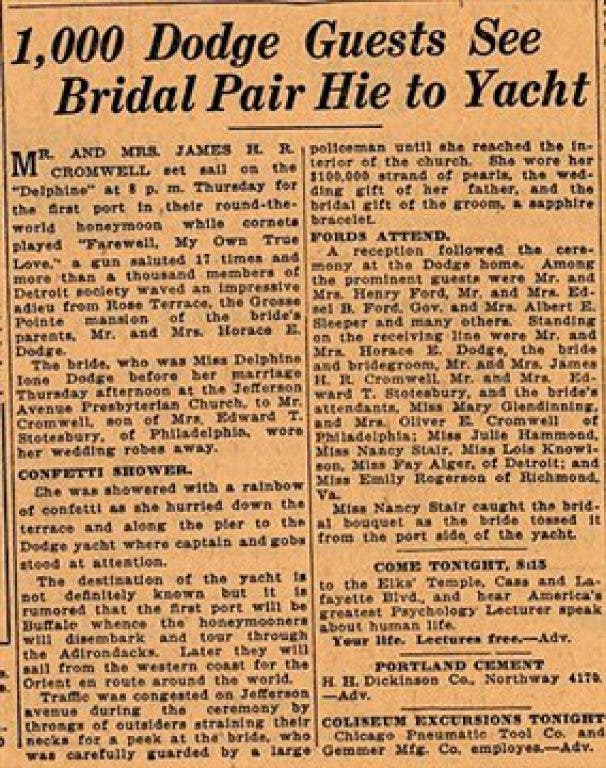
Delphine fell in love with James Cromwell, son of Eva Stotesbury. The Cromwell family from Evas’s first marriage were well connected in Philidelphia society.
Delphine married Cromwell in June of 1920 at Rose Terrace.
When it came time for the June nuptials, Anna Dodge found out that Eva Stotesbury, mother of the groom, was known for her pearls. So she decided she should have some pearls of her own for the wedding day. Naturally, they had to be better. Cartier found them for her: a five-strand pearl necklace of 389 perfectly matching pearls. For whom had they originally been strung? They “once belonged to Empress Catherine the Great of Russia, as evidenced by the necklace’s clasp, a jeweled miniature of the empress.” The necklace was valued at $825,000 in 1920.
The mother of the groom quietly made sure she herself was not outdone by new-money Anna. In addition to wearing her own infamous polite-society pearls, she wore “a diamond collar said to have belonged to Queen Marie Antoinette and a pearl-and-diamond earrings from the treasure chest of Queen Isabella of Spain.”
Despite their quiet old-money-new-money war of wealth, the match to Cromwell was perfectly suited to Anna’s needs for an ‘in’, “The connection with the Stotesburys would give the Dodges entrée into the society in Palm Beach, Philadelphia, New York—everywhere.”
Horace Jr. later followed suit and married a woman from Detroit society family.
Anna finally had her wish to be accepted by her social peers, but what was the cost of her own social climbing?
Was it worth it?
Despite rocky beginnings in Grosse Pointe society, all the wealth, and all of the legends, Latham and Agrestra write, “In later years, sitting in a fragile antique chair that had once belonged to Queen Marie Antoinette and wearing pearls that any queen would envy, Anna liked to say that the days when she packed Horace’s lunch pail every morning were the happiest of her life.”
So what did Anna Dodge really think of all of their money? “Wealth is a curse.”
As far as the status of the descendants of the Dodge dynasty, as of 1989 things were not looking so good. The last paragraph of the book is poignant, somber and disquieting in that disappointing sort of way which elicites a response much like, ‘Oh, wow, that’s really how it ended? Wait... no, that can't be. Really? That's it? No! NO!’ So it only seemed appropriate to share it in its entirety:
“Little splinters of past grandeur are embedded in the lives of the grandchildren and great-grandchildren, into whose hands the fragmented Dodge fortune has now passed: a grove of jade trees on a bookcase shelf, gold-rimmed dishes from the yacht in a cupboard, a key chain from which dangles the bejeweled portrait of Catherine the Great that was once a pendant to her pearls. At worst, they drink and take drugs and forget about the way things used to be; at best, they have learned to live quietly, with modest aspirations and low profiles. They are like the survivors of some terrible tragedy—and yet the worst thing that happened to the Dodge family was that they achieved the American Dream.”
The craving of social acceptance could not satisfy the burdens that come with the extreme weight of instantaneous wealth.