Arts & Entertainment
Hartland’s Cromaine Library Hosts Harry Potter Event
Participants see the moons of Jupiter, as mentioned in J.K. Rowling book.


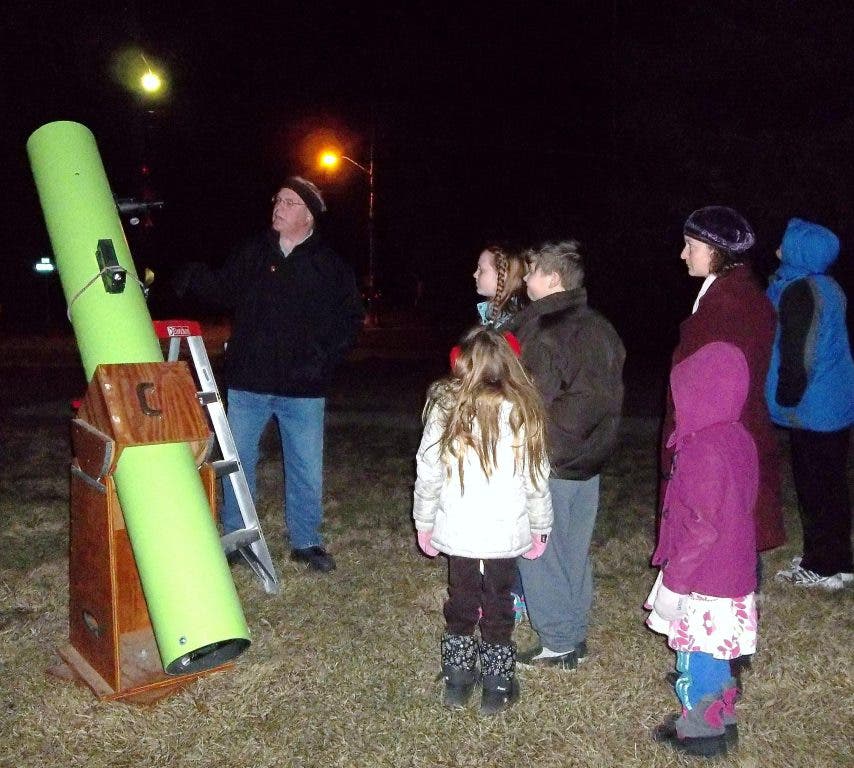

Hartland area Harry Potter enthusiasts enjoyed a chilly night under the stars at the , with astronomer Richard Walker.
Walker, of Longway Planetarium, in Flint, shared how astrology and astronomy connect with author J. K. Rowlings’ famous series of books about the wizarding world.
The event was part of “Harry Potter’s World: Renaissance, Science, Magic and Medicine.” The library has a traveling exhibit, featuring items from the National Library of Medicine. In addition, Cromaine Library has held Harry Potter events, with the next one taking place on Monday and featuring a presentation on herbs. http://evanced.cromaine.org/evanced/lib0/eventcalendar.asp
Find out what's happening in Hartlandfor free with the latest updates from Patch.
Outdoors, guests peered through the large, bright green telescope Walker brought along with him. Walker pointed out four of Jupiter’s moons and the belts on Jupiter. Ben Taggert, a student at Charyl Stockwell Academy, said, “It actually looked like orange and brown, but half of the top was white. It was like two stars on this side, and the other side had one, he said.
“It was pretty cool. They looked tiny,” the 8-year-old said.
He saw clouds on Jupiter, Ben added.
Find out what's happening in Hartlandfor free with the latest updates from Patch.
Kyle Mogg, 12, a student at Ore Creek School, said he’s a Harry Potter fan. He was looking forward to going outside and seeing the moons of Jupiter, just as Potter did in the fifth J.K. Rowling book, Harry Potter and the Order of the Phoenix.
Many characters in the Harry Potter books are named for stars, Walker said. These include Sirius Black, named for Sirius, the “Dog Star,” since Black’s character can change into a dog. Another fictional Harry Potter character, Draco Malfoy, gets his name from the constellation Draco, a dragon. Malfoy was always picking on Potter, Walker said, and in fiction, dragons are reputed to have bad tempers.
Walker gave participants a map of the sky for February, offering suggestions on remembering where certain stars and constellations are located. A red star, Betelgeuse, is in the “armpit” of the constellation Orion, the hunter. And when one squashes a beetle, it produces “Betelgeuse,” he said. Many names of stars, including Betelgeuse, are in Arabic.
Karol Fisco, of Hartland, brought her children, Kayla Fisco, 12, Eric Fisco, 7, and Kelsey Fisco, 4, to the presentation. “We liked it,” Karol Fisco said. “We enjoy learning about the stars and the planets.”
They’ll probably go outdoors to search for Orion’s belt and the other constellations Walker talked about — when the weather gets warmer, Fisco said.
Different people have different ways of remembering where constellations and stars are located. One of Walker’s friends doesn’t see the same pictures in the stars that Walker does. Instead of looking for a scorpion to find Scorpio, Walker’s friend looks for a fish-hook.
That’s how people began studying the sky, Walker said. Five thousand years ago, people didn’t have radios or televisions to keep them entertained when it got dark outside. So, they looked up into the night sky and saw the bright points of light — some of which moved.
The planets are the wanderers in the sky, he said. People watched stars and planets and wondered if these celestial objects could see them and had an affect on human lives on earth.
An experiment he’s performed didn’t support truth in astrological signs and horoscopes, Walker noted. When the identifying dates and signs were taken off horoscopes and only the predictions were left, he asked each person in a group to select which horoscope described his or her day. Less than 10 percent of the group chose the correct horoscope for his or her astrological sign.
But, astrology played a role in astronomy. “Astrology really was trying to make sense of the night sky,” Walker said. “If there hadn’t been a study like astrology, astronomy never would have happened.”
Fun Facts
• Comets are named for the people who discover them.
• The view of the night sky from earth changes depending on what season it is.
• In Michigan, fewer than 100 nights per year are clear. That’s one night out of four, average, that is good for viewing the stars.
• Telescopes might look big and sturdy, but they move very easily.
Source: Richard Walker, Longway Planetarium
Get more local news delivered straight to your inbox. Sign up for free Patch newsletters and alerts.