Schools
Hartland Superintendent Asks Parents to Oppose School Cuts
Classroom reductions likely only place left to reduce costs, Sifferman says.


Hartland instructional programs could be in jeopardy and students face possible larger class sizes next fall under state funding proposed in Gov. Rick Snyder's budget for the 2011-12 fiscal year, said Superintendent Janet Sifferman, who is urging parents to lobby against the reductions by contacting lawmakers.
"The enormity of the cut is just unbelievable to me," she said. "We've been cutting for years … The answer is not that easy."
With a $470 per pupil reduction — which is from a $300 cut proposed by the governor plus $170 not replaced when federal stimulus dollars run out — the district faces losing about $2.6 million. That coupled with an additional $1.2 million in increased costs owed to the state retirement system would give the Hartland Board of Education a nearly $4 million hole to fill as it prepares next year's budget. This year, the budget was about $46 million.
Find out what's happening in Hartlandfor free with the latest updates from Patch.
Under Snyder's plan the reductions, which amount to about 5 percent, would save the state $452.5 million statewide. In addition, intermediate school districts would face a similar percent cut.
Wide-ranging plan
The proposal is part of a comprehensive plan to overhaul state government that include cuts across state government that range from education and state aid to governments to state police and corrections funding. The state faces a $1.4 billion deficit.
Find out what's happening in Hartlandfor free with the latest updates from Patch.
In addition, Snyder wants to revamp the tax system to make the state attractive to investment. Residents, too, would have see a lower income tax but those with pensions would have to pay for the first time.
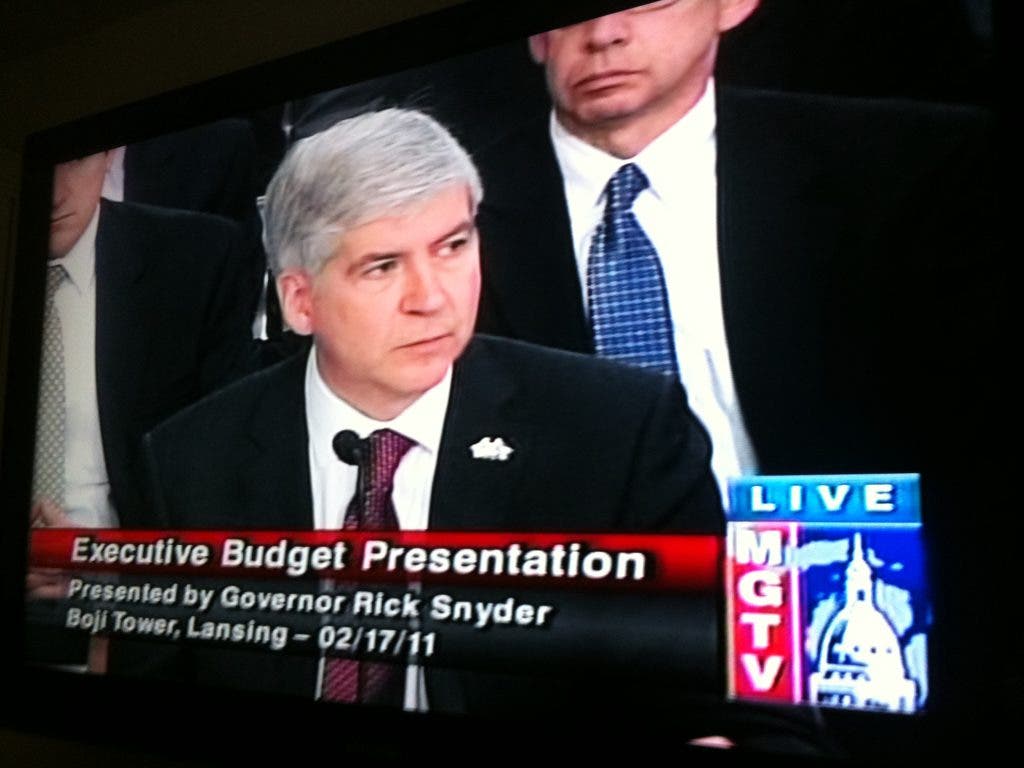
Snyder, who said he'd refund his pay except for $1 this year, spoke in broad terms emphasizing his priorities over specifics, calling the proposal an opportunity to reshape Michigan's future and set an example for the nation. He spoke Thursday for about 35 minutes before the joint session of the House and Senate appropriations, finance and tax policy committees. A more in-depth focus on education reforms is planned for April.
"This day should have happened a long time ago," said Snyder during the address that was televised live on Michigan Government Television. "We shouldn't waste an opportunity. Not doing this would be kicking the can down the road. That's not why I got elected and it's not why you got elected. A lot of us are going to have to make sacrifices.
"The reason to do this isn't to avoid the negative. It's to jump to the positive."
After the governor and Lt. Gov. Brian Calley spoke, state Budget Director John Nixon spoke on many issues including education, saying a system that focuses on early childhood through higher education needs to be adopted. Specifically focusing on K-12, he said districts could avoid instructional cuts if they adopt an 80-20 employer-employee split on their health care contributions. He said that would generate $300 million in savings. In addition, if districts cut 10 percent non-instructional costs by following "best practices," it would generate another $300 million in savings.
"We feel this a very defensive plan that doesn't have to impact the classroom," he told lawmakers. "We know that's the critical area that needs to be maintained in school funding."
But Sifferman said Hartland already has tied in pay and benefits to revenue in its contracts and cut non-instructional costs by privatizing custodial services and contracting its busing with the Livingston Educational Service Agency. She said the district has cut $7 million over the past decade including $1 million last year with employee givebacks at every step.
"We've been proactive," she said, adding that unless things change the board likely will have to look at cuts that would affect students.
Instead of the cuts, Sifferman said the state needs to fully use dollars that were originally intended for education, such as money from Proposal A.
"They've got to quit raiding our funds," she said.
Teacher's union says districts likely would have to cut jobs
On its surface, Snyder’s proposed cuts represents a potential loss of an estimated 10,000 jobs statewide said Don Noble, lobbyist for the Michigan Education Association, which advocates for 157,000 teachers, faculty and education support staff throughout the state. Noble said he’d be immersed in the 140-page bill over the next few days.
“From the kindergarten-through-12th grade standpoint, it’s going to mean very drastic cuts,” he said. “I believe that a lot of hardship for students.”
He said a $470 per-pupil reduction could destroy school districts struggling to survive, put marginal school districts “over the brink,” and put otherwise stable school districts at risk.
“I would expect fairly significant layoffs as a result of this and that translates not only to increased class size but a total elimination of the kinds of things that would be extracurricular programs or elective classes like band and physical education or anything not mandated by the state.”
But some experts say more reform is needed. Former state Superintendent Tom Watkins said Snyder brings hope for fundamental structural changes to health care and retirement costs, which soak up additional revenues.
"Gov. Snyder is doing the right thing to make Michigan competitive on the world stage," he said in an email to Hartland Patch.
"Real change requires real change — and the day has arrived. Remember, the governor will be making his education speech to the Legislature come this April. I suspect even greater change to come then."
What's next
One area lawmaker promises a review of the proposals that's fair to all sides.
State Rep. Bill Rogers, R-Brighton, is the newly-appointed chair of both the Department of Education and School Aid Appropriations subcommittees. Rogers said he will be hands-on when it comes to reviewing the budget.
“I just got the budget myself. I’m tagging it so I can go back and find out what just happened,” Rogers said. “The puzzle is now handed to us. I’ve opened the box and spilled it out and now I have to sit down and put it together see what it’s going to look like.”
Both committees meet next Tuesday to delve into the budget in more depth, hearing presentations by the House Fiscal Agency, along with testimony and phone calls from the public. Rogers said he also hopes to hear from school superintendents in his district, which includes part of the Hartland School District.
“It’s definitely going to be painful,” Rogers said of the cuts.
But he added the bright side is that Snyder is calling something school districts have been requesting for years — consistency. Changes and political wrangling at the state level meant districts often didn’t even know how much they were going to receive from the state until October. Now, the governor himself has demanded a two-year budget by June 1.
“That in itself will help although some of the news as we’re all looking at it, it’s not pretty,” Rogers said.
Rep. Cindy Denby, a Republican whose district includes all of Hartland Township, issued a statement that didn't speak to educational issues directly but said the push for reform is what's needed.
"I applaud the governor for his leadership to start difficult discussions on real government reform and for taking a new approach to how our tax dollars are spent. It is an undeniable reality that some decisions will be uncomfortable for many Michigan residents, but short term pain will lead to long term gain as our state's economy is revitalized," her statement said.
For detailed information about the budget proposal, click here.
Get more local news delivered straight to your inbox. Sign up for free Patch newsletters and alerts.