Community Corner
French Settlers Had Great Impact on Chesterfield
The Salt River inspired a settlement and township inhabitants even had their own dialect called Sugar Bush.


The first French explorers and missionaries came to the area around 1611, naming the dominant waterway Luc Ste Claire on August 12, 1687.
Now called Lake St. Clair, reports vary as to how the lake received its name. Some say it was named for General Arthur St. Clair who was governor of the Northwest Territory from 1787 until 1800. But because the lake was called St. Clair since 1687, it is believed that the lake was named for the French Catholic Ste. Clair, whose feast day is Aug. 12. (Other French water names in the area include the rivers “Aux Vases” and “Crapeau.”)
Settling in Macomb County
Find out what's happening in New Baltimore-Chesterfieldfor free with the latest updates from Patch.
From about 1679 until 1763, French fur traders and homesteaders started settling in the Macomb County area. They befriended, learned from and intermarried with the Native Americans who were there when the French settlers arrived. The settlers built earthen huts and farmed "strip farms," which were long pieces of land. The narrow end was near the lake, taking maximum advantage of the natural waterways. The width of these farms was about 500 feet and extended inland for about a half mile.
The chief commerce of the French settlers was the buying, selling and trading of animal fur and pelts. They adapted the Native American canoes and bateaux to move their furs, as well as using sailboats.
Find out what's happening in New Baltimore-Chesterfieldfor free with the latest updates from Patch.
Settling Along the Salt River in Chesterfield
The French, like the Native Americans, also made salt, so their settlement was known as La Saline and later became known as the Salt River Settlement. This was located at the peninsula where the Salt River connects with Lake St. Clair in Chesterfield Township. Most of the high land of the river was later removed when a gravel pit operated on Baker Road between 23 Mile and 24 Mile. Much of this area is now the . Around the sixth hole of the course there was once an old house where artifacts, including pottery and an 1840s coin, were found.
The salt in the Salt River comes from a salt spring located about four miles from the mouth of the river. Unlike the Native Americans who were content to lay the salt water in the sun and let the water evaporate to get the salt, the French would take the quicker method of boiling away the water to obtain the salt.
Settlers Bring Traditions to Town
Many of the early French settlers in the area did not come directly from France. They hailed from the large French settlements in Montreal and Quebec. Many of the French Canadians settled at the mouth of the Clinton River and in the area of New Baltimore and Anchorville.
The French brought many of their customs to the New World, including having the oldest male inherit the farm. When the other brothers and sisters married they received a dowry from the father, if he was still living. If not, they received it from the oldest brother.
Christmas was a serious holiday, marked by attending Mass. New Year’s Day was the holiday that was celebrated with gift-giving and celebration. New Year’s Day was also the day children honored their parents and ask for their blessing. Another big holiday was Shrove Tuesday, the day before Lent began. If weather permitted, parades were held in New Baltimore and Mount Clemens. The evening dinner was traditionally pancakes sweetened with butter and maple syrup between each layer.
The French pear trees were a favorite part of their orchards. They also developed many new varieties of apples, such as Detroit Red, Roseau, and the Snow Apple.
Horse racing was a much-loved sport. In winter when the snow covered the roads and trails they would race on the iced-over rivers and lakes.
Chesterfield Area Had Its Own Dialect
At one time there was a local French dialect known as Sugar Bush, named for Sugarbush Road. This dialect, also known as “Up River French,” was investigated by linguist Dr. Pilling in February 1960. The last main enclave of the dialect, from where Dr. Pilling assembled the vocabulary, was considered to be Chesterfield and nearby Anchorville and Marine City.
When the British Empire gained control of the land following the French and Indian War, most of the French pioneers stayed on to protect their vested interests. Some had land grants from the Indians and some from the French court. These were honored by both the British and American governments.
Reenacting History in Chesterfield
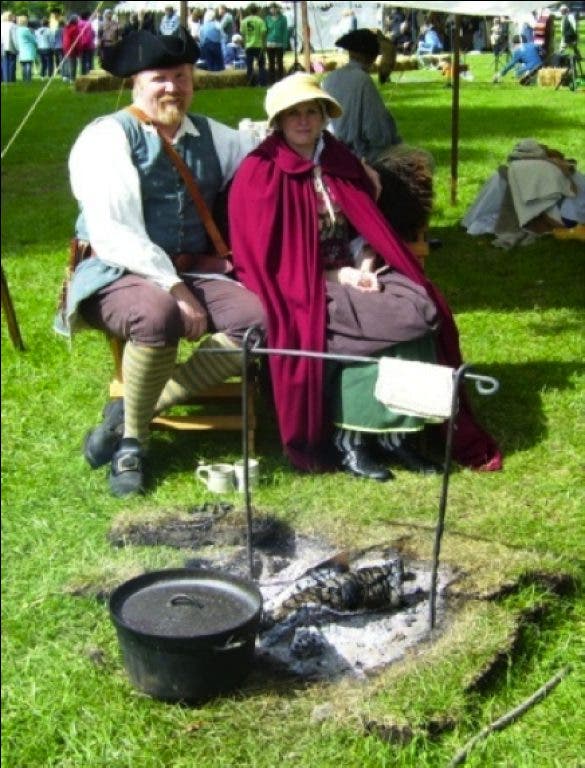
The Anchor Bay area is fortunate to have a group that re-enacts the days of the French settlers.
The Ste. Claire Voyageurs formed in 1994 with Lee Caripidis, Tom Smith, retired head naturalist of the metroparks, Gerry Wykes, an employee of metroparks and Ron Pinson, a retired Department of Natural Resources worker, as charter members.
They ran a classified ad in the metroparks newsletter, seeking people interested in re-enacting the Great Lakes Fur Trade Era of 1600 to 1800. The new members spent the first year learning about the era. They practiced skills, trades and talked with experts.
Once they felt confident that they could re-enact the era—down to the tools and clothing—they held their first encampment. The Voyageurs have had encampments at Metro Beach in Harrison Township every August since. They have also re-enacted the landing of French settlers in this area. Besides Metro Beach, they've held encampments at Port Sanilac and for the first time, .
Voyageurs Bring Detailed Accounts of Past
If you are interested in the early history of our township, then you should. The Ste. Claire Voyageurs recreate what life was like in the early 1700s for the French settlers in the Lower Michigan area.
Visitors to the encampment learn about and experience the rich history connected with the Voyageurs, Coureur de bois, early settlers and military of the Great Lakes fur trade era. Their living history reenactments of the lifestyles and skills of the era include demonstrations and displays of canoe building, traditional crafts and skills, trade goods and artifacts, blacksmithing, campfire cooking, cannons and weaponry. Visitors to the encampments enjoy music, dance, stories, lectures and the sharing of a unique culture and history.
The Ste. Claire Voyageurs, besides the from 10 a.m. to 5 p.m. June 11-12, will be setting up in Port Sanilac, Sanilac County, on June 18 and 19. They will also be at the Port Sanilac Historical Museum just before the main business area and hold the 15th annual encampment on the shores of Lake St. Clair at Metro Beach Metropark in Harrison Township on Aug. 27-28 from 10 a.m. to 5 p.m.
Alan Naldrett is the author of “The History of Chesterfield Township." The Arcadia Publishing book is due for release July 4.