Community Corner
Interurban Provided Northville With Mass Transit
Northville travelers rode the rails on electric streetcars.


A regional mass transit system for southeast Michigan once again is making headlines. Bills recently introduced in the Michigan Senate address formation of a regional authority to consider a myriad of initiatives including high-speed bus service, light rail on Woodward and commuter train service linking Ann Arbor to Detroit.
It is hardly the first time Michigan has considered a regional mass transit system for this area of the state. Truth be told, we’ve been down this road. A little more than a century ago, southeast Michigan had a mass transit system in the interurban electric streetcar. For nearly 30 years, from 1899 to 1928, commuters throughout the region — from Ann Arbor to Detroit and all stops in between and beyond— enjoyed the efficient, economical and comfortable ride of the interurban.
Replacing its predecessor, the steam engine streetcar, electric streetcars came into their own in the late 1890s with streetcar firms capitalizing on the advent of the new technology by building lines that fanned out of Detroit in all directions. Detroit was known as the “interurban capital of America.”
Find out what's happening in Northvillefor free with the latest updates from Patch.
With its central location between Detroit and Ann Arbor, Northville was a desirable location on the interurban line. The first to approach local officials with a proposal was the Detroit, Ypsilanti and Ann Arbor electric line. Its plan was to extend its line through Northville and Plymouth, offering hourly service at a fare of only 5 cents from Northville to Plymouth and 35 cents to Detroit.
Local officials were then approached by the Pike’s Peak & Ann Arbor Railway which not only provided passenger service, but offered transportation of farmers’ milk.
Find out what's happening in Northvillefor free with the latest updates from Patch.
Northville eventually ended up partnering with Detroit and Plymouth in forming the Detroit, Plymouth & Northville Electric Railway (DP & N), later becoming the Detroit and Northwestern Railway Company.
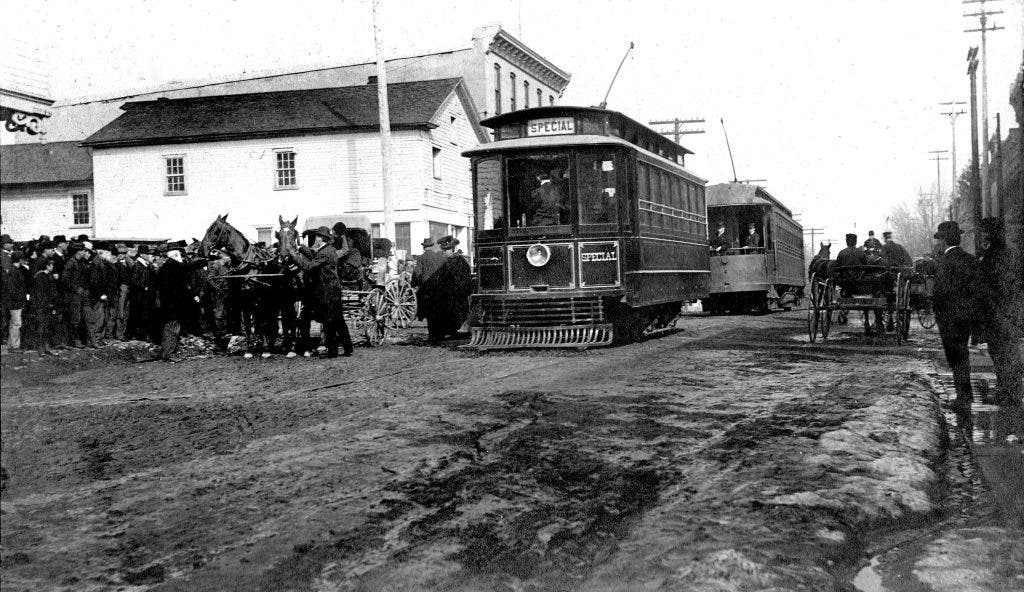
Northville’s first electric streetcar arrived on Main Street from Plymouth on November 10, 1899. A photograph from the Northville Historical Society Archives (see accompanying image) shows the first streetcar’s debut on East Main Street along with the private car of F. W. Brooks, president of the DP & N Electric Railway.
Regular service began the following day, with complimentary rides given to residents. “The cars were crowded beyond even the standing room capacity with Northville, Plymouth, and Wayne people,” reported The Northville Record in a November 17, 1899 article. “It seemed that all the Plymouth people were over here, and all of Northville certainly over at Plymouth. Up till Sunday night more than 1,000 passengers had been carried.”
The fare to Plymouth was 5 cents, Newburg 10 cents, Wayne 15 cents, Detroit and Ypsilanti 35 cents and Ann Arbor 45 cents.
Not long after the original interurban arrived in Northville, another company added a second line. In his book “Northville . . . The First Hundred Years”, Jack Hoffman noted, “with establishment of the ‘north’ line into town, Northville was served by two separate companies that, on Main Street, shared the streetcar tracks.
“The line from Plymouth traveled along what today is the northbound lane of Northville Road Boulevard. It rounded the curve on a bridge over what then was a pond of water and then headed directly east up the middle of Main to Center Street where the line ended.” In the middle of the intersection was the raised bandstand known as the Crow’s Nest.
To turn around, the Plymouth car backed up to and around Griswold and the “north” line, according to Hoffman. Here it stopped, then proceeded front first around the corner headed east on Main Street.
The “north” car entered the village near Griswold and what is now Eight Mile Road, proceeded along Griswold to Main, rounding the corner and traveling west along the joint tracks to Center. According to Hoffman, it “too, backed up, but beyond Griswold so that it would be front first as it rounded the corner and headed north on Griswold past what is today Mill Race Historical Village.”
By 1901, the Detroit United Railway (DUR) consolidated all independent lines into one, and the DP & N became a branch line of the Detroit United Railway.
The interurban proved a boon to local farmers looking to transport goods economically and efficiently. A central DUR freight station, located on the northeast corner of Griswold and Main streets (now occupied by the Water Wheel plant) was the primary location for local farmers to load their milk and produce onto interurban cars for transport to markets and cheese factories.
A waiting room for the passenger cars was located on the west side of North Center Street in a frame building somewhere between the northwest corner and the mid-block. The waiting room occupied the lower level of the building, and Lyman “L.L.” Ball’s photographic studio was on the second floor.
In addition to efficiency and economy, interurban cars appealed to travelers for their speed, comfort and amenities. Because the interurban could travel at speeds of up to 60 miles per hour, pedestrian crossings posed considerable hazards. Cars were heated and contained toilets and drinking fountains. Each car had a motorman who occupied a compartment at the front of the car, and a conductor who collected fares and was responsible for switching trolley cars.
The earliest interurban cars were about 35 feet long, but were later increased to 50 feet in length with some extending to 67 feet. The earliest cars were painted a bright yellow and green, which was later changed to dark red.
The wood base construction of the early cars eventually gave way to steel. An article in the November 26, 1915 issue of The Northville Record described the arrival of 60 new steel cars on the DUR line:
“The steps are so low that the cars are generally designated as “stepless” in actuality they are two short steps within the car. So low are these steps that the designers of women’s dresses haven’t yet made a skirt so narrow that the lady’s hosiery is displayed to the bad man’s eyes when the wearer is boarding the car.
“The seats, designed to fit the curve of the body, are arranged around the car, making a seated capacity of 50. Conveniently arranged so as to assist the passengers in taking their seats — and for other purposes too — are 52 straps all with celluloid handles. Both entrance and exit doors are operated by air control and slide into the walls instead of folding. The windows open by raising instead of by lowering and car is built of steel.
“One great safety arrangement is that the conductor of the trail car is enabled to make an emergency stop of the motor car by pulling a string that sets the brakes on both cars.”
In addition to passenger cars, the interurbans also had other rail equipment such as freight cars and gasoline tankers as well as specialty cars. A 1902 article in The Northville Record highlighted the addition of a funeral car on the DUR that held a casket along with 34 green upholstered passenger seats. The interior of the car was cherry, and contained electric heaters and electric lamps. The exterior was black with gold trim.
When the interurban first made its appearance in Northville, the Flint & Pere Marquette Railroad was still transporting passengers, and pedestrians on Northville’s streets were more accustomed to dodging horses and buggies. By the end of its first decade, the electric streetcar vied for space not only with horses and buggies, but automobiles.
Ironically, one of the DUR’s frequent passengers was Henry Ford. In “Northville . . . The First Hundred Years”, Hoffman noted, “Ford used to drive to Farmington, park his car and climb aboard an interurban, ride into Northville where he visited his Northville plant, and then continued south visiting his plants at Waterford (Six Mile and Northville roads) and at Phoenix Lake (Five Mile and Northville roads).”
In 1919, Henry Ford purchased the former Dubuar Manufacturing plant on the northwest corner of Griswold and Main for the production of Model T and Fordson tractor valves. The plant was replaced in 1936 with an Albert Kahn-designed brick and steel structure distinguished by its water wheel, a symbol of Henry Ford’s “village industries.” The DUR field station was located on the northeast corner of the plant property.
By 1928, automobiles and buses became more popular modes of transportation, and the interurban was discontinued.
In September 1936, the last of the streetcars’ tracks on East Main Street were covered with sand and tar. In 1980, during the Mainstreet ’78 downtown renovation, remnants of the long buried interurban rails were uncovered.
Though little physical evidence remains today of Northville’s interurban past, the Northville Historical Society this year plans to install interpretative displays in the interurban station located at Mill Race Historical Village. The station waiting room, which was originally located at Baseline (Eight Mile) and Haggerty, was moved to the site in 1990.
It remains one of the last tangible reminders of a time when Northville rode the interurban rails.