Politics & Government
Northville Democrats Presenter Talks About Campaign Finance
"Issue ads" give political parties and candidates an opportunity to influence local elections to their benefit — but often at the cost of public policy, a watchdog group says.
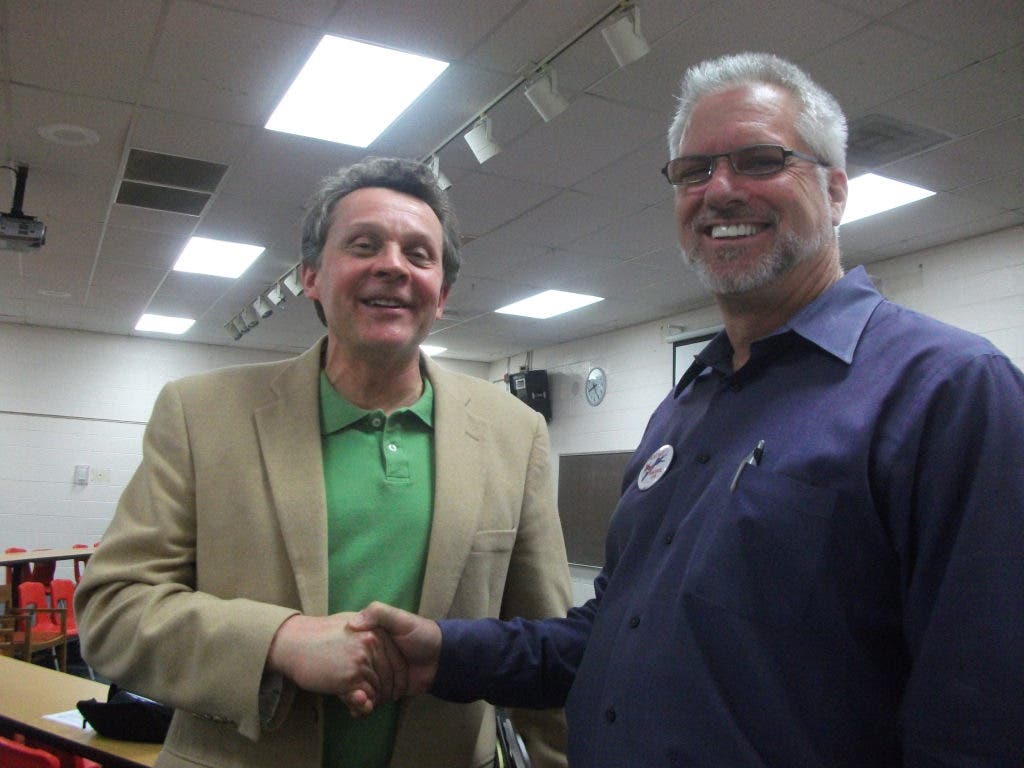
Rich Robinson of the Michigan Campaign Finance Network – a nonprofit, nonpartisan watchdog group that tracks conventional donations as well as donations to political action committees (PACs) – presented its research on campaign finance last week to the Northville Democratic Club.
According to Robinson, as much as $60 million in donations were made to candidates running for several statewide offices across party lines. And, he said, not all of the campaign dollars were publicly accounted for under the state’s campaign finance laws.
"Business groups and other groups don’t donate this money out of altruism, they do so to influence and create policy that favors them,” Robinson told a group of 28 members of the club at . “It’s vital that people know how this works; huge sums of money are moving though the system.”
Find out what's happening in Northvillefor free with the latest updates from Patch.
The net result is that the donations made by business, political and special interest groups for advertising are influencing elections, and finding out the sources of the money that pay for the advertising is impossible because of lax statewide campaign reporting rules, said Robinson.
The ads can avoid disclosure requirements because they don’t specifically ask viewers to vote for a candidate, but they make clear whom they think should and shouldn’t be supported. Each ad does have a disclaimer that identifies the group that is sponsoring the ad.
Find out what's happening in Northvillefor free with the latest updates from Patch.
It’s not just a Republican or Democratic problem, said Robinson.
“These ads have a huge effect on the outcome of elections,” Robinson said. “It’s a huge loophole that I don’t think is going to be closed off any time soon. Both parties are equally adept at exploiting that loophole.”
A complex system
The Michigan Campaign Finance Network’s estimate of $60 million was determined after the network pursued data from television stations, which are required to track political dollars paid for commercials.
“These are the ads that say things like, ‘Why does Virg Bernero hate children, or the elderly,’ ” Robinson said. “They appeal to voters’ emotions.”
Sometimes, the shadow spending for political ads by interest groups outstrips the more transparent traditional spending by candidate committees, Robinson said.
For example, the money spent on candidate-sponsored commercials for the Michigan Supreme Court election exceeded those paid for by PACs by $6 million, with $15 million spent traditionally – and thus reported – and $21 million spent that was not reported. This was a huge change from the mid-1990s, when campaign spending never exceeded $4 million for Michigan’s Supreme Court contests, said Robinson.
Changing tides
Despite the amount of bad ink given to campaign finance during the past several years, there is little will in Washington – or Lansing – to reform the system.
Still, there are some remedies that could help voters weed through tremendous amounts of partisan information on television during election cycles.
Robinson suggests that donors who pay for issue advertisements should be identified in time for voters to consider an ad’s sponsor before an election, not after. Also, candidate and PAC committees should have to file reports more frequently that are broadly available to the public, as should lobbyists.
Scott Craig, the president of the Northville Democrats, said he found Robinson’s presentation “compelling.”
“I think people would really think differently about our political process if they knew this information,” he said.
Joan Wasdworth, who attended the meeting, said she learned a lot from the lecture.
“What surprised me the most is the amount of money,” she said. “That’s a huge sum of money that doesn’t have to be accounted for.”
Robinson said that although the amount of unreported campaign dollars is staggering, what’s more important is the net result of those contributions – the fact that elections can be easily bought is contrary to the best interests of most citizens.
“People need to know that (donors) expect something in return for these contributions,” he said. “The people that make these donations want to hold on to their anonymity. That usually doesn’t translate into good public policy, and we’re crazy to let this continue unabated.”