Community Corner
Northville's Census: History in Numbers
Population statistics reveal more than a century of community change.
It’s all in the numbers.
While Detroit’s staggering population loss revealed in the has overshadowed the of Michigan’s other villages, cities and townships, the Census statistics reveal much about the changing populations of our communities.
Northville’s numbers are a case in point. According to the 2010 Census, the City of Northville’s population decreased 7.2 percent from a decade ago. In 2000, the population was 6,459 compared to 5,970 in 2010. Assessing the numbers by county (the City is divided between Oakland and Wayne counties), the Wayne County portion of the City (south of Baseline Road) saw its population decrease 11.8 percent from 3,107 in 2000 to 2,739. The Oakland County portion of the City saw a decrease of 3.6 percent from 3,352 in 2000 to 3,231 in 2010.
Find out what's happening in Northvillefor free with the latest updates from Patch.
Northville Township saw a gain of 35 percent in the last decade growing from a population of 21,036 in 2000 to 28,497 in 2010.
What do the population numbers tell us about our community?
Find out what's happening in Northvillefor free with the latest updates from Patch.
There is no question that the timing of the Census — in the midst of an economic freefall — had an impact on the statistics. The numbers would likely be different if the Census had been taken in 2005 before the bottom fell out of the housing market and unemployment increased. Nevertheless, economics reveal only one side of the story.
Census numbers over the last century provide an interesting perspective on Northville’s population trends. Even the numbers prior to 1900 offer a glimpse of the changes in the community’s demographics. Once the first settlers established the beginnings of the community in the late 1820s, Northville saw a steady increase in its population over the next 35 years. By 1865, at the conclusion of the Civil War, Northville’s population was approximately 700. By 1890, the population had more than doubled to 1,573 and increased just three years later to 1,721.
The sharp spike in population can be partly attributed to Northville’s thriving manufacturing base. By the 1890s, Northville ranked second only behind Detroit in manufacturing in Wayne County.
Among its most noted industries were the Globe Manufacturing Company which employed more than 200 workers and was the largest manufacturer of church and school furniture in the world; Stimpson Scale & Manufacturing which produced scales and coffee mills; J.A. Dubuar Manufacturing Company which expanded from its sawmill roots to produce other items such as wheelbarrows, pulleys and screen doors; Clover Condensed Milk, founded by Charles Rogers, who invented the first milk condensing machine; and Northville Fish Hatchery, the nation’s first U.S. Fish Hatchery with millions of game fish reared and shipped throughout the world.
As Northville’s manufacturing expanded, so too did its population. To accommodate a growing work force, new residential sections were added to the village. By 1899, workers began commuting from outside the village limits on the interurban — or electric streetcar.
The Village of Northville’s population changed little from 1890 to 1920. By comparison, Northville Township, which was predominantly farms, had a population of 616 in 1900, 609 in 1910 and 511 in 1920. Nevertheless, by 1930, the population in both the village and township had spiked with the village population at 2,566 and the township at 2,656. For the first time, the 1930 Census recorded the population numbers for both the Oakland and Wayne County portions of the village with 87 residents in Oakland County and 2,479 in Wayne County.
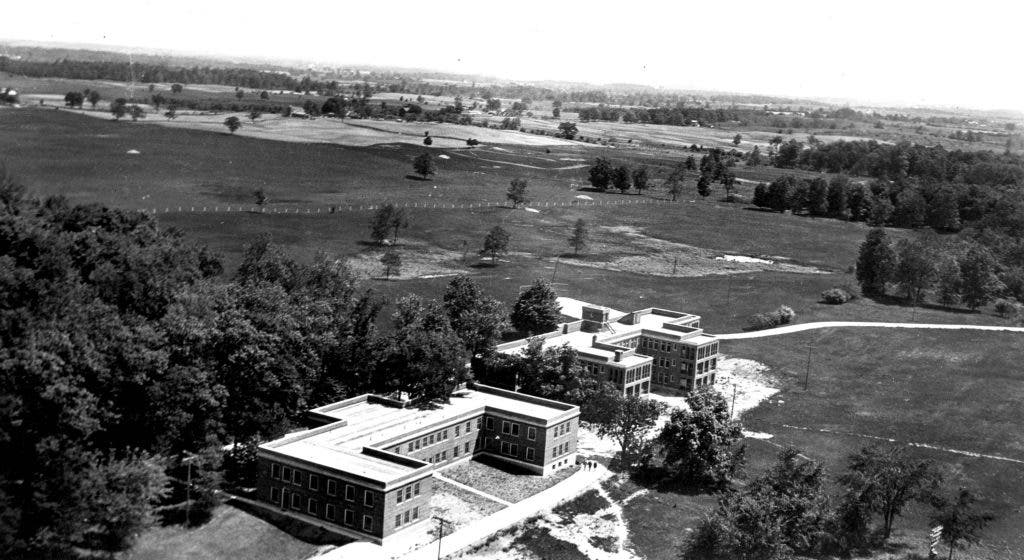
The increase in population in the township in the decade between 1920 and 1930 is likely due to the construction of the renowned Maybury Sanatorium, a leading center for the treatment of tuberculosis opened in 1921 on a 900-acre site in Northville Township. Maybury would be the first of many state institutions to be built in the township over several decades. (The Northville Township Historic District Commission will present a program titled Prison Bars and Hospital Beds on April 13 that looks at these historic institutions. See below for details).
In the village, a sanatorium for the treatment of tuberculosis was built by Dr. A.B. Wickham on the former site of the Buchner mansion on High Street. The construction of Eastlawn Sanatorium may have attributed to the increase in the village population to 3,032 between 1930 and 1940.
Northville Township’s population soared in the decades between 1920 when the population was 511 to 1960 when it increased to 7,548. One-third of the township’s territory was occupied by facilities such as Maybury Sanatorium, the Wayne County Training School, the Detroit House of Correction Women’s Division, Northville Psychiatric Hospital, the Plymouth State Home and Training School and Hawthorn Center. The 1960 township population of 7,548 included 4,413 institutional residents and 3,145 non-institutional residents.
In 1955, Village of Northville voters approved city incorporation, forever changing the village status. During the next decade, the city boundaries expanded through annexation of portions of Novi Township and the village of Novi both east and west of the city and north of Baseline. The city’s northern boundary was fixed by the incorporation of the Village of Novi into the City of Novi in 1969.
The greatest area of growth in the city occurred north of Baseline in the decades between 1960 and 2000. Several large housing developments brought about a surge in population. By 1980, the City of Northville’s population was 5,698 and by 1990 it reached 6,226. The 1990 Census showed for the first time that the city’s population residing in Oakland County exceeded its population in Wayne County.
In the township, the institutional population diminished with the closure of many of the state-operated facilities. Nevertheless, the implosion of residential development during the last 30 years has resulted in unprecedented population growth in the township. In 1980, the township’s population was 12,987. By 1990, it had grown to 17,313 and by 2000 to 21,036.
When the details of the 2010 Census are analyzed – age, employment, ethnicity, and income are only a few of the details included – the results will give us a snapshot of Northville in the first decade of the 21st century.
I think we'll find it’s all in the numbers.
Prison Bars and Hospital Beds, a program highlighting the historic institutions of Northville Township, will be presented at 7 p.m. Wednesday, April 13, in the Northville High School Auditorium. Sponsor for the program is the Northville Township Historic District Commission. Admission is free, but donations will be accepted to support the commission’s research.