Kids & Family
20 Years Ago Today, Gas Explosion Rocked Downtown Rochester
Where were you on May 20, 1992? It was a day of destruction — and death — in our downtown's history. 'That tragic event changed my thinking about what's truly important in life,' one business owner recalls.
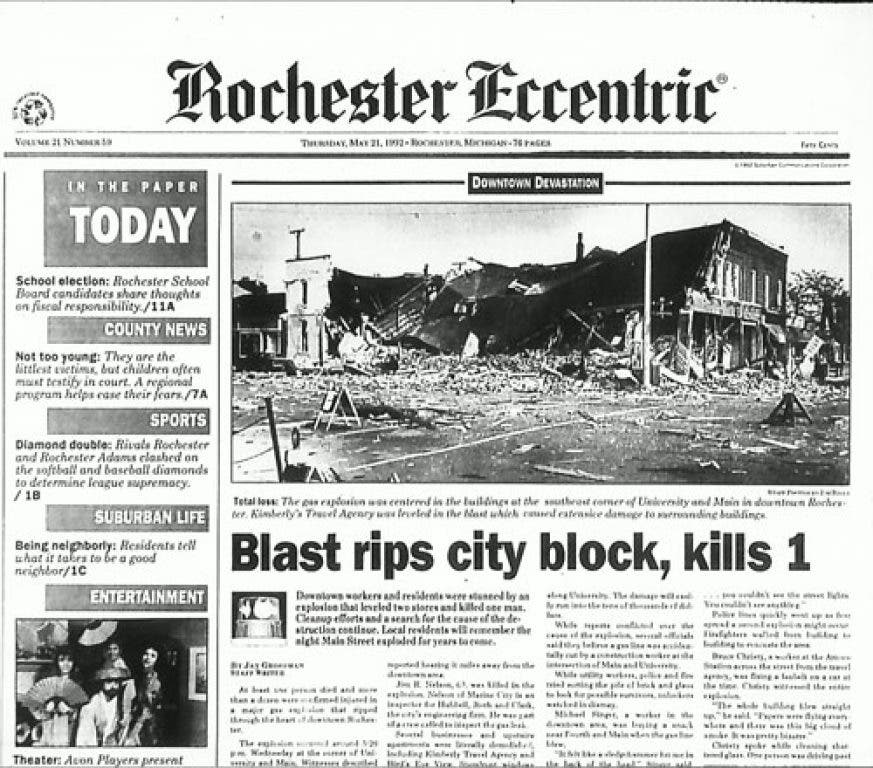


It was the blast heard around the city and for miles away. Some likened it to a bomb exploding and in many ways they were right.
On May 20, 1992, a fatal natural gas explosion at the southeast corner of University Drive and Main Street in downtown Rochester leveled two stores, some second-floor apartments and a huge portion of the historic J. W. Smith/Crissman building, where now stands.
Find out what's happening in Rochester-Rochester Hillsfor free with the latest updates from Patch.
Here's the story of what happened on that tragic day in our town's history, gleaned from a variety of published reports of the event.
A spring day turns chaotic
It was a bright, sunny Wednesday afternoon. Like most days, merchants were busy in their stores and shoppers strolled down the sidewalks. But later that afternoon, store personnel, office workers, residents and pedestrians in and near the J.W. Smith/Crissman building were being told to evacuate the premises immediately.
Find out what's happening in Rochester-Rochester Hillsfor free with the latest updates from Patch.
Among those warning people to get out was Jim Nelson, the chief construction engineer for Hubbell, Roth and Clark, a civil engineering firm hired by the city of Rochester to plan and oversee a beautification project jointly sponsored by the Downtown Development Authority.
Nelson, who was attempting to evacuate people when the blast occurred at approximately 5:20 p.m., was killed in the explosion and more than a dozen people were injured by shattered glass, flying debris and the deafening noise.
More than half of the building, whose tenants included Kimberly Travel, Bird’s Eye View, P.R. Haig Jewelers (now ) and apartment dwellers, was leveled in seconds. Kimberly Travel, Bird’s Eye View and the upstairs living quarters were completely demolished, while P.R. Haig Jewelers, like several stores and buildings along Main Street and even University Drive, sustained minor structural damage, including blown out storefront windows and collapsed ceilings.
Emergency crews were on the scene immediately. Police cordoned off the area as firefighters entered the building looking for people who may have been trapped or too injured to move. They were soon called back, however, out of fear there would be a second explosion. Evacuations continued as firefighters made their way down Main Street, building-by-building.
When utility crews were able to shut off the gas to the exploded building, firefighters resumed their search for possible victims.
Considering that the blast occurred at rush hour, there were few casualties reported and no one was trapped in the building.
According to a report in the May 21, 1992, edition of the Daytona Beach News-Journal, “Motorists driving by at the time reported suffering from ruptured eardrums, and passers-by said they were hit by bricks and other debris.”
The injured ranged in age from 29 to 63. Most were treated at area hospitals and released, while nine others were hospitalized.
It felt like a sledgehammer
Witnesses interviewed at the time by the Rochester Eccentric compared the tragic event to a bomb being detonated as the explosion was heard for miles throughout Rochester and Rochester Hills.
The day after the tragedy, local papers reported that a worker from VIL Construction of Sterling Heights, a firm hired to install new lampposts and other enhancements downtown, hit and ruptured a natural gas line while planting trees. Some merchants, including Paul Haig, owner of P.R. Haig Jewelers and who was in his store at the time of the blast, told the newspaper he and an employee had smelled gas that afternoon and first thought there may have been a sewage backup in the basement of the store.
Haig was one of the first to make a call to report the smell of gas.
On May 21, 1992, the Rochester Eccentric reported that Consumers Power Co. had a received a call from a VIL Construction employee about a gas leak and that a Consumers representative “headed out immediately missing the explosion by mere minutes.”
Nelson, 61, had also been called in to inspect the gas leak.
Michael Singer who worked downtown and was near Fourth and Main when the blast occurred told the Rochester Eccentric in May 1992 that the blast “felt like a sledgehammer hit me in the back of the head. There was this giant cloud of smoke . . . you couldn’t see the street lights. You couldn’t see anything.”
Later that night, then-Michigan Governor John Engler toured the devastation as workers boarded up storefront windows and swept away debris. The Rochester Eccentric reported that about 30 prison trustees were brought in by the Oakland County Sheriff’s Department to assist in cleaning up the rubble and a Salvation Army Truck from Pontiac arrived on the scene to hand out refreshments to workers and those effected by the blast.
How did this happen?
In the weeks and months that followed the explosion, questions arose over who was to blame for the ruptured gas line. Consumers Power Co. blamed VIL Construction and VIL in turn blamed Consumers. Police and city officials at the time told news reporters it was a question that would be left to the courts to answer.
More recently, it’s been reported that the debate over who did what was misconstrued. It seems both VIL Construction and Consumers Power Co. had done their work properly, locating and marking gas lines before the digging and installation of lampposts and trees.
On the web site oaklandregionalhistoricsites.org, maintained by the Rochester-Avon Historical Society, a description of the J.W. Smith/Crissman Building states that on May 20, 1992, the “construction crew hit an illegal and unknown gas line in the area.”
Looking back: 'Life is fleeting'
In the 20 years that have passed since that tragic day, many, including Haig, still remember it vividly.
“Someone dropped a diamond on the floor and all of us – every employee working that day – were on our hands and knees looking for it when the explosion occurred,” remembers Haig. “Glass flew over our heads as the storefront windows imploded. The ceiling in my office also collapsed moments after I stepped out to help look for the diamond.”
As Haig explains it, the reason much of his store was spared is because all of the doors and windows were open that afternoon causing minimal pressure build-up when the explosion occurred.
Amazingly, no one in Haig’s store was injured. But why were they still in the store at the time of the blast?
“No one came to warn us or evacuate us,” he says. “My guess is that no one thought we were in danger since we were three doors down.”
But the effects of that tragic day linger.
“Even now I think about the damage done that day and how that tragic event changed my thinking about what’s truly important in life,” said Haig. “It made me think how much more important life is than the objects we attain.
"Even though I’m a jeweler who specializes in and works with objects all day long, it’s really the people that surround us and what we do in life that matters most. Life is fleeting.”
Historical Note: The J.W. Smith/Crissman Building
Originally built in 1901, the J.W. Smith/Crissman building was a two-story brick building designed by Michigan architects Frederick H. Spier and William C. Rohns who, according to oaklandregionalhistoricsites.org, were noted designers of Michigan railroad stations including the Michigan Central Railroad depots in Ann Arbor and Niles, the Union Depot in Lansing and the Union Station in Durand.
The site also notes that the building was built by James Wilson Smith, owner of the St. James Hotel which once stood directly across the street on the southwest corner of Main and University. The building’s early twentieth-century tenants included the North End Café, Edwin A. Hudson grocery, and Smith’s Idle Hour Theatre.
From 1925 to 1966, the building housed the Crissman Pharmacy. Soon after the explosion in May 1992, the Crissman family rebuilt the southern portion of the building that was destroyed in the blast.
Built in 1992-1993, the new section recreated the building’s original brickwork designs, ornamental detail and even the 1901 marker at top. The only original portion of the building still standing is the southern-most section occupied today by .