Politics & Government
6th Circuit Sets Stage for Supreme Court Showdown on Gay Marriage
The 2-1 ruling upholding the right of voters to impose same-sex marriage is the first defeat in a string of appeals court victories.


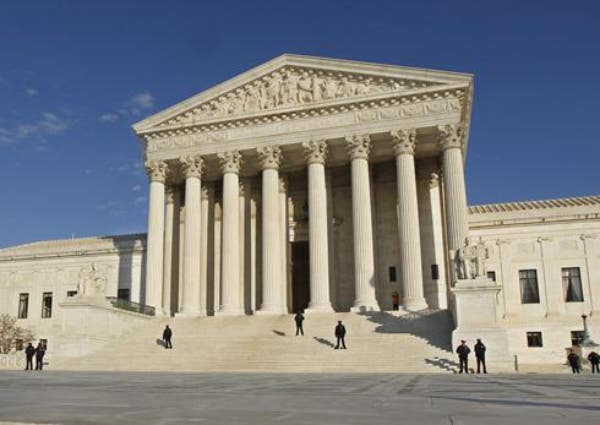
The 6th U.S. Circuit Court of Appeals has upheld same-sex marriage bans in Michigan and three other states in a ruling that sets the stage for a full hearing before the U.S. Supreme Court.
The ruling handed down in Cincinnati Thursday is the first defeat for same-sex marriage proponents in a string of appeals court victories that made gay marriage legal in 32 states, USA Today reports. Rulings earlier this year by the 4th, 7th, 9th and 10th circuits struck down same-sex marriage bans from Alaska to Florida.
In Minneapolis earlier this fall, Justice Ruth Bader Ginsburg said a ruling against same-sex marriage from the 6th Circuit panel would increase the likelihood of quick consideration of the issue by the high court.
Find out what's happening in Rochester-Rochester Hillsfor free with the latest updates from Patch.
Bans in Ohio, Kentucky and Tennessee were also upheld in Thursday’s 2-1 ruling by the three-judge panel that heard appeals filed after federal judges in each of those states ruled the bans unconstitutional.
The Michigan case was brought by Hazel Park nurses Jayne Rowse and April DeBoer, who said the state’s voter-backed ban prohibited them from jointly adopting children. After U.S. District Court Judge Robert Friedman’s historic ruling declaring the ban unconstitutional, about 300 couples rushed to county clerks offices to obtain marriage licenses before the 6th Circuit issued a stay of the ruling.
Find out what's happening in Rochester-Rochester Hillsfor free with the latest updates from Patch.
In his appeal, Michigan Attorney General Bill Schutte argued that the will of voters should be upheld. The court agreed. Republican-appointed Judge Jeffrey Sutton wrote the 42-page decision, and another GOP nominee, Deborah Cook, concurred.
“When the courts do not let the people resolve new social issues like this one, they perpetuate the idea that the heroes in these change events are judges and lawyers,” Sutton wrote. “Better in this instance, we think, to allow change through the customary political processes, in which the people, gay and straight alike, become the heroes of their own stories by meeting each other not as adversaries in a court system but as fellow citizens seeking to resolve a new social issue in a fair-minded way.”
In a 22-page blistering dissent, Democratic appointee Judge Martha Craig Daughtrey disputed Sutton’s reasoning.
“If we in the judiciary do not have the authority, and indeed the responsibility, to right fundamental wrongs left excused by a majority of the electorate, our whole intricate, constitutional system of checks and balances, as well as the oaths to which we swore, prove to be nothing but shams,” Daughtrey said.
Gay marriage is now legal in 32 states: Oregon, Pennsylvania, Massachusetts, California, Connecticut, Iowa, New Hampshire, Vermont, New York, Maine, Maryland, Washington, Delaware, Hawaii, Minnesota, New Jersey, Rhode Island, New Mexico and Illinois.
The Cases Before the 6th Circuit
Michigan: On March 21, U.S. District Judge Bernard Friedman ruled against Michigan’s voter-backed ban on same-sex marriage in DeBoer V. Snyder. The case was filed by a lesbian couple who wanted to jointly adopt children, but were prohibited from doing so by the 2004 voter-backed ban on same-sex marriage.
During the 24 hours that same-sex marriage was legal, more than 300 couples wed, only to have their marriages put on hold when the 6th Circuit granted a stayin the decision. The marriages are legal, but Michigan won’t recognize them until the issue is sorted out by the 6th Circuit. U.S. Attorney General Eric Holder said that for federal purposes, the marriages are legal.
Kentucky: On July 1, U.S. District Judge John G. Heyburn III ruled in Love v. Beshear against a provision forbidding the commonwealth from performing same-sex marriages. That ruling followed a Feb. 12 ruling in Bourke v. Besher that said the Commonwealth could not refuse to recognize valid same-sex marriages performed in other states.
Heyburn stayed his own rulings pending an appeal to the 6th Circuit.
Ohio: Two Ohio cases have been consolidated in the appeal before the 6th Circuit. On Dec. 23, 2013, U.S. District Judge Timothy Black ruled in Obergefell v. Himes that Ohio’s refusal to recognize a same-sex marriage performed in another jurisdiction was unconstitutional. The case was filed on behalf of Jim Obergefell and John Arthur, who wanted their Maryland marriage to be recognized on Arthur’s death certificate before he died. The court ordered the state to recognize the marriage when Arthur died in October 2013.
In a subsequent ruling in Henry v. Himes, Black ruled that the state must recognize the marriages of all same-sex couples performed in other jurisdictions.
Tennessee: On March 14, U.S. District Judge Aleta Trauger ordered Tennessee officials to recognize three same-sex marriages performed in other jurisdictions. The ruling was later stayed by the 6th Circuit.
Related:
- Judge Rules Ban Unconstitutional; Wedding Bells Can Ring for Gay Michigan Couples
- 6th Circuit Stays Historic Gay Marriage Ruling
- Governor: Gay Marriages Legal, But State Won’t Recognize Them
- 6th Circuit’s Marathon Gay Marriage Hearing Signals Historic Shift
- Supreme Court Clears Way For Gay Marriage In Virginia, 4 Other States
- 6th Circuit Could be Pivotal in Gay Marriage Debate
____
Photo via Creative Commons
Get more local news delivered straight to your inbox. Sign up for free Patch newsletters and alerts.