Schools
Oakland University English professor's bilingual novella explores the creative power of words
Doris Plantus wrote a novella in Romanian and English. The story invites readers to reimagine the history of the world.
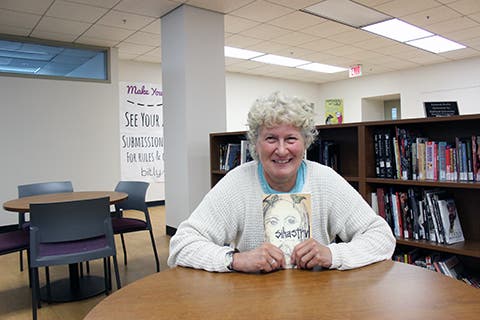

For Doris Plantus, words are the essence of life. The special lecturer in Oakland University’s Department of English recently published her first novella, “Sihastrul: The Hermit,” which explores how language has shaped human experience, literally, since the beginning of time. In the foreword to her work, Dr. Plantus describes the novella as “a collection of apocryphal works, whose themes offer a sense of innocent, if quirky, ingenuity with which to reimagine the history of the world.”
“At its heart, its a story about words and how words tell stories,” Dr. Plantus said. “The main character searches for the very first word by chiseling out letters from inside a cave.”
The story is inspired by Daniil Sihastrul, (Daniel the Hermit), a 15th-century saint of the Romanian Orthodox Church. A mix of prose and poetry, the narrative “is told from different points of view across a timeless expanse from the very beginning of the world, to present day,” the foreword explains. References to God, Heaven and humanity abound in this slender volume of cosmic proportions.
Find out what's happening in Rochester-Rochester Hillsfor free with the latest updates from Patch.
Starting with language
The novella is steeped in words and meaning. Dr. Plantus began writing the narrative in Romanian, then translated it into English. Born in Detroit, she grew up in a primarily Romanian household. Her father was born in Romania and her mother was born to Romanian parents, who had immigrated to the United States. Coming from a bilingual culture has given Dr. Plantus an appreciation for language, which is expressed through her writing.
Find out what's happening in Rochester-Rochester Hillsfor free with the latest updates from Patch.
“The world is created by language...that’s where you start,” she said. “Language is so much more powerful than we give it credit for.”
With artistry and sensibility, Dr. Plantus weaves a tale rich in meaning and purpose. Her words are her own in both languages, which distinguishes her from other writers.
“A lot of writers have had their work translated into other languages,” Dr. Plantus said. “But I can count on one hand the number of writers who can write in more than one language.”
Found in translation
As a bilingual writer, Dr. Plantus was able to translate her work with uncompromising authenticity.
“People always say that you lose something in translation, but I came to find out that it’s not so much about the loss of meaning, but about the meaning you discover,” Dr. Plantus explained. “When you have to try to understand what a word means, you look at other words to figure out the meaning. The words I chose may not have been the choice of another translator.”
Dr. Plantus said that when she began writing Sihastrul roughly a decade ago, it was in the form of an epic poem. As she began to translate it into English, the form shifted to a short story and eventually into a novella. It is composed of 20 books, which are unified by the main character, a cave-dwelling hermit who seeks the meaning of the life by trying to discover the very first word.
“It developed as an alternative version of the (Biblical) Creation story, offering other possibilities of what might have happened (at the beginning the world),” Dr. Plantus said.
Dr. Plantus first published the novella online, in Romanian, with the help of a colleague at the University of Bucharest, in Romania. She later sent the manuscript to OU alumna Rebecka Vigus, owner of Lilac Publishing, who published a paperback and Kindle version in English in February 2015. A Romanian paperback version is forthcoming.
Student to teacher
Dr. Plantus is also a graduate of OU, having earned a bachelor’s and master’s degree in English, before going on to receive her Ph.D. from Wayne State University. She began teaching at OU in 2005 as a visiting professor. One of the most rewarding aspects of her career, she says, has been the chance to learn from professors who are now her colleagues.
“I always found professors to help me study the things I needed to achieve my goals,” Dr. Plantus said of her time as an OU student.
These experiences have contributed to her success as an instructor. She taught the first translation seminar offered at Oakland, which explored the significance of translation as a means of historical preservation. She also taught the first screenwriting course at Oakland, prior to the inception of OU’s Cinema Studies program. She has taught courses in modern and world literature, fiction and Bible as Literature, as well as an Honors College course titled Photography as Text, which focused on constructing a narrative based on a photograph. In 2012, she was honored with OU’s Excellence in Teaching Award. She says her experience with diverse media and cultures helps her connect with students.
“I have a good relationship with students,” Dr. Plantus said. “They respond to my interdisciplinary background because they come from so many different backgrounds.”
Dr. Plantus’s creative talents aren’t limited to the written word. She drew the artwork for the cover of her novella and is also skilled in painting, sculpture, woodworking, photography and music – she plays the accordion.
Asked about the motivation for her artistic and literary pursuits, she said, “Mine is a creative search for the meaning of life down to its smallest particle. It cannot be detected in a lab, or in a mathematical formula. Rather, it lies in the very first word that continues to unleash its passion from the very beginning of Creation. Sihastrul is both the character and concept that defines my journey.”
For more on Dr. Plantus’s work, visit her website at bucovinamica.net.