Politics & Government
Activist Tom Hayden, 'At the Creation' of '60s Movement, Donates Personal Papers, FBI File
The Port Huron Statement, other personal papers of the Royal Oak activist shedding light on the turbulent 1960s are coming home to U-M.


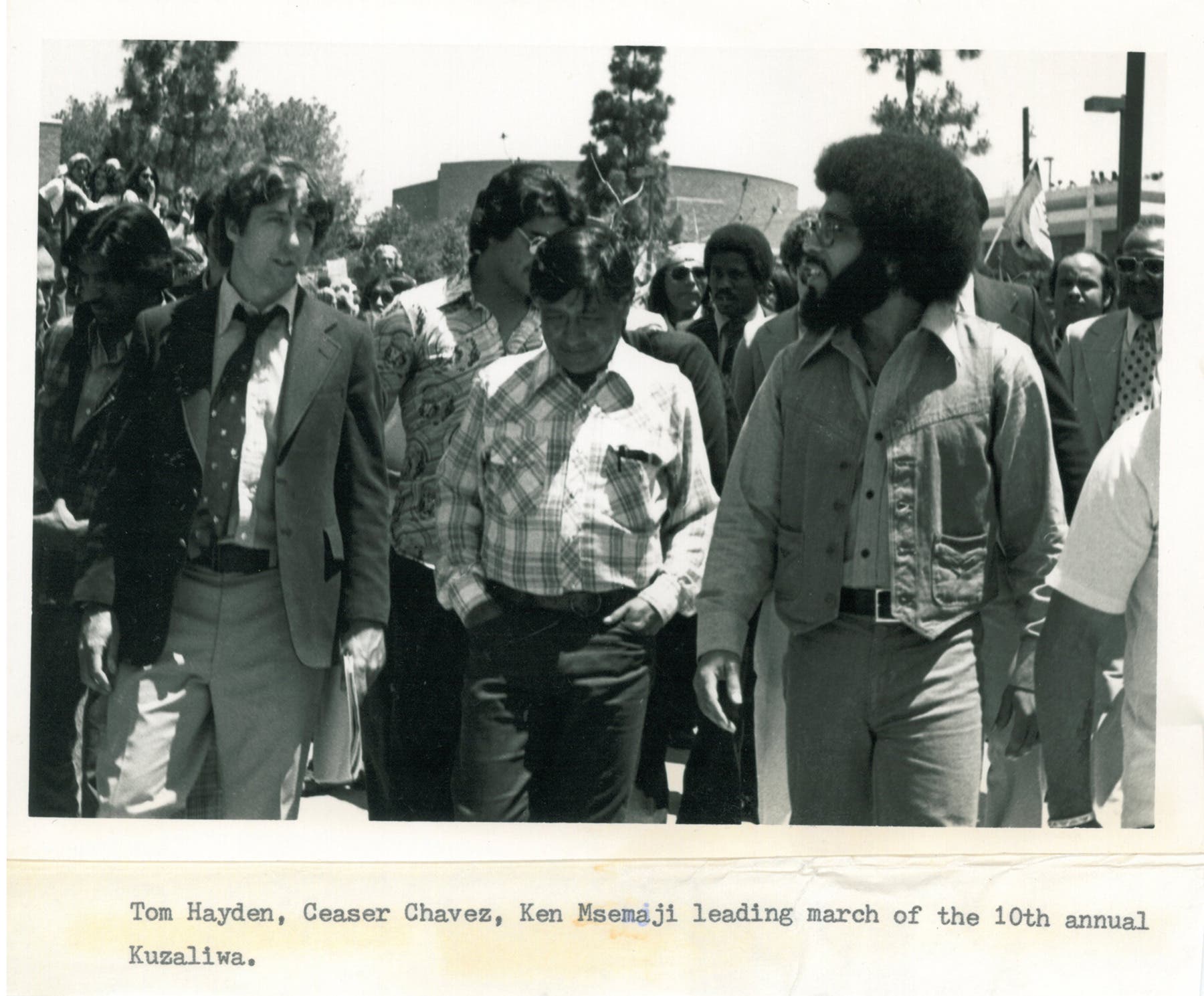
From left, Tom Hayden, Cesar Chavez (United Farmworkers Union), and Ken Msemaji (Nia Cultural Organization) leading the march of the 10th annual Malcolm X Kuzaliwa (birthday) celebration, May 1977. (Image credit: Tom Hayden Papers held at the University of Michigan Library)
___________________________
Activist Tom Hayden, who presided over campus demonstrations during the turbulent 1960s as one of the founders of the Students for a Democratic Society, is donating his personal papers – including a thick FBI file – to the university that was at the apex of the revolution.
Find out what's happening in Royal Oakfor free with the latest updates from Patch.
“Tom was there ‘at the creation,’ you might say, of the ‘60s protest movements,” Howard Brick, the Louis Evans professor of history in the College of Literature, Science and the Arts at the University of Movement, said in a news release.
The collection of his papers “provides evidence of how the dissent of the 1960s had a life-long effect on the social and political life of the U.S.,” Brick said.
Find out what's happening in Royal Oakfor free with the latest updates from Patch.
Hayden, a Royal Oak native and U-M graduate, was the primary drafter of the “Port Huron Statement,” a 1962 manifesto that contained 25,000 words – 7,000 more than the Communist Manifesto, The New York Times wrote in a 2012 look back at the document at 50.
Tell Us:
- What are some the important legacies of the 1960s campus protests?
The Times noted that its lasting legacy may be limited to a line from “The Big Lebowski,” in which the stoner protagonist claims to be the author of “the original Port Huron Statement, not the compromised second draft.”
But historian Michael Kazin disagrees, calling the document “the most ambitious, the most specific and the most eloquent manifesto in the history of the American left.”
The “radically new democratic political movement” rejected hierarchy and bureaucracy.
Hayden, whose activism began a career that included stints as a politician, education and author, said in a news release that “Ann Arbor is where a new life began for me.”
“So many memories are deeply embedded there,” he said. “There are so many ‘nuggets’ in these thousands of pages, and I want to share my interpretations with the young student researchers who will become the future. Perhaps there is more to discover. Listening carefully to each other creates a missing link.”
Hayden’s papers will be open to the public for perusal, beginning in the middle of September. Hayden plans to attend a Sept. 18 public reception at Hatcher Graduate Library, and will meet with the staff of the Michigan Daily, where he was the editor from 1960-61, while he’s in town.
The collection includes 120 boxes of materials spans Hayden’s youth in Royal Oak to his most recent activities, including Hayden’s FBI file – all 10 linear feet of it, which Hayden, ex-wife Jane Fonda and folk singer Joan Baez obtained after suing the government for illegal surveillance.
The detailed government records of Hayden’s travels, speeches and other activities spanning the 1960s and ‘70s, though redacted in parts, offers a fascinating view of the government’s access to and reporting of a private citizen’s life, U-M said.
As one of the “Chicago 8,” he was indicted for conspiracy after organizing anti-war protests outside the 1968 Democratic National Convention. He was a founder of the Indochina Peace Campaign and the Campaign for Economic Democracy, among others.
Hayden was also involved in the civil rights movement, working with the Student Nonviolent Coordinating Committee and fighting racial segregation in the South with the Freedom Riders.
Hayden served nearly 20 years in the California state legislature, and has written 20 books. His most recent book is titled “Inspiring Participatory Democracy: Student Movements from Port Huron to Today.”
The Tom Hayden Papers will become part of the University of Michigan Library’s Joseph A. Labadie Collection.
Get more local news delivered straight to your inbox. Sign up for free Patch newsletters and alerts.