Schools
Science lessons sink in at Velocity Jr.
Love of science surfaces in underwater robotics program
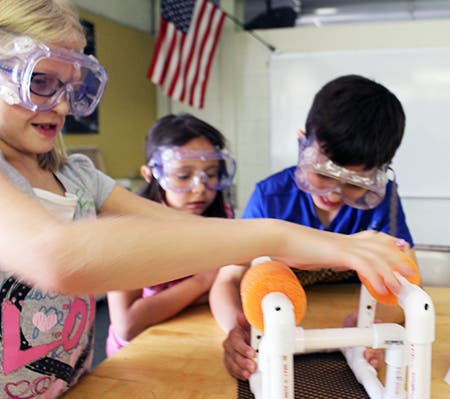
A group of students recently plunged into science at an underwater robotics camp.
The week-long camp, one of nearly 20 science and technology-related programs offered at the Velocity Jr. site this summer, allowed students to build and tests a working underwater robot.
“I have always enjoyed building things, so I thought this would be a lot of fun,” third-grader Emily Leusby said. The program allowed students to spend a week building a hands-one, fully functional ROV - Remotely Operated Vehicle - from scratch.
Instructor Ashley Evard said the program also shows students the real-world applications of underwater robotics - such as its applications for submarines.
“I want students to have fun but also learn more about the real-world use of STEM (Science, Technology, Engineering and Mathematics,” she said.
Students create their robots out of pieces given to them in a big bucket. The students used PVC pipe in various lengths, foam for buoyancy, connecters and plastic parts like propellers etc. to end up with a unique vehicle of their team’s design.
The program stresses physics principles such as buoyancy, force and motion, and basic design engineering principles: brainstorming, designing, building, testing, modifying, and perfecting.
Fourth grader Marcello Piazza said his interest in robotics comes from his uncle.
“My uncle works in robotics so I have a lot of fun helping him with projects,” he said.
The day before the units were being tested in an underwater testing, students were putting the final touches on their robots. Both Piazza and Evard felt their robot was ready for the water, but they still had a plan B.
“If something happens, I’ll dive in after it,” Leusby said.
The underwater robotics course was the final class this summer at Velocity Jr. - a Science, Technology, Engineering and Mathematics (STEM) partnership between UCS and the city of Sterling Heights designed to create and sustain a workforce capable of filling current and future high-tech job opportunities that will help Michigan’s economy grow.
Velocity Jr. was also partially funded through a $12,500 grant from the FCA Foundation, formerly The Chrysler Foundation.