Community Corner
'Leap Second' to be Added June 30 As Earth's Rotation Slows
No one knows exactly why the Earth is moseying in trip around the sun; after Leap Second ate the Internet in 2012, not everyone likes it.


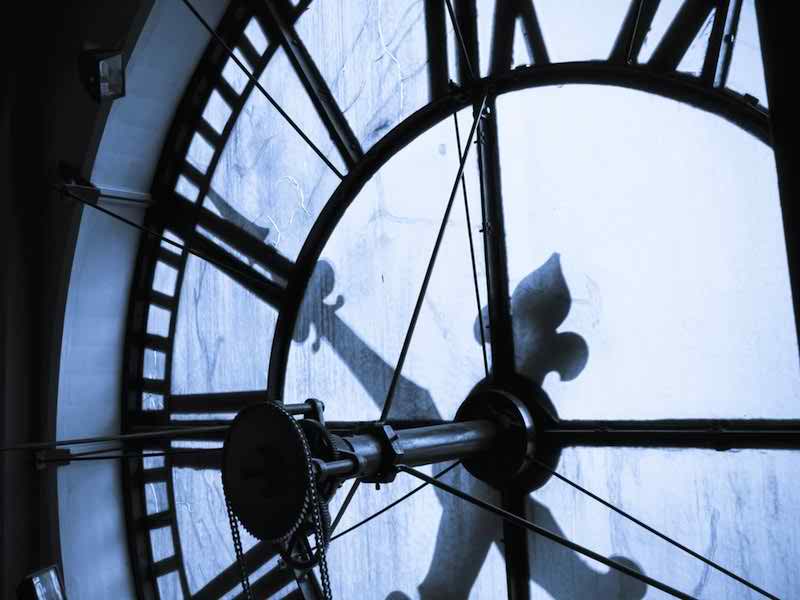
An extra second, called a Leap Second, will be added to the world clock at 11:59:59 p.m. Tuesday. (Photo via Shutterstock)
__________________
After the summer solstice, the days began getting shorter. That hasn’t changed, but something unusual will happen Tuesday, June 30, just before the stroke of midnight: The day will be stretched just a wee bit longer.
Find out what's happening in Trenton Grosse Ilefor free with the latest updates from Patch.
It’s not something like Daylight Saving Time, which messes with your internal time clock. You won’t even notice that a “leap second” has been added for an extended, 61-second minute. It’ll happen in less than a blink of the eye.
If everything goes as planned, the atomic clocks should read 23:59:59, then 23:59:60, before switching over to Wednesday with 00:00:00.
Find out what's happening in Trenton Grosse Ilefor free with the latest updates from Patch.
NASA scientists say it’s necessary to synchronize the world’s clocks with the Earth’s rotation to correct a bit of fudging about time it really is.
You see, days don’t uniformly consist of exactly 86,400 seconds – a fact that, really, only rocket scientists and the quiz bowl circuit care about. It’s explained by a complicated, head-exploding mathematical formula, but all you need to know is that the Earth wobbles quite a bit on its axis, shifting a little here and a little there, as it moseys around the sun.
And that affects time. The difference is slight – 2 milliseconds, or two-thousandths of a second – but if the small discrepancy were repeated every day for an entire year, it would add up to almost a second. If only it were that simple. NASA scientists have discovered something else: What’s happening is unpredictable.
“Earth’s rotation is gradually slowing down a bit, so leap seconds are a way to account for that,” said Daniel MacMillan of NASA’s Goddard Space Flight Center in Greenbelt, MD.
Leap seconds were added like, well, clockwork from 1972, when they were first implemented, through 1999. But the Earth’s been taking its time lately, and Tuesday’s leap second is only the fourth to be added since 2000.
Scientists aren’t sure why the Earth is slowing down. It could be that fewer leap seconds are needed because of earthquakes, volcanic eruptions or other geological events that cause the Earth to jiggle around on its axis.
And not everyone is a leap second fan.
A decision on a proposal to abolish the leap second could be decided in late 2015, at the earliest, by the International Telecommunication Union, a specialized agency of the United Nations that addresses issues in information and communication technologies.
In 2012, the last time the world clock was adjusted, the extra second ate the Internet for a while, crashing high-user websites like Reddit, Gawker and Mozilla, leading some to call for abolition of the leap second.
Leap seconds are challenging for computer systems, NASA acknowledges, because scientists can’t predict down to the nanosecond, so to speak, when they’ll be needed.
Chopo Ma, a geophysicist at Goddard and a member of the directing board of the International Earth Rotation and Reference Systems Service, thinks getting rid of them is a bad idea.
“In the short term, leap seconds are not as predictable as everyone would like,” he said. “The modeling of the Earth predicts that more and more leap seconds will be called for in the long-term, but we can’t say that one will be needed every year.”
Below, watch the video from NASA explaining the need for leap seconds.
Get more local news delivered straight to your inbox. Sign up for free Patch newsletters and alerts.