Politics & Government
Urban Deer Overpopulation and Road Safety
The increasing incidence of deer-vehicle crashes points to a need for action by local and state governments.



Driving along I-75 to work last month, I noticed trees being clear-cut in preparation for the widening of the road: many more than needed for the construction. Then I remembered that car-tree collisions are often fatal or life-changing – like Konstantinov’s crash along Woodward Avenue several years ago, which tragically ended his hockey career.
Some modern signs are designed to break away in a collision. Trees do not. Bridge supports sometimes have crushable barrels to protect motorists. If removing trees for road safety is OK in today’s environmentally conscious world, how about reducing another hazard that moves in front of cars? Roughly one out of six insurance claims involves a collision with an animal.
The suburban deer population has greatly increased in recent years, and so have the numbers of deer-vehicle crashes (DVCs). Earlier this year, I had a minor incident coming south on Adams Road from I-75. I braked for a fawn crossing the road, as did a northbound car. A doe followed and slammed into my left front fender, leaving a dent. Fortunately for the doe, she stumbled off and continued on her way, probably with an injured shoulder. Later that week I observed deer crossing the road again. I heard that a certain number of crashes have to occur before road signs can be put up warning people. If not, there would be signs on nearly every road in the county.
Find out what's happening in Troyfor free with the latest updates from Patch.
Both sides of the environmental debate agree that there is a problem. This link laments the loss of the animals’ lives, framing the solution quite differently than most people would.
More importantly for most people, the Insurance Institute for Highway Safety (IIHS) noted that deer-vehicle collisions in the U.S. cause about 200 human fatalities annually. 1,230,000 deer-vehicle collisions occurred in the U.S. between July 1, 2011 and June 30, 2012, costing the life of the deer and more than $4 Billion in vehicle damage.
Find out what's happening in Troyfor free with the latest updates from Patch.
The average claim was $3,305, up 4.4% from the previous year. The number of deer related claims paid by State Farm was up 7.9% over a 4 year period.
An increasing number of these are occurring in suburban areas. Oakland County had the second-highest incidence in Michigan, after Kent County (Grand Rapids).
What to do about it?
Pennsylvania
Pennsylvania has the highest incidence of any state, with an estimated 115,000 DVCs in 2013 causing $400 million in damage.
Here is an excerpt from a news article, written by Jon Schmitz for the Pittsburgh Post-Gazette in October, 2013:
"Allegheny County (Pittsburgh’s county) recorded 308 reportable crashes, up sharply from the 263 that occurred in 2011. Seventy-two people were hurt, one fatally.
The problem might be worse were it not for a volunteer organization, Whitetail Management Associates of Greater Pittsburgh, which provides experienced archers at no cost to municipalities that want to thin their deer herds.
The group's president, Joe McCluskey Jr., said members are hunting in nine Allegheny County parks and a handful of other communities. "We want to try to make [the population] a healthy number. We don't want to overharvest," he said.
In addition to reducing the potential damage to vehicles and property, the group has donated more than 25 tons of processed venison to charity since its creation in 1996. Hunters donate the meat from their first deer and every third one after that to the Greater Pittsburgh Community Food Bank.
According to Cornell University Cooperative Extension, deer cause at least $2 billion in damage to vehicles, crops, timber and gardens annually in the U.S., with half of that inflicted on vehicles."
Michigan
Michigan has the second-highest incidence of crashes, after Pennsylvania. The counties with the most crashes are Kent (Grand Rapids) and Oakland. See where your county ranks in this article. In 2012 in Michigan, deer crashes resulted in 1,329 injuries and eight deaths, an average of 134 DVCs (deer-vehicle crashes) each day.
Should we copy Pittsburgh’s idea, which has worked well for 20 years, and get a non-profit association of bow-hunters together to handle the metro Detroit deer herd overpopulation, or hire a company to thin the herd? If the latter option is chosen, perhaps the Michigan DNR would provide matching funds if the funding is an issue.
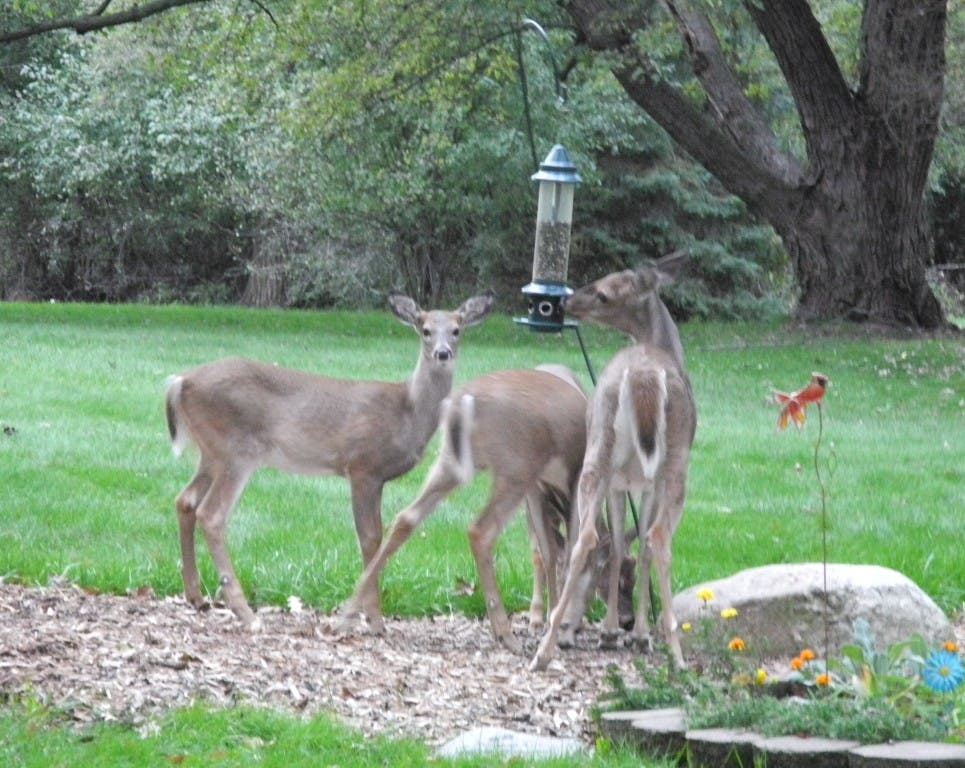
The Lloyd Stage Nature Center, a 100 acre treasure in Troy donated by a doctor many years ago, has had wire mesh over ground vegetation to show people what the plants look like for over 20 years. With no natural predators and no hunting, the dear deer love to eat everything on the forest floor. Now they are feasting in people’s gardens, running across local roads like Adams Road and M-59 and wreaking havoc in more than just the forested areas.
I support wildlife conservation and love to see deer, too (in their natural habitat, not in my back yard eating our vegetables or flowers or emptying the bird feeders), but I don’t like to see them malnourished, and I sure don’t want to have a person I love be injured or killed in a car-deer crash.
How about it, Troy and other Southeast Michigan communities? What will it take before you take action to reduce the local suburban deer herd? A fatal accident involving someone you love?
Southfield is warning its residents to watch out for deer on the roads this spring. Police there reported a doubling of deer-related incidents to 30 from January to mid-April 2016 from 15 last year.
How about allocating some money to combat the problem this year? Plenty is being spent in Troy to upgrade other services that will help people – maybe part of the $800,000 capital expense for the renovation of the city hall entrance could be delayed. Most of this expense will go towards building improvements for the welcome center, which will hire only one person to direct people.
Let’s thin the deer herd this summer before the peak DVC months of October & November.
Further reading:
This article from Cornell University about car-deer crashes was written in 2005.
Here's an article from IIHS, written in 2003.
Deer history in Pennsylvania: Deer Wars book by Bob Frye, subtitled “Science, Tradition and the Battle over managing Whitetails in Pennsylvania”
Nature Wars, 2012, Jim Sherba, a book:
flyer:
For four hundred years, explorers, traders, and settlers plundered North American wildlife in an escalating rampage, but in the twentieth century an incredible turnaround took place. Conservationists created wildlife sanctuaries, restored habitats, and imposed regulations on hunters and trappers. Over decades, they nursed many wild populations back to health.
Then, after World War II, something happened that conservationists hadn’t foreseen: sprawl. People moved into suburbs, and then kept moving outward. All the while, well-meaning efforts to protect animals allowed wild populations to burgeon out of control, causing damage costing billions, degrading ecosystems, and touching off disputes that polarized communities. The result is a mix of people and wildlife that should be an animal-lover’s dream, but often turns into a sprawl-dweller’s nightmare.
Deeply researched, eloquently written, and perceptively humorous, Nature Wars expresses the need for organic reconnection with our natural ecosystem by offering a provocative look at how Americans created an inadvertent mess.
Reviews
"In this book, Jim Sterba has given us a fascinating, powerful, and important lesson in why we should be careful when we mess with Mother Nature.” – Winston Groom, author of Forrest Gump
“In this elegant and compelling tour of America’s mutating connections with its land and wildlife, Jim Sterba uses wit and insight to reveal new and unintended consequences of human sprawl and the ways in which they have shaped today’s relationships with Nature.” -John H Adams , Founding Director , Natural Resources Defense Council
"The facts about wildlife resurgence that Sterba present in his mind-bending dispatch from the new world of "people-wildlife conflicts" are startling and staggering." - Chicago Tribune
"Smart and provocative...Nature Wars is a counterintuitive take on a social problem, and the tone is knowing and smart, not sarcastic or snide." - Chicago Tribune
“It's a jungle out there - and we're living in it. Jim Sterba's Nature Wars is a smart, stylish and altogether provocative account of how we are confounded by that which we claim to hold so dear - Mother Nature and all her creatures moving in right next door.” --Tom Brokaw
“Quite unintentionally and with little awareness by its inhabitants, over the past century the Eastern United States has become one of the most heavily forested and densely populated regions in world history. Nature Wars explores this marvelous story of environmental recovery and the opportunities and challenges that it brings to its residents and the entire globe in fascinating detail and with great insight by Jim Sterba. This is a great book and a story with lessons for us all.” – David Foster, Ecologist and Director of the Harvard Forest, Harvard University
Top Critical Review on Amazon, with perhaps a balanced view:
Interesting information, but limited., February 22, 2013
By Bill C
This review is from: Nature Wars: The Incredible Story of How Wildlife Comebacks Turned Backyards into Battlegrounds (Kindle Edition)
I found the information interesting. He concentrated on trees, deer, turkeys, Canada geese, and the like, all in the eastern United States. It would have been nice to see more species discussed (perhaps in not as much detail), like squirrels, chipmunks, raccoons, o'possums, and others. Also, only a limited discussion of the mid-West, plains, or Rockies, and essentially nothing about the Pacific coast or Alaska and Hawaii. I am sure that the author annoyed both the animal rights groups and the animal control groups, with perhaps more annoyance to the former. It would be interesting to read a brief rebuttal from each group to see where they think he misrepresented.