Community Corner
Endangered Turtle Destined for Dinner Table 'SAFE' at Detroit Zoo
The western pond turtle is one of 10 species targeted in new Saving Animals From Extinction international conservation effort.


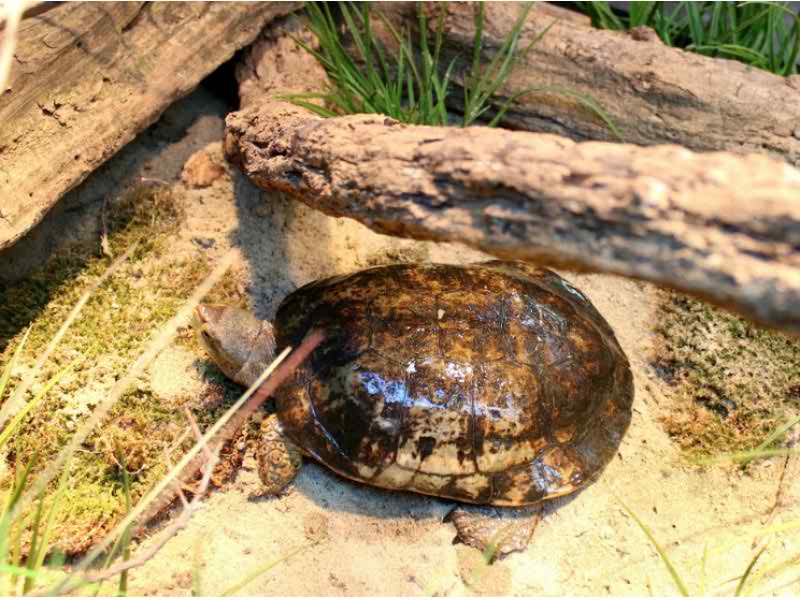
Water pollution, over-collection and disease make the Pacific pond turtle — also known as the Western pond turtle — vulnerable to extinction. (Detroit Zoo photo by Jennie Miller)
A critically endangered turtle confiscated from a California resident in May is being sheltered at the Detroit Zoo under a major international conservation effort announced earlier this year by the Association of Zoos and Aquariums.
Find out what's happening in White Lake-Highlandfor free with the latest updates from Patch.
The Pacific pond turtle, which is also known as a western pond turtle, was rescued after authorities received a tip about a social media post by the person who reportedly had illegally obtained the turtle and claimed he was going to cook and eat it, the zoo said.
Knowing the species was endangered, the woman offered to purchase the turtle from the individual and contacted authorities. The animal was seized and taken in by the San Francisco Zoo and Gardens for several days before being moved to the Detroit Zoo in mid-June, zoo officials said.
Find out what's happening in White Lake-Highlandfor free with the latest updates from Patch.
Also on Patch:
- Endangered Chimp Dies Suddenly at Detroit Zoo
- Wanda - Former Detroit Zoo Elephant Who Changed Ethics – Dies
- Detroit Zoo Conservationist Working to Stop Snow Leopard Slaughter
- Detroit Zoo-Bred Siamese Crocodiles to be Released in Cambodia
The turtle was in poor condition and appeared to have been confined in the man’s home for a while. It was recently released from quarantine at the Detroit Zoo and can now be seen in its new habitat at the Holden Reptile Conservation Center.
“We are happy to be able to provide a great home and permanent sanctuary for this turtle,” Scott Carter, DZS chief life sciences officer, said in a statement. “Because this species is critically endangered, this is also an opportunity for us to help save the species and to educate our visitors on the importance of conservation and the efforts we are making to save wildlife and wild places all over the world.”
The AZA launched its Saving Animals From Extinction (SAFE) initiative in May 2015, with early efforts focusing on 10 species and a goal of more than 100 species going forward.
“Through collaborative programs like SAFE, zoos can have an even greater impact saving animals in nature,” Carter said.
The Pacific pond turtle (Actinemys marmorata) inhabits different types of wetland habitats including rivers, streams, lakes and ponds, as well as reservoirs in California, northwestern Nevada, Oregon, Washington and the southwest corner of British Columbia. It is the only native freshwater turtle on the west coast.
The population of western pond turtles in Washington was once near extinction, with approximately 150 animals remaining. However, concerted head-starting and reintroduction efforts have helped this population grow to 1,200-1,500 individuals.
The species on the SAFE list are:
- African penguin: There were once more than 1 million breeding pairs of this warm-water penguin; now only 18,000 pairs live in the wild.
- Asian elephant: Smaller than their African cousin, these elephants have smaller rounder ears. Because they live in dense forest over difficult terrain, only crude population estimates — between 41,000 and 52,000 individuals — exist.
- Black rhino: Less than 5,000 black rhinos remain, primarily because of European hunters.
- Cheetah: Only 7,500 cheetahs remain, roughly half of the 15,000 estimated in 1975.
- Gorilla: All four subspecies of gorilla are endangered or critically endangered because of hunting, habitat loss, wildlife trade and infectious diseases, such as Ebola.
- Sea turtle: All five sea turtle species whose ranges include the North American coast are in decline..
- Vaquita: The vaquita is one of the most critically endangered cetaceans in the world and has the most limited range of any marine cetacean. Located only in the northwestern corner of the Gulf of California, Mexico, there may be as few as 200 individuals remaining.
- Sharks and rays: Sharks play a vital role in balancing the ecosystems in the world’s oceans, yet they are threatened because of unsustainable fishing practices.
- Western pond turtle: The Center for Biological Diversity has determined this turtle is actually at least two species, meaning each is more endangered than previously thought because of water pollution, disease and overcollection. They are found in the lowlands of Puget Sound in Washington State, southward through Western Oregon and California into the northwestern Baja California peninsula.
- Whooping crane: These birds were nearly extinct in the 1940s, when just 15 birds remained. Through conservation efforts, the population has increased to about 600 individuals in both wild and captive populations, but the whooping crane remains endangered.
Get more local news delivered straight to your inbox. Sign up for free Patch newsletters and alerts.