Politics & Government
Labor Memorializes 92nd Anniversary Of ‘Bloody Friday,' As History Rhymes
This year's event has special meaning, given labor's role in resisting Operation Metro Surge.

July 20, 2026
When Minneapolis police sprayed bullets into a crowd of hundreds of strikers in 1934, John Hanson’s father plugged wounds to stop blood from seeping into the cobblestone.
Find out what's happening in Across Minnesotafor free with the latest updates from Patch.
“My father approached the closest fallen man, who was moaning, screaming and bleeding into the pavement,” he said. “Can you imagine what those cracks we’re looking like?”
Standing 92 years later on the same ground, Hanson the younger lamented the deaths of Henry Ness and John Belor — the two union members police killed after shooting nearly 70.
Find out what's happening in Across Minnesotafor free with the latest updates from Patch.
“In the end, victory took mutual aid, caring for one another, coalition building, trust, solidarity and resilience,” he said.
Hanson’s father, also named John Hanson, was a coal truck driver and member of the Committee of 100, a group of union leaders elected to manage the 1934 strikes and union activity beyond.
His recollection was among the stories striker descendants shared with the nearly 100 people who gathered Sunday for an annual event remembering tribulations surrounding what’s known as Bloody Friday.
The 1934 shooting was a crescendo of a months-long battle between the truckers and warehouse workers of Teamsters Local 574, and the “Citizens Alliance,” who were the corporate owners trying to suppress workers’ pursuit of fair wages and working conditions.
President Franklin Roosevelt eventually intervened to hand the workers a victory. The companies succumbed to worker demands, and union participation exploded in Minnesota and across the country. Teamsters 574’s membership alone grew from 175 to more than 5,000 workers.

Marchers memorialized Henry Ness and John Belor on Sunday in Minneapolis. Police killed the two men after shooting nearly 70 during Bloody Friday in July 1934. (Photo by Peyton Haug/Minnesota Reformer)
History rhymes
The solidarity theme remained center stage, but this year’s memorial was different.
On the sweltering, smoky Sunday afternoon, history’s rhymes sang loudly through the city as crowds paused for a bit longer to remember the slain Renee Good and Alex Pretti — the two Minneapolitans shot and killed by immigration agents during Operation Metro Surge.
They also memorialized Victor Manuel Díaz, a Nicaraguan man who died in ICE custody.
“The organizing of rapid response, mutual aid and the many ways people came out to defend their neighbors during Operation Metro Surge, it was like the way the community was responding to the Teamsters strike in 1934,” said event organizer Peter Rachleff.
He taught and studied American history for decades at Macalester College, focusing largely on immigration and labor.
Rachleff said there are echoes this winter of labor battles past: “It’s this idea that word would get out about a point of conflict, and a whole bunch of people would show up.”
Among the parallels to “Bloody Friday”: The two civilian deaths; frequent tear gas deployment during street battles; creative civil disobedience tactics; and hundreds of thousands of people flooding the streets — for Ness’ funeral and the 2026 general strike.
‘Why work if you can’t make enough to live anyway?’
Between growing up listening to his father's stories and watching the Minneapolis labor movement evolve, Hanson said he has noticed a Great Depression-era mindset resurfacing: “Why work if you can’t make enough to live anyway?’”
“A lot of people, younger people, are coming into these industries, seeing the unfairness and wanting to do something about it,” he said, citing union drives spanning across sectors, from health care and higher education to the service industry.
Hanson said his father would be pleased to see how labor and allied groups coalesced during Operation Metro Surge.
The temporary political victory during Operation Metro Surge comes at a difficult time for labor unions, however: President Donald Trump ended collective bargaining for more than 1 million federal workers, and the Bureau of Labor Statistics reported this year that the number of wage and salary workers belonging to unions was 14.7 million in 2025, or 10%, which was down from 17.7 million and 20% in 1983, the first year for which comparable data are available.
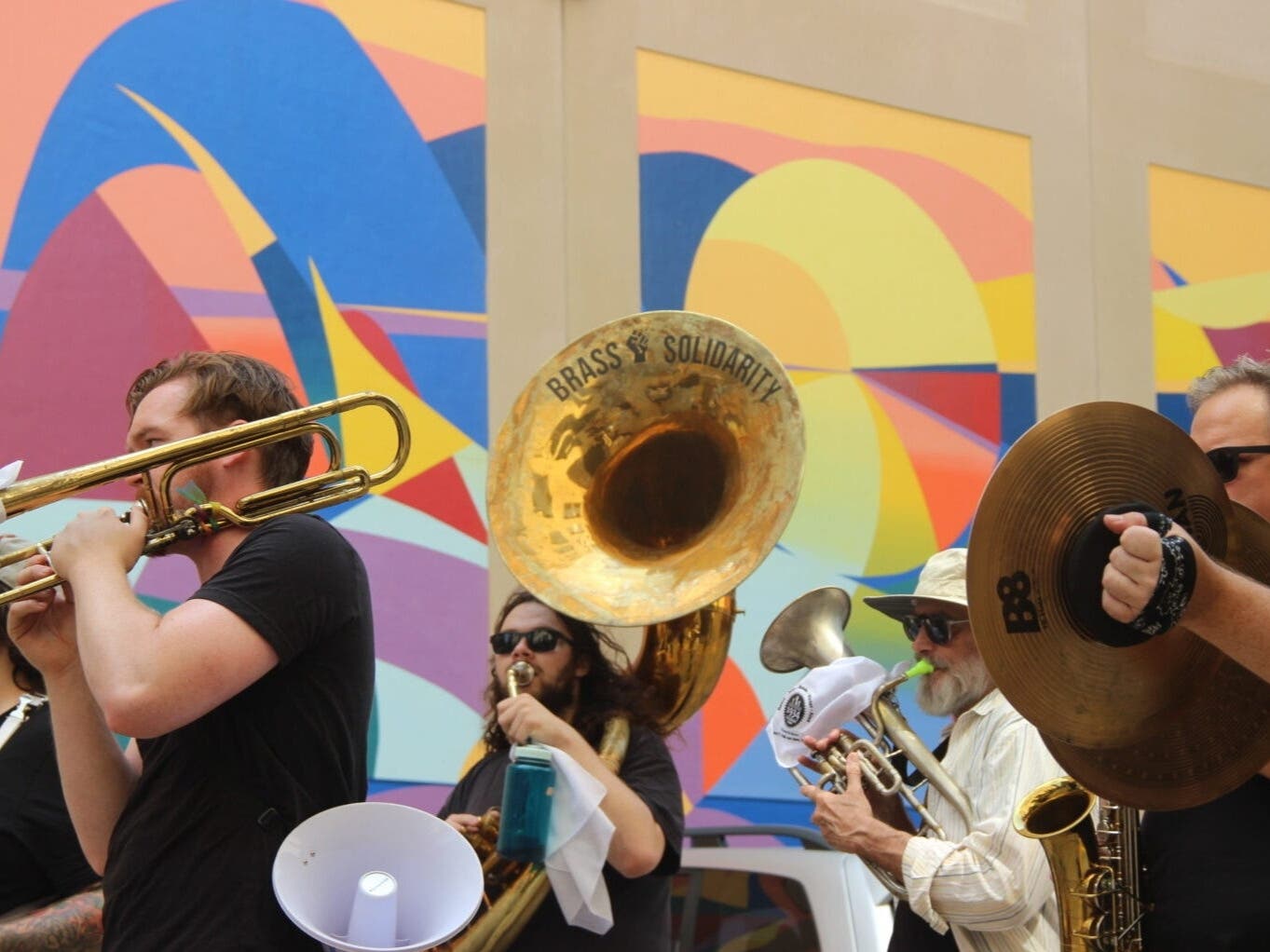
Sunday’s remembrance closed off with music from Brass Solidarity. The activist brass band marched the streets in a fashion reminiscent of the New Orleans second-line celebrations known for honoring the dead.
Carpenter and musician Emmett Doyle also performed an original song called “the 1934 Strike Song.”
He is among the Minnesota 15 who were indicted in May and are being accused of impeding the feds during their immigration operations.
“The (Trump) administration is terrified of the power of the general strike and the power of mass resistance. They think that by targeting a small number of radicals, they can cleanse the city of a tint of leftism,” Doyle said.
For now, local unions are focusing on the Faster Labor Contracts Act, according to Paul Slattery of Teamsters Local 120. The bipartisan bill would fast-track collective bargaining agreements between employers and newly formed unions — a common management tactic is to delay contract negotiations, hoping the new union will die on the vine.
“Whether it’s ICE, whether it’s more labor organizing, the fight continues for workers' rights, and people’s rights,” he said.
The Minnesota Reformer is an independent, nonprofit news organization dedicated to keeping Minnesotans informed and unearthing stories other outlets can’t or won’t tell.