Arts & Entertainment
Local Author Talks Racism, Baseball At Apple Valley Book Signing
Local author Tom Swift talked about his book, "Chief Bender's Burden," during a book signing in Apple Valley on Saturday.
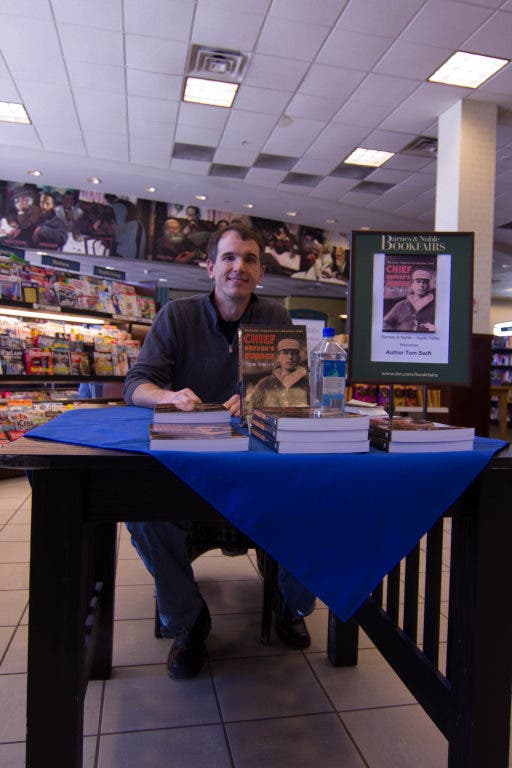


A local author took the chance to talk about his book and meet some fans in Apple Valley on Saturday.
Northfield-based author Tom Swift signed books at Apple Valley’s Barnes and Noble and spoke to readers about the compelling story of Charles “Chief” Bender. The book, "Chief Bender’s Burden: The Silent Struggle of a Baseball Star," earned Swift the 2009 Seymour Medal for outstanding baseball research. He also was a finalist for the 2009 Larry Ritter Award.
In the book, Swift explores a little-known figure from Major League Baseball.
Find out what's happening in Apple Valley-Rosemountfor free with the latest updates from Patch.
Charles Albert Bender wasn’t the Jackie Robinson of American Indians, and he wasn’t the greatest pitcher of all time. But his story still helped change people’s minds and his skill on the mound got him a place in the National Baseball Hall of Fame in Cooperstown.
The story of Charles Albert Bender isn’t well known outside of baseball history, Swift said.
Find out what's happening in Apple Valley-Rosemountfor free with the latest updates from Patch.
“I wouldn't have known about Bender if I wasn’t a baseball fan, but I can’t say I would have written the book if he had been just a baseball player,” Swift said about his book. “His human story is really what kept me going, kept me wanting to tell his story.”
The desire was there, but writing a book about a captivating but little-known, turn of the century baseball player was a difficult task for a number of reasons.
“First of all, I had to learn what research was about,” Swift said. He said he built upon his longtime journalism skills, but had never worked on something of such scope. “Quite frankly, I didn’t know what I was getting myself into when I started.”
One hurdle was a serious lack of living sources.
“The number of people who remember being in the same room with Bender might fill a telephone booth,” Swift said. And of those, most knew Bender long after his baseball days. “There wasn’t a lot of information from them that went into the book.”
So, with few people around to tell the hall of fame player’s story, Swift looked to the newspapers of the time; which provided a wealth of historical knowledge.
“A major city would have anywhere from six to 10 newspapers who would have a writer that would cover a major league team,” said Swift. His research quickly became a baseball historian’s dream job.
“I had to read sports sections day after day," he said.
He said reading numerous papers on microfilm and in archives gave him the window on Bender’s experience he was searching for.
He said his research prompted many surprises about the bigotry that Bender and other American Indians dealt with.
“The level of racism and the prejudice was quite staggering,” said Swift. He said Bender never really escaped that racism.
“There was seldom a time when Bender’s race was not part of the story—even after some of his greatest performances, lead paragraphs mentioned that he was ‘the child of the forest,’ ” Swift said. “It was eye-opening to me to see what he had to go through just to play baseball.”
He said unlike Jackie Robinson, who struggled publicly to break the racial barrier, Bender’s struggles were not well known because he was allowed to play from day one.
“In Bender’s case, we didn’t have any of that understanding. It wasn’t common knowledge that he had to withstand what he did. So that was a big surprise,” said Swift.
But through all his trials, Bender never seemed to want to be a part of a sea change.
“I don’t think he was leading an ‘ism,’ if you will," Swift said. "He wasn’t trying to be leader of a cause. I think he changed things for the better for people just by the things that he did and conducting himself like he did.”
Off the diamond, Bender was known as an intelligent person and renaissance man. He read books, spoke well and even had a side career as a nationally renown trap shooter. His greatest lessons, Swift said, were taught by example.
“I think over time, you couldn't see this guy who conducted himself professionally and pitched at such a high level and not think a little differently,” said Swift.
After writing the book, Swift said his interest in the game of baseball has waned some. But he still thinks the Twins stadium is astounding.
“It’s amazing; it’s hard to imagine a bigger change from what we had to what we now have,” said Swift. “It’s a great way to spend an evening.”
As for the author’s next project, he is taking a bit of a break from the research-heavy endeavors.
“I’m working on what I think will be something of a memoir,” said Swift. “That’s what I’m trying to do.”
And despite his quick rise to becoming an accomplished author, he has no plans to leave the Northfield home he shares with his wife. He said work brought him there, and the community kept him around.
“Years ago, I was the editor of the paper here," he said. "I just really love living here. I think the only thing I don’t like about living here is that every year the winters seem to get a little worse.”
"Chief Bender’s Burden," is available in hardcover and paperback.