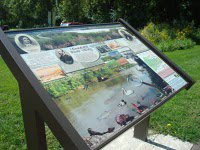
Ellet’s and Thoreau’s Trip
Minnesota Historical Timeline
1. Why did Ellet and Thoreau visit Minnesota?
Find out what's happening in Eden Prairiefor free with the latest updates from Patch.
Ellet’s trip in 1852 was arranged by a local New York newspaper whose interest was in a series of articles with a sensationalist telling of the expansion of the Western Territories, including habitat, Indians, settlers and the journey getting there and back. Her trip was described as Fashionable Tourism, an exploration of the western expansion. The result was a book, “Summer Rambles in the West.”
Thoreau came in 1861 with his friend Horace Mann Jr., the son of the well-known educator, (This was recently cross referenced and corrected. Thoreau did not travel with Horace Mann Senior.) Thoreau came westward with the goal of regaining his health and continuing his exploration of natural history, writing about place and botany. It was the farthest away he had ever been from Concord. The trip was dubbed the Grand Excursion. The draw was recovery from ill health and his obsession with primeval forests and Indians. Thoreau was an amateur botanist and scrawled notes in pen about the flora and fauna he saw from the deck of the Franklin Steele as it churned up the Minnesota River.
Find out what's happening in Eden Prairiefor free with the latest updates from Patch.
2. What did they write during their stay in Minnesota?
Thoreau was a writer of place. On his trip to Minnesota he wrote about the flora and fauna he observed. It was intended as a recuperative journey, but Thoreau tired of all the traveling and returned home sooner than he had planned. He died a year later in 1862.
Ellet wrote about everything she saw, detailed and often opinionated, in what might be considered a commercial travelogue of a place.
3. What kinds of things did they see and mention in recounting their trip to Minnesota?
Interestingly, Ellet received more press from the Minnesota papers than Thoreau.
Thoreau marveled at the five drug stores in Minneapolis and commented on how much he did not like St Paul. Ellet described her travels in beautiful pros, named some of the Lake Minnetonka inlets and anecdotally referred to the area north of the Minnesota River across from Shakopee as the ”..garden spot of the territory..”
4. What was happening in Minnesota during the time of Ellet’s visit in 1852 and Thoreau’s in 1861?
Ellet’s Trip 1852-
1849 - Minnesota Territory formed with present day eastern and southern boundaries set. The population amounts to less than 4000 people, not including persons of pure Native-American heritage. Law provides for free public schools to be open to all people between four and twenty-one years of age. Minnesota Historical Society formed to collect, publish, and educate people about Minnesota history. James Madison Goodhue begins publishing Minnesota's first newspaper, the Minnesota Pioneer.
1850- Treaties concluded at Traverse des Sioux and Mendota with the Dakota Indians whereby the Dakota ceded their lands east of the Red River, Lake Traverse, and the Big Dakota River and south of a boundary line between the Dakota and Chippewa. In return the Dakota received $1,665,000 US, $1,360,000 of which was set into a trust fund, of which the interest would be distributed to chiefs partly in cash, partly in supplies, and partly in education and civilization funds. The vast majority ended up being used to pay off Indian debts to white traders. Wheat becomes a major crop in Minnesota.
1851 - Charter granted to the University of Minnesota, the first collegiate institution in the territory.
1853-1857- Population explosion occurs in Minnesota from 40,000 people in 1853 to approximately 150,000 people in 1857.
Trip 1861-
1859 - First Minnesota State Fair held.
1861 - Civil War of the United States begins. Minnesota volunteers one thousand men for service in the Union Army. Minnesota eventually provides 24,000 men for service in the Union Army for fighting in the Civil War or the Indian Outbreak.
1862 - The Dakota Conflict sweeps across Minnesota with a series of attacks motivated by hungry Dakota enraged by the failure of land treaties and unfair fiscal practices of local traders. By the end of the conflict 486 white settlers would be dead. On December 26 thirty-eight Indians were hung at Mankato. Minnesota's first railroad is completed, connecting Minneapolis and Saint Paul.